Dataview
LIST
FROM #Collection
WHERE file.name = this.Entry-For
📗 -> Chapter 6: Perception and Attention
🎤 Vocab
❗ Information
Small summary
✒️ -> Scratch Notes
Computational Model of V1
Primary Visual Cortex (V1)
- Self-organizing learning explains the origin of oriented edge detectors
- Also shows how excitatory lateral connections can result in topographical map
- Neighboring neurons tend to encode similar features
Visual Pathways
What/Where -> Ventral Dorsal
Ventral What
Learns to recognize objects of considerable variability
Go in a ventral direction, recognize the identity of object:
- V1 -> V4 -> Areas of inferotemporal cortex (IT) (TE, TEO, labeled as PIT for posterior IT in the previous figure)
Dorsal Where
Spatial attention, helps when multiple objects in view
- Damage to this pathway can cause hemispatial neglect when one side damaged, and Balint’s syndrome if both damaged
Go up through parietal cortex - Extract spatial information, including motion signals in areas:
- MT and MST
Through the retina -> lateral geniculate nucleus of the thalamus (LGN) ->primary visual cortex (V1)
Areas of Visual Cortex
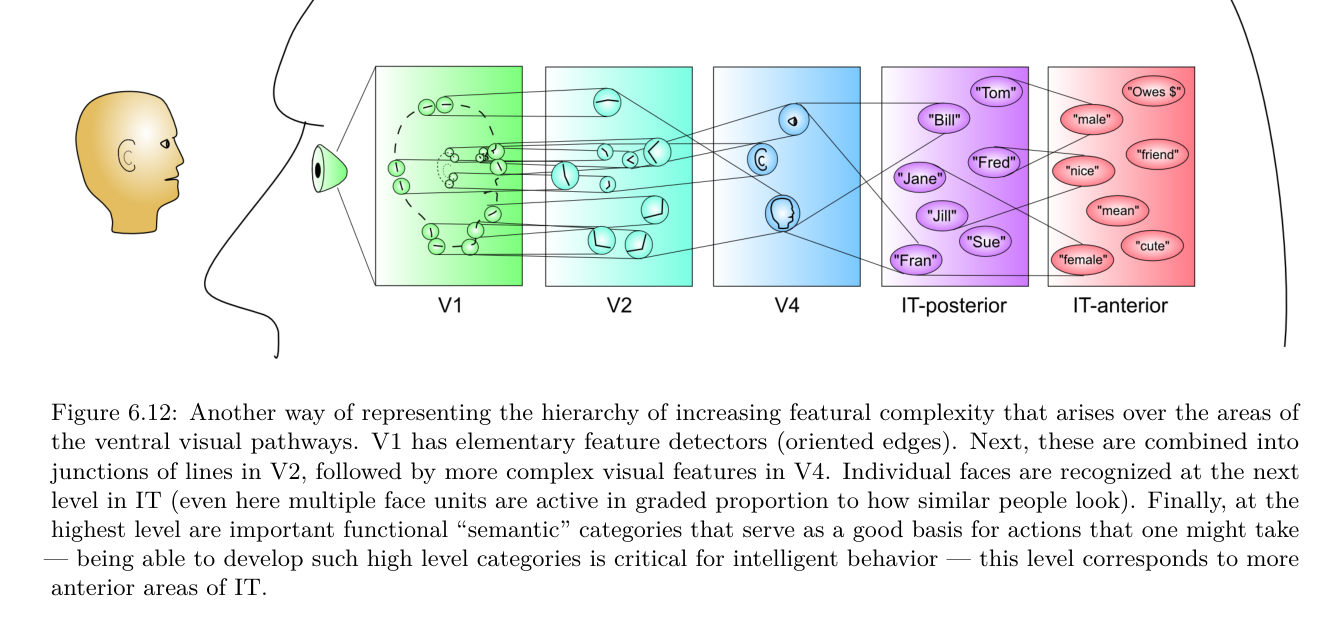
V1 - Primary visual cortex, encodes the image in terms of oriented edge detectors
V2 - Secondary visual cortex, encodes combinations of edge detectors, encodes intersections and junctions, and other basic visual features
V4 - Detects more complex shape patterns, over a larger range of locations, sizes, and angles. More robust and complex. Involved in Ventral What
Inferotemporal Cortex (IT)
IT-Posterior (PIT) - “detects entire object shapes, over a wide range of locations, sizes, and angles. For example, there is an area near the fusiform gyrus on the bottom surface of the temporal lobe, called the fusiform face area (FFA), that appears especially responsive to faces.”
IT-Anterior (AIT) - “this is where visual information becomes extremely abstract and semantic in nature — it can encode all manner of important information about different people, places and things.”
🧪-> Example
- Big picture: general reaction
Did you generally find the overall content understandable or compelling or relevant or not, and why, or which aspects of the reading were most novel or challenging for you and which aspects were most familiar or straightforward?)
I've always found the recognition task to be very interesting, as a computer science student trying to come up with an algorithmic solution to it is mind boggling. The difficulty of the problem makes it all the more amazing that the brain can pull it off, and that modern deep learning and computer vision are as good as they are.
- Specifics: specific reaction to one aspect of the reading
Did a specific aspect of the reading raise questions for you or relate to other ideas and findings you’ve encountered, or are there other related issues you wish had been covered?)
I found the visual pathways to be very interesting. One of the things that I find most interesting is the increasing complexity of visual cortex, and learning a concrete example of how things are processed was very interesting to me.

I found the visual pathways to be very interesting. One of the things that I find most fascinating is the increasing complexity of the visual cortex as it provides such an interesting allegory for the hidden layers of a neural network. I like learning more about the components of visual cortex, and the manipulations each layer makes towards the end of recognition.
🔗 -> Links
Resources
- Put useful links here