Cramming before final
Transclude of ECS154A-L23-2025-03-19-21.27.38.excalidraw
Motivation for virtual memory:
- Trying to solve problem of:
- Each process assumes a complete virtual machine
- The OS breaks physical memory into something called frames (page frames)
- Each process will have a page table, which contains a map of virtual page number to physical frame number
- [ Virtual Frame Number | Page Number ] => [ Physical Frame Number | Page Number ]
- VF # will be longer than PF #
- Inside the OS, it keeps track of which page tables and processes:
- Page # -> Process/Owner
For Example
Transclude of ECS154A-L23-2025-03-19-21.38.10.excalidraw
13 bit VA, 1k byte mem, 64 byte pages
[ 7 bits | 6 bits]
- 13 bit VA
How many frames? - 1k / 64 = 16
How wide is each page table entry? - 4
How many entries in the page table? - 2
New Ex
17 bit address, 16k mem, 512 byte pages
VA: [ 8 bits | 9 bits] (out of 17 bit address)
PA: [ 5 bits | 9 bits] (out of 14 bit address (thats log2(16k) mem))
- How many page table entries?
- 2
- How wide is a page table?
- 5
- How many frames?
- 16k / 512 = 2^14 / 2^9 = 2^5 = 32
- How wide?
- 5
New Ex
19 bit VA, 32K mem, 1k page
VA: [ 9 | 10]
PA: [ 5 | 10]
MAPPING FROM VA TO PA KNUCKLEHEAD. THESE ARE EASY
Number of entries in PT?
- 2^9
How wide? - 5
How many frames? - 32 (32k/1k)
- Can use this to get how wide too, SHOULD BE log2(frames)=wide
New
32 bit VA, 1M mem, 2k byte
VA: [ 21 | 11]
PA: [ 9 | 11 ]
^ get by either doing bit assignment, or: 1M/2k = 2^20 / 2^11 = 2
Mapping from 21 bit space to 9 bit space
Number of entries:
- 2^21
Wide? - 9 bits
How big is our page table? 2^21 x 2 bytes = 2^22 bytes
- Our total memory is 2^10, 2^22 MOGS it
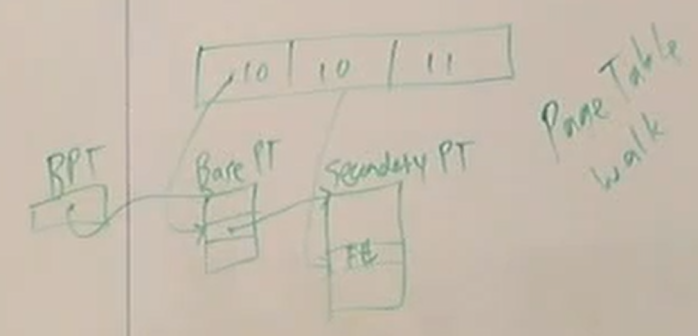
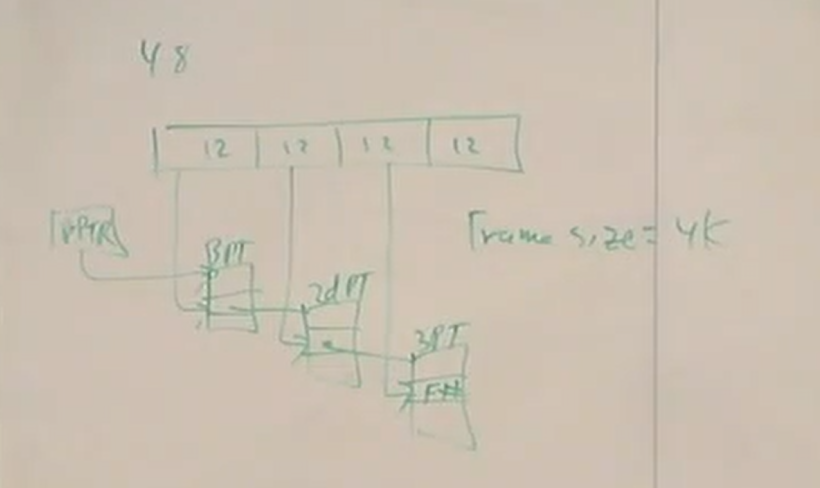
So, we need a base page table, and a secondary page table. - But now, we can
Page table walk
I don’t understand it, but instead of the one page table, you introduce secondary, and event tertiary page table
 |  |
|---|---|
How to implement a cache:
A cache of recent virtual to physical translations
IBM invented this, since they didnt have caches they had lookaside buffers.
They called the translation cache, a TLB or Translation Lookaside Buffer
Two Options:
- Send VA to cache, and on miss have TLB check the translation
- Don’t have to go to memory
- Problem: aliasing, each program has the same VA but not the same PA
- Send
Physically Addressed Cache
CPU <-> TLB <-> Page Table <-> Mem
Virtually Addressed Cache
CPU <-> Page Table <-> TLB <-> Mem