📗 -> 05/29/25: ECS170-D9
🎤 Vocab
❗ Unit and Larger Context
Doing Course Review Part 1
✒️ -> Scratch Notes
Seven Properties of Task Environments
- States observability
- How many agents
- Successor states determinism
- Agent decisions, episodic or sequential
- Environment, static or dynamic
- State of the environment and actions, discrete or continuous
- Environment, known or unknown
Observable
Agents
Deterministic
Episodic
Static
Discrete

Five Agent Programs
Agent Program - maps from percepts to actions
- Simple reflex agent
- Model-based reflex agent
- Goal-based reflex agent
- Utility-based agent
- Learning-based agent
Graph Algorithms
b (branching facts) - max num successor nodes
d (depth) - number actions in optimal solution
m (maximum depth) - maximum actions on any path
BFS
BFS is complete
BFS is optimal ~
- If all actions have the same cost
- Otherwise, its a different problem (road map navigation problem)
Time:
Space:
- Every node until depth has to kept in memory and visited, time = space
Intractable with large state space
Uniform Cost Search (UCS)
Also known as: best first search
Instead of expanding the shallowest node, expand the lowest cost node
Implementation similar to BFS, but with a path cost function f to each step
- Orders frontier by f
- First node on frontier is the one with current lowest path cost
UCS is complete
UCS is optimal
- For ANY cost function, will expand cheapest route first
An upgraded BFS, ordering by cost
Iterative Deepening Search
Problems with DFS:
- Fails in infinite search spaces
- Inefficient if m >> d (m=maximum depth, d=depth of solution)
Idea #1 (Depth Limited Search): Set a limit
- Prevents infinite growth of early paths that do not contain goal node
- Succeeds if
, fails otherwise
Idea #2 (Iterative Deepening Search, or Iterative Deepening DFS)
- Set an initial limit
- At each next depth with not goal, increase
Relaxed Problems and Heuristics
The solution to a relaxed problem is a heuristic for the original problem
Example:
- For the 8-puzzle, we relax the rules so that a tile can move to any adjacent square (including occuped)
- We use the heuristic of total manhattan distance
- Since this is a solution to the relaxed problem, it’s a valid heuristic for the original problem
How to judge if heuristic is good or not?
Criteria for good heuristic functions
Admissibility - An admissible heuristic never overestimates the distance to the goal
Consistency - Consistent if, for each node n and its successor n’, cost function c, action a and goal state G, we have
Roughly, we want the the heuristic to say
It is equal or more expensive to go from n to n’ than the goal directly when factoring in cost
A* Search
Best known form of best-first search
- Avoid expanding expensive paths
- Expand most promising first
Evaluation: - g(n) = cost so far to current node n
- h(n) = heuristic estimate for cost to get to goal from node n
- f(n) = estimated total cost through n to goal
Implementation: Frontier as priority queue by increasing f(n)
h(n) -> Heuristic could be straight line distance
g(n) -> Distance covered to get to node
f(n) -> A* estimation function
A* Seach is:
- Complete IF consistent
- Optimal IF consistent
Consistent -> Complete and Optimal (like BFS)
Minimax Algorithm
One tries to maximize score, the other tries to minimize
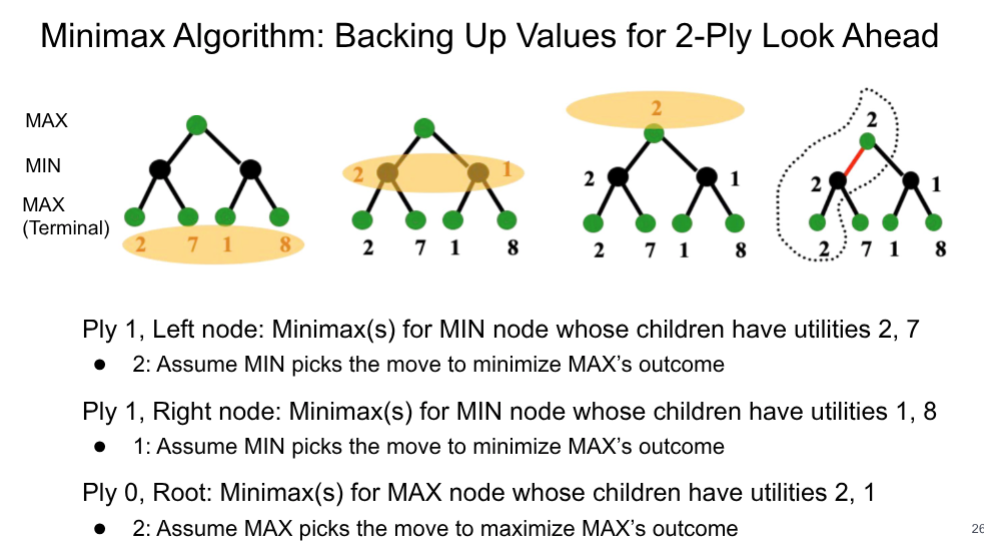
Not very efficient, need to expand a lot of leaf nodes
We introduce:
Alpha Beta Pruning
In MAX node:
- If current child value
then its MIN ancestor above won’t consider this MAX node, so prune - Else update:
In MIN node: - If current child value
then its MIN ancestor above won’t consider this MAX node, so prune - Else update:
Essentially:
In a MIN node: We know that a higher up MAX node won’t consider this MIN node if it has the option to choose a node of value that is less than the highest found so far.
In a MAX node: We know that a higher up MIN node won’t consider this MAX node if it has the option to choose a node that is greater than the smallest value found so far.
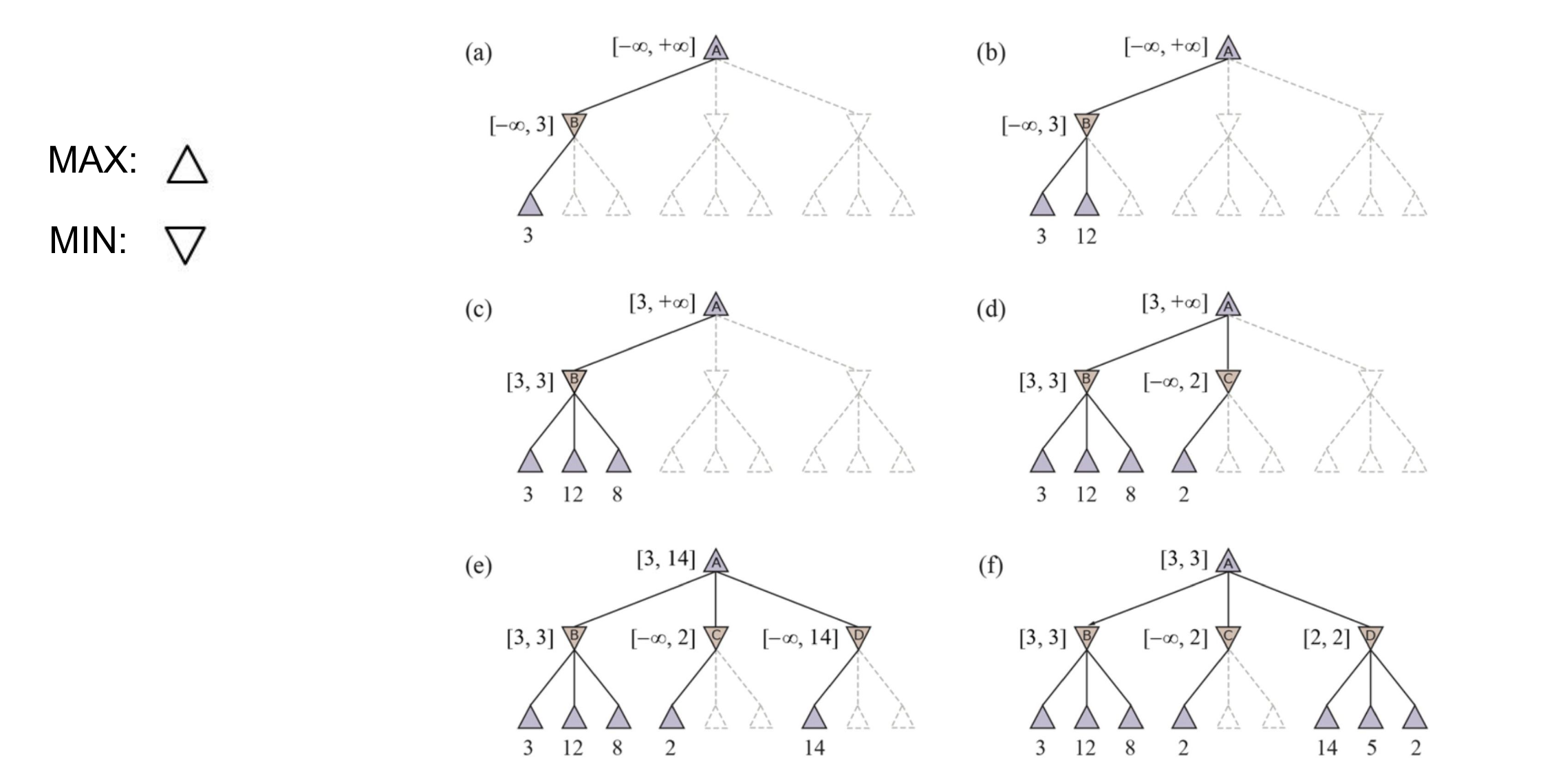
a) We explore our first leaf, and pass 3 as our smallest (best) value so far for our MIN node above, updating beta. (
b - c) We continue exploring leaves, but find that there is not a value less than 3 so
c2) We update the alpha in the MAX node above, as the biggest (best) value it can choose so far is 3
d) We explore leaf nodes, and find 2 in the next MIN node. This means that no matter what, the value of this min node will be less than or equal to 2. Since we know this MIN node won’t be picked
# from above
alpha = 3

# initializing
beta = float('inf')
for leaf in MIN node:
    val = leaf.val
    beta = min(beta, val)
    if beta <= alpha:
        break # we prune
return beta
e-f) We explore leaf nodes in the next MIN node, and find the smallest leaf to be 2. This will not be picked by the root MAX node, which will pick 3.
Four Steps of MCTS (Monte Carlo Tree Search)
Selection: Start from root R and select successive child nodes until a lead node L is reached
Expansion: Unless L ends the game (e.g. win/loss/draw) for either player, create on child node C
Simulation: Complete one random play-out from node C (also called play-out or roll-out). A play-out may be as simple as choosing uniform random moves until the game ends
Backpropagation: Use the result of the play-out to update information in the nodes on the path from C to R
Selection:
- Select a node with the highest upper bound confidence bound of its utility
- Exploitation term - average utility of n - It is high when this node has not tried much times, so it encourages exploration on this node is the total utility of all play-outs through node n is the number of play-outs through node n is the number of roll-outs at the parent node of n is a constant to balance the two terms
Core Idea of MCTS (from Wikipedia)
- Find the most promising moves and expand the search tree.
- Based on each selected path, play out the game to the very end by selecting moves at random.
- The final game result of each playout is then used to weight the nodes in the game tree so that better nodes are more likely to be chosen in future playouts.
Hill Climbing
Blindly tries to maximize an evaluation function f(n), going up the function maximization hill one successor at a time
Given: current state
- If
, move to - Else, halt at n
Chooses a random best successor if multiple
Terminates when a peak is reached
Has no look-ahead, and cannot backtrack
Simulated Annealing
Combine hill climbing with a random walk in a way that yields both efficiency and completeness
- incorporate a random walk into hill climbing. Allow some ‘exploration’
- “Allows to pick an action that results in a worse state, but gradually diminishes this probability”
Control parameter T, temperature
- “Allows to pick an action that results in a worse state, but gradually diminishes this probability”
- T controls probability of picking a worse successor
- Start out high to promote escape from local maxima, then gradually decreases to zero
Beam Search
Hill climbing only keeps track of one best state
Beam search keeps track of k best states in memory
- starts with k randomly selected initial states
- Find successors of all k states
- Take top k successors across all successors and put them in memory
Beam Search for Language Generation
Generate a sentence, and track the most promising completions over time
🧪 -> Refresh the Info
Did you generally find the overall content understandable or compelling or relevant or not, and why, or which aspects of the reading were most novel or challenging for you and which aspects were most familiar or straightforward?)
Did a specific aspect of the reading raise questions for you or relate to other ideas and findings you’ve encountered, or are there other related issues you wish had been covered?)
🔗 -> Links
Resources
- Put useful links here
Connections
- Link all related words