📗 -> 04/30/25: ECS170-L14
🎤 Vocab
❗ Unit and Larger Context
Small summary
✒️ -> Scratch Notes
Propositional Logic: a simple logic language used to describe a world, using sentences that follow a particular syntax
- Sentence - A expression assessable for Truth Value
- Atomic Sentence - True | False | P | Q | R | …
- Complex Sentence - A combination of sentences bound together with logic operators
“There is no pit in (1,1)” :
Knowledge Base: a set of sentences (declarations) in a formal language, e.g., propositional logic
- Used to create deductions
- we know that there is not pit
- we know that the square is breezy if and only if there is a pit in a neighboring square
- …
Model: a truth assignment function that maps each propositional symbol to either True or False
- A sentence could be true or false in a model, depending on the truth assignments. It can be true in some models, true in all models, or false in all models
- A model is a model of the KB if it satisfies every sentence in the KB, or all the sentences in the KB are true
Both Logic and Natural Language aim to express information
Logical Formalism - A language to express truth-conditional meaning
- More rigorous than natural language
- Can characterize reasoning (inference) of various forms
Pros of Propositional Logic (PL)
In contrast to DB languages or programming languages
- PL is declarative rather than procedural
- PL has sufficient expressive power to deal with partial information, using disjunction and negation
- PL is compositional, can compose complex statements from their sentences and operators
Cons of PL
- Meaning is context-independent
- Cannot capture context dependent information, like natural languages “look”
- Limitations on the expressivity, can only state specific truths, not generic ones
- Specific truth: B1,1 is a pit
- Generic truth: Squares adjacent to pits are breezy
with that context, we move onto…
First Order Logic (FOL)
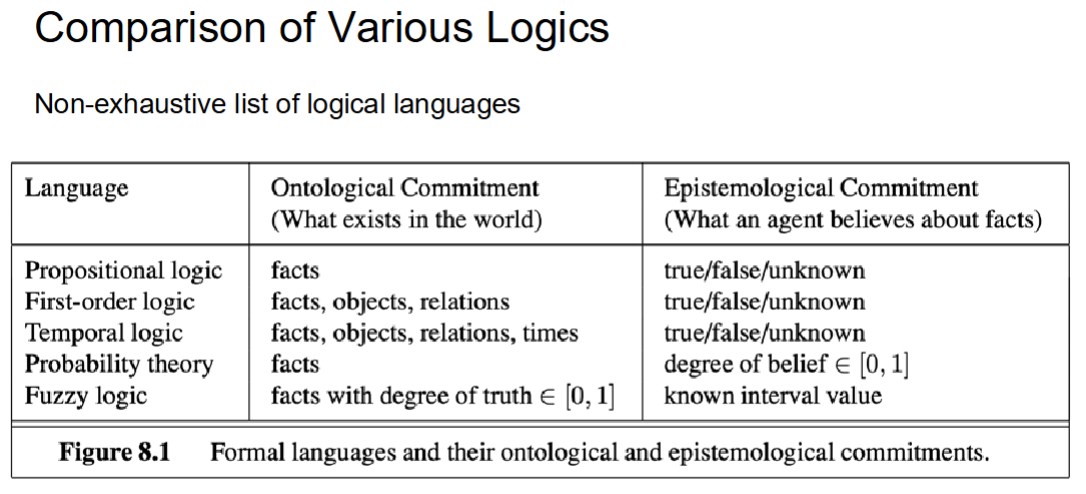
Propositional Logic (PL) assumes the world contains
- Atomic terms for statements
- Operators to combine with atomic statements
First-order logic (FOL) assumes the world contains - Objects - people, houses, numbers, …
- Relations - red, round, prime, …
- Functions - father of, best friend, …
- Quantification - all wumpuses smell bad; some squares are breezy
- Statements - about objects, relations, functions, and their quantification
There is higher order logic: Second-order logic also quantifies over relations
FOL and Natural Language (NL)
FOL expressivity is closer than PL to NL
FOL statements are context independent and unambiguous, while NL is still context dependent and ambiguous
FOL symbols
- Constants - John, 2, …
- Variables - x, y, a, b…
- Logical operators from PL
- Predicates - True, False, Person, give, more than, …
- Person(John)
- KingOf(John, a)
- Functions - Sqrt, LeftLegOf
- Quantifier -
- Equality -
Quantifiers
Be careful with translating NL into FOL using quantifiers
For All:
Everyone in ECS170 is smart:
- Good -
- BAD -
- This means everyone is in ECS170 and everyone is smart
Exists
Someone in ECS170 is smart:
- Good -
- BAD -
- This could be true vacuously, even if x is not in ECS170
Equality
- Father(John) = Henry, says that the object referred to by Father(John) and the object referred to by Henry are the same
FOL Syntax in Backus Naur Form
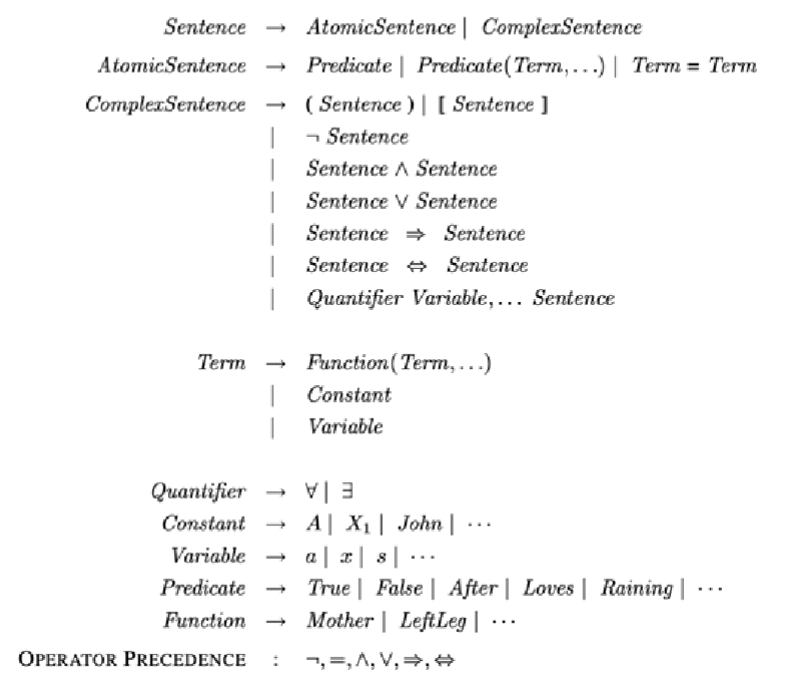
Models in FOL
Models in FOL consist of:
- A set of object
- Their relations
- An interpretation that mas
- Constant symbols -> objects
- Predicate symbols -> relations
- Function symbols -> functional relations
🧪 -> Refresh the Info
Did you generally find the overall content understandable or compelling or relevant or not, and why, or which aspects of the reading were most novel or challenging for you and which aspects were most familiar or straightforward?)
Did a specific aspect of the reading raise questions for you or relate to other ideas and findings you’ve encountered, or are there other related issues you wish had been covered?)
🔗 -> Links
Resources
- Put useful links here
Connections
- Link all related words