📗 -> 05/28/25: ECS170-L25
HMM Extended
Machine Learning Slides
🎤 Vocab
❗ Unit and Larger Context
- What’s Machine Learning
- Types of Machine Learning
- I.I.D Assumption and Generalization
- The Fundamental Tradeoff between Bias and Variance
- Bias and Variance
- Overfitting and Underfitting
- Regularization
- Hyperparameters, Three-fold split, Cross-Validation
- Example of Polynomial Regression
✒️ -> Scratch Notes
Laaate
HMM Extended
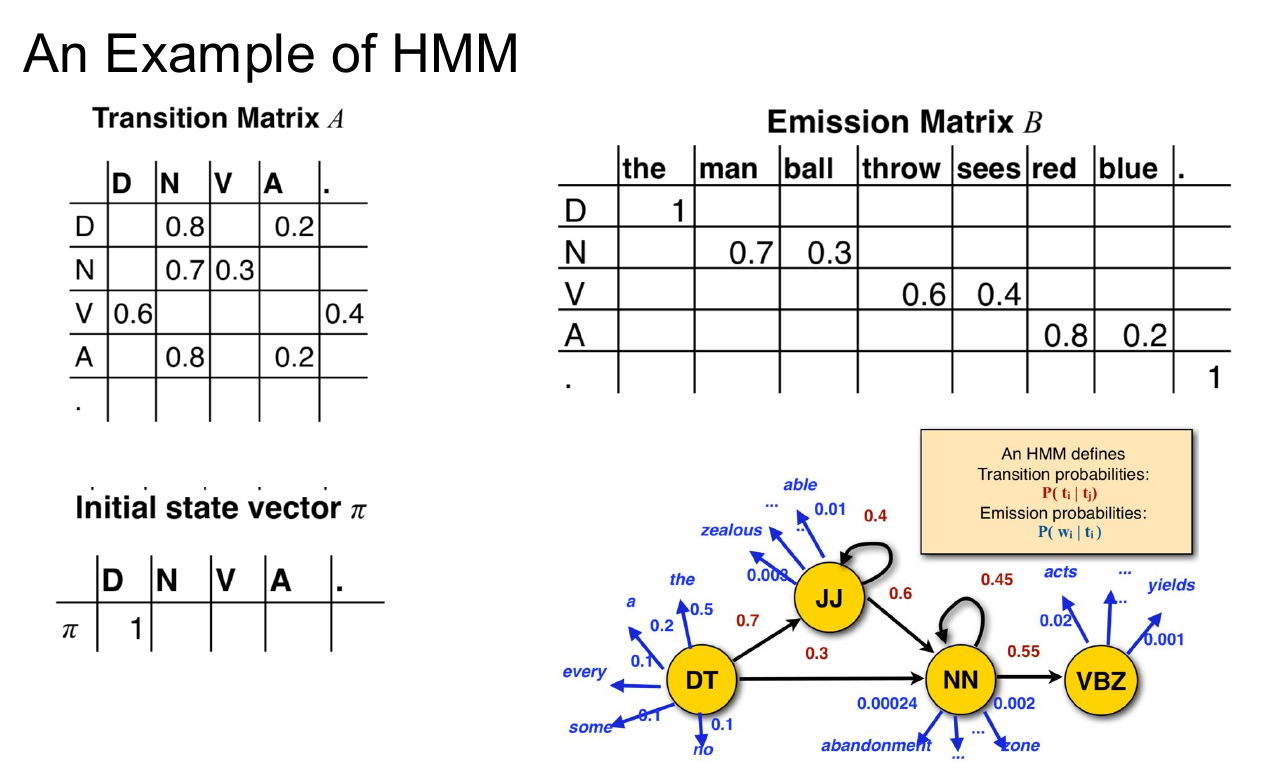
HMM for POS Tagging
Requirements:
- A set of states (POS tags)
- Observations - Observation is a word from an output vocabulary V
- An NxN state transition probability matrix
is the probability of moving from to
- Emission probability - an NxM matrix
is the probability of emitting word in state
- an initial state probability distribution
the probability of being in state at the first timestamp
Building an HMM Tagger
Need to train the model:
- Supervised - A corpus labeled with POS tags
- Estimate the parameters based on the MLE
- Unsupervised - Have a corpus, but its raw text without tags. Helps to have a dict of which POS tags each word can have
- Forward-backward algorithm
Viterbi Decoding
Find the most likely sequence of tags for the given sequence of words
- A decoding problem
Use Viterbi decoding
Evaluation:
Solves problem, evaluation metric already exist
Machine Learning
Traditional Computer Science
Given a well defined description of a problem to map a given input to its corresponding output
- Input output relations are well-defined
- E.g. sorting, shortest path, spanning trees, scheduling, etc.
The goal is to write a computer program that efficiently generates an output for a given input.
However, for some problems this is intractable, like determining whether an image of a mushroom is edible.
Data-driven problem solving
Given data on previously seen and classified edible and poisonous mushrooms, can we classify future unseen mushrooms?
What we have
- Input/output relations
What we don’t have - Knowledge on how the mapping works
Common types of problems:
Given:
- Input
Predict: - Output
(label, decision, action, etc.)
Goal
The ultimate goal of machine learning is generalization. Making future prediction on unseen examples accurate.
When to apply ML
Tasks are too complex to program
- Tasks performed by animals/humans, where there is no known program:
- Driving, speech recognition, image understanding
- Tasks beyond human capabilities:
- Turning medical archives into medical knowledge, weather prediction, web search engines
Adaptivity
- Traditional programs are static. Once written and installed, stays unchanged
- ML can adapt to new input data
- Decode handwritten text, speech recognition
Problems
- ML systems can not predict stuff it does not know about
- An ML systems trained on cats and dogs might label a moose as a dog. It would be the closest match.
Types of ML
Determined by:
- Nature of data (statistical, adversarial, benign, etc)
- Availability of outputs
- Availability of data (streaming, batch, etc)
- Interaction with environment
Supervised
Learn from desired outputs, and generalize to unseen test data
Classification - Data -> Discrete classes.
- Mushrooms image -> Edible / non-edible
- Spam filtering, object detection, predicting weather class (sunny/cloudy, etc.)
Regression - Predicting a numeric value - Study time -> Exam scores
- Stock market, predicting weather temperatures
🧪 -> Refresh the Info
Did you generally find the overall content understandable or compelling or relevant or not, and why, or which aspects of the reading were most novel or challenging for you and which aspects were most familiar or straightforward?)
Did a specific aspect of the reading raise questions for you or relate to other ideas and findings you’ve encountered, or are there other related issues you wish had been covered?)
🔗 -> Links
Resources
- Put useful links here
Connections
- Link all related words