📗 -> 06/04/25: ECS189G-L27
🎤 Vocab
❗ Unit and Larger Context
Summary of Sec_16 Graph Bert
SGC operator and its problem
- What is suspended animation problem?
GResNet with Graph Residual Learning - Graph residual terms in GResNet
- GResNet architecture and Performance
Graph-Bert - Graph-Bert overall architecture
- Sub-graph batching with PageRank
- Positional embedding
- Graph-Bert pre-training and ne-tuning
✒️ -> Scratch Notes
Starts from “A dive into graph-bert model architecture”
Step 2: Initial Embeddings for any Node
Step 3: Graph-Transformer Based Encoder for Subgraph Representation Learning
Step 4: Subgraph Representation Fusion as Target Node Final Representation
For each node in graph, define a corresponding embedding vector
- Similar to GCN architecture
Subgraph sample:
- Minibatch
Step 5: Pre-Training, Transfer, Fine-Tuning
Unsupervised Pre-training
- Node Raw attribute reconstruction (predicting ground truth with predictions from representation)
- Graph structure recovery
Fine-Tuning
- Node classification - cross entropy loss for classifcation for prediction
- Graph clustering - Distance from mean of cluster to node representation
Moving onto Final Review Slides
Final Exam
Take home, Sat+Sun (48 hrs)
Open everything, but individual
25% of grade, cumulative
1 calc question for transformer:
- Given tables (x, etc.), calculate resulting Z
Topics Review
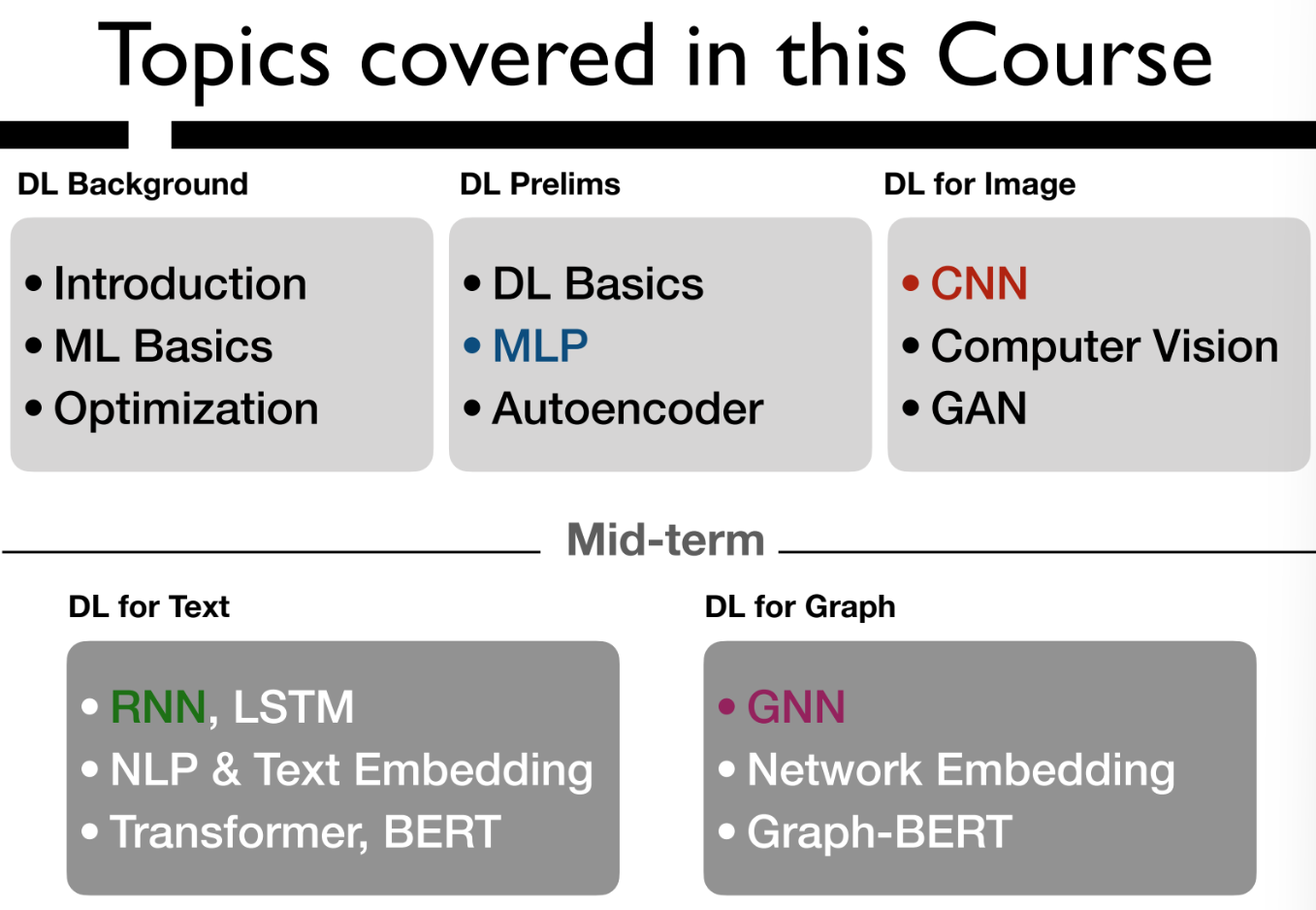
RNN & LSTM
Sequential data
RNN specifically, architecture
Gradient exploding/vanishing problem
LSTM
NLP & Word Embedding
NLP history
Word embeddings - specifically word2vec
text generation with RNN
Transformer & BERT
Attention
Transformer
BERT
GNN
Graph neural network intro
SGC operator and GCN
GAT
GNN Application
GNN Applications & Network Embedding
Heterogenous information networks (HIN)
GNN for heterogenous information network embedding
GNN for recommender system learning
GResNet & Graph-Bert
SGC operator and its problem
GResNet with graph REsidual LEarning
Graph-bert
What the course did and didnt
Covered:
- architecture
- Motivation
Didn’t cover: - “tricks”
- dropout
- weight decay
- batchnorm
- Xavier initialization
- Data augmentation
- etc..
Suggestions
CS changes quickly
Find an interest, an study hard on it. Self-study even
Open mind, but not swept away by hype.
Covered
Existing DL Models/Algorithms & their proposed year
- Back-propagation Algorithm (1974),
- GD, SGD, Mini-Batch SGD
- Momentum (1999), Adagrad (2011), Adam (2014)
- Perceptron (1958), Multi-Layer Perceptron (1974)
- Auto-Encoder (1986), VAE (2014)
- CNN (1998), ResNet (2015)
- GAN (2014)
- RNN (1986), Bi-RNN (1997)
- LSTM (1997), GRU (2014)
- Skip-gram (2013), CBOW (2013)
- Transformer (2017), BERT (2019)
- GCN (2017), GAT (2018)
- RGCN (2017), BPR (2009)
- GResNet (2019), Graph-Bert (2020)
🧪 -> Refresh the Info
Did you generally find the overall content understandable or compelling or relevant or not, and why, or which aspects of the reading were most novel or challenging for you and which aspects were most familiar or straightforward?)
Did a specific aspect of the reading raise questions for you or relate to other ideas and findings you’ve encountered, or are there other related issues you wish had been covered?)
🔗 -> Links
Resources
- Put useful links here
Connections
- Link all related words