📗 -> 9/30/24:
When lectures is over, add the content as aliases above
🎤 Vocab
❗ Unit and Larger Context
Bitwise operations are useful:
- They’re very fast
- Very useful for boolean representations
- Read/Write/Execution Permissions:
- 755 (rwxr-xr-x): 111 / 101 / 101
- 700 (rwx------): 111 / 000 / 000
- Read/Write/Execution Permissions:
Bitwise operations to accomplish a task:
Uses for AND:
Check to see if a bit is a 0 or 1
- Create a new variable called mask that has 1’s in the positions you want to check and 0’s in all other positions
- if(A & mask) then at least one of the bits in that was set to 1 in the mask is set to 1 in A
- If not then all of the positions in A you were trying to check were 0’s
Change the value of a bit to 0 - Create a new variable called mask that has 0’s in the positions that you want to change to 0 and 1’s everywhere else
- A &= mask
Uses for OR:
Setting bits to 1
-
Create a new variable called mask that has 1’s in the positions that you want to change and 0’s everywhere else
-
A |= mask;
-
OR with 1
-
Bits will become 1 if 0, and remain 1 if 1
Uses for XOR:
Flip particular bits and leave the rest unchanged
-
Create a new variable called Mask that has
- 1’s at the position you want to flip
- 0’s at the positions you want to leave unchanged
-
Variables ^= Mask
-
-
XOR with a string of bits, with 1 being the bit to be flipped
- Only the bits with 1s are flipped, rest are kept the same
Uses for bit shift:
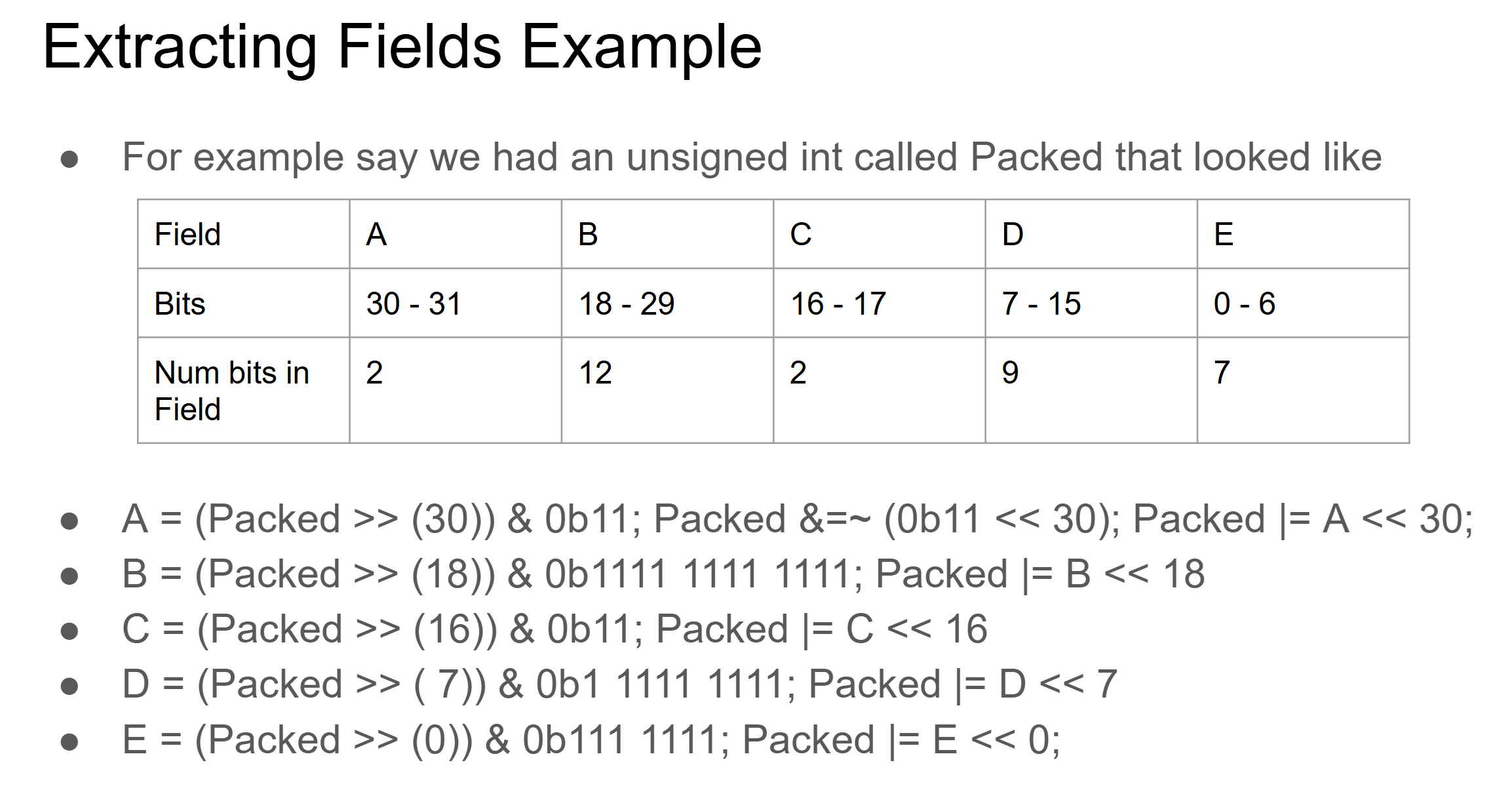
- There are times when you may have multiple fields packed into a single variable and will need to extract them
- To extract a field use the following procedure
- Shift the variable containing the field to the right so that the least significant bit of the field ends up at index 0
- Then and the field with a mask that has as many 1’s in it as there are bits in the field