Abstract:
- CNN used to study the features of objects and classify them
- LSTM (an RNN) is used since text is sequenctial
- To deal with different placements of the text in the image, Connectionist Temporal Classification (CTC) loss is employed
The model was trained with nearly 86000 samples of human handwriting and was validated with 10000 samples. After training for several epochs, the model registered 94.94% accuracy and a loss of 0.147 on training data and around 85% accuracy and a loss of 1.105 on validation data.
Section I: Intro
Convolution used
LSTM divides the image into time steps and attempts to understand where each character occurs and what it means
Since human handwriting isn’t even, LSTM would have trouble. To remedy this, we use CTC loss.
CTC attempts all possible placements of characters and takes the sum of all probabilities.
Section II: Existing System
Segmentation of words -> character segmentation -> prediction
- Not always feasible, diving characters not easy. However, strategies like this have reached 89.6% accuracy (on Devanagari numerals).
- Hidden Markov Models? (HMM)
Section III: Proposed Model
Data Pre-Processing
Greyscaling:
Trained Model
Convolutional Layers work well with max-pooling layers succeeing it
- Calculates the largest value of a feature map generated by the convolutional layer
- Only important/prominent features consider. Minor features ignored. Trains faster.
CNN
CNN uses the convolution operation to extract high-level features of an image, such as edges, and discard other unimportant low lever features
Recurrent Neural Networks and LSTM
RNNs useful when sequence in which the data occurs is important
LSTM has 3 gates viz:
- Input gate to decide whetehr to let the info into the memory
- Output gate to gecide whether to let the input affect the output at the current step
- Forget gate decies when to deem information non-essential and forget it
Gates in LSTM are a sigmoid, and in general either 0 or 1
CNN needed because:
If LSTM only is used, placement of the word in the image is significant and each character in the text label needs to be placed exactly where the character appeared in the text
Important Preprocessing
In order to generalize to other text:
- Input text has to be resized to the same length the model expects
- IAM handwriting data has to be augmented with varying lighting (since the originals all have the same lighting)
Section IIII: Experimental Analysis and Results
The following python libraries are used to implement the proposed model. Tensorflow, Open CV and Numpy. Tensorflow provides a simple interface to implement a deep learning model. Open CV is used to read images and manipulate those images accordingly. The word segmentation algorithm mainly uses Open CV and its find_countours() method to separate words from each other in the document. Numpy library is used to perform complex mathematical operations and it provides a NumPy array object which the TensorFlow model uses
Word Segmentation
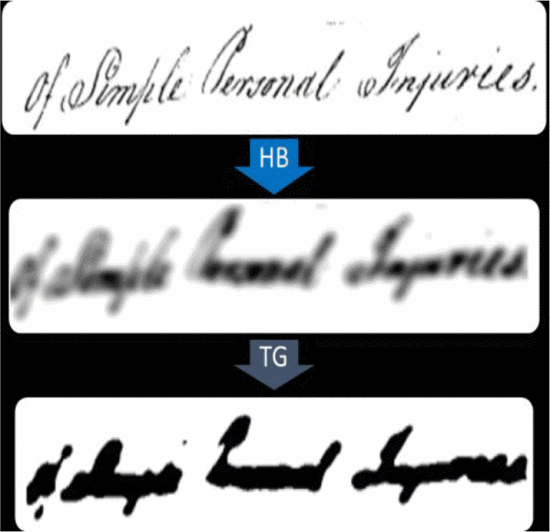
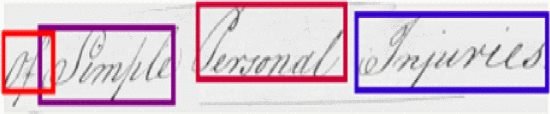
The process is as follows:
- Horizontal blurring, to combine within word contours, but no so much as to combine different words
- Images are thresholder so that values are black or white
- OpenCV’s
find_contours()used to draw contours around every word - Use the counters to cut each word into its own image
Neural Networks
A model is created with tensorflow.keras.Sequential()
- Layers added:
model.add() - Convolutional layers added:
tensorflow.keras.layers.conv2d() - Max pooling added:
tensorflow.keras.layers.maxpooling2d() - Then, two layers of bidirectional LSTM:
Bidirectional(tensorflow.keras.layers.LSTM())- Activation is softmax
- Model compiled and trained with:
model.compile()model.fil()
- Saved with:
model.save() - Predicted with:
model.predict(word)
Activations:
Options
- Sigmoid:
- Tanh:
- ReLU
- Leaky ReLU
ReLU chosen. Popular for CNN, and helps to mitigate the vanishing gradient problem
Optimizer and Loss Function:
For a model to predict correctly, it is trained for multiple epochs. Optimizers and loss functions improve the model for the next epoch. CTC (Connectionist Temporal Classification) solves the problem of alignment of the characters in the image, hence this is chosen as the loss function. Adam is chosen as the optimizer.