📗 -> 01/28/25: LIN175-L7
🎤 Vocab
❗ Unit and Larger Context
Uber late, only caught last 20 mins
✒️ -> Scratch Notes
Catch up
Techniques to measure brain activity in space:
- fMRI (functional magnetic resonance imaging)
- fNIRS (functional near- infrared spectroscopy)
- PET (positron emission tomography)
Measuring blood flow:
-
Neuronal metabolism
-
Brain cell activity is powered by glucose an oxygen, supplied vja blood flow
-
Neuronal activity leads to increased local oxygen consumption
-
Contrast with EEG / MEG neural electromagnetic effects
Physics of MRI
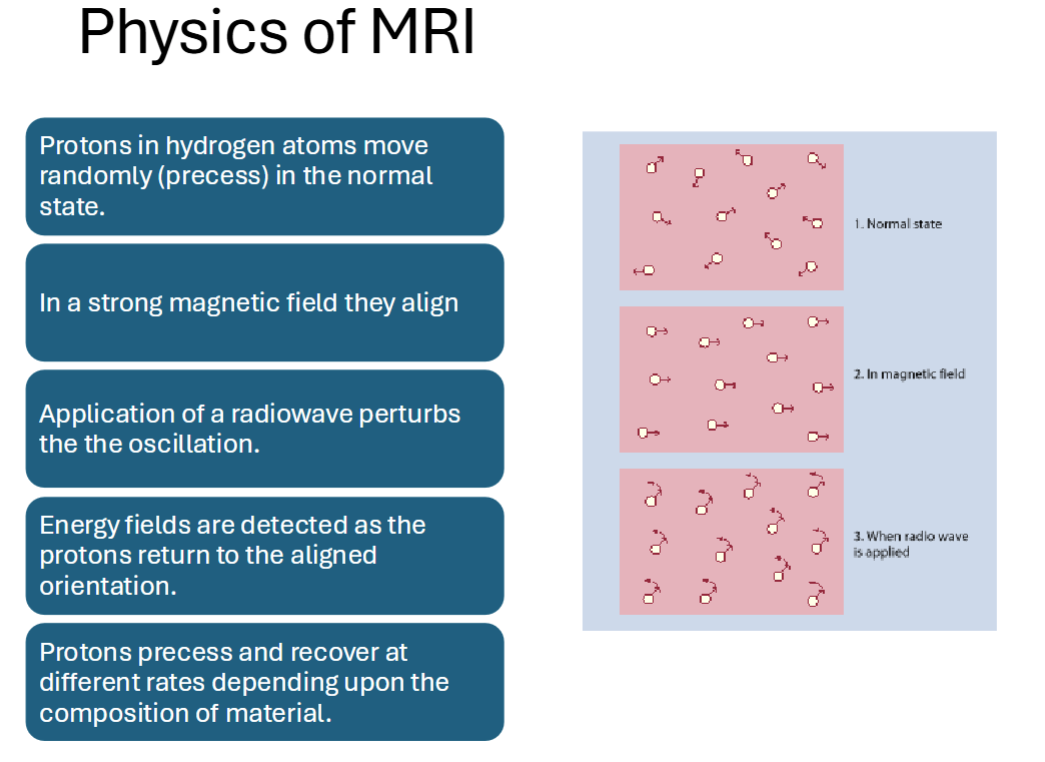
- Protons spin are aligned by a strong magnetic field
- Spins are added together and result in a net magnetization vector (NMV)
- They are perturbed by a radio wave
- Excitation
- The recovery of the protons to the aligned orientation is measured
- Relaxation
Theres a T1 and T2 weighted image that highlight distinct things. In the example he gave, a T2 weighted image showed a tumor and edema much more clearly.
fMRI
Measures the differences of blood composition across time, due to oxygenation differences of blood
Hemoglobin (Hb) protein carried by red blood cells picks up oxygen from lungs to cells to maintain viability
- Results in 2 states:
- Oxygenated Hb - HbO2
- Oxygenated blood is ‘paramagnetic’ (differences in iron)
- Deoxygenated - HbR (reduced)
- Oxygenated Hb - HbO2
🧪 -> Refresh the Info
Did you generally find the overall content understandable or compelling or relevant or not, and why, or which aspects of the reading were most novel or challenging for you and which aspects were most familiar or straightforward?)
Did a specific aspect of the reading raise questions for you or relate to other ideas and findings you’ve encountered, or are there other related issues you wish had been covered?)
🔗 -> Links
Resources
- Put useful links here
Connections
- Link all related words