Study Guide: Neurobiology of Language Midterm
Neurological Basis of Language Disorders
- Differences between aphasia and motor speech impairments (e.g., Broca’s vs. Wernicke’s vs. Conduction aphasia)
- Language disorders can arise from many different problems:
- Broca’s: Speech production. Broken / difficulty producing words. Non fluent aphasia.
- Wernicke’s: Speech comprehension. Fluent aphasia. Nonsense
- Conduction Aphasia: Language comprehension mostly intact, but production is distorted by phonemic paraphasias and repetition is severely compromised.
- 2 theories (W.L. model and 2 pathways)
-
Disconnection syndrome
-
Impaired transfer of acoustic image of words to motor programs via arcuate fasciculus
-
Left supramarginal gyrus
-
Interiorly adjacent tissue deep inside the sylvian fissure
- Damage to sensorimotor interface, area Spt
-
This is different than the claim in the W.L. model, that claims it arises from damage to the arcuate fasciculus
-
- 2 theories (W.L. model and 2 pathways)
- Language disorders can arise from many different problems:
- Selective vocal cord impairment and its effects on speech production
- Speech errors: phonemic vs. semantic paraphasias, neologisms, and tip-of-the-tongue states
- Phonemic: Substitute phoneme for another (cat -> bat)
- Semantic: Substitute word for semantically related word (cat -> tiger)
- Neologistic: Insert strings of speech sounds for a word target (toothbrush -> sez sez sez sez, hospital -> nezaful)
Neural Models of Language Processing
-
Wernicke-Lichtheim-Geschwind model
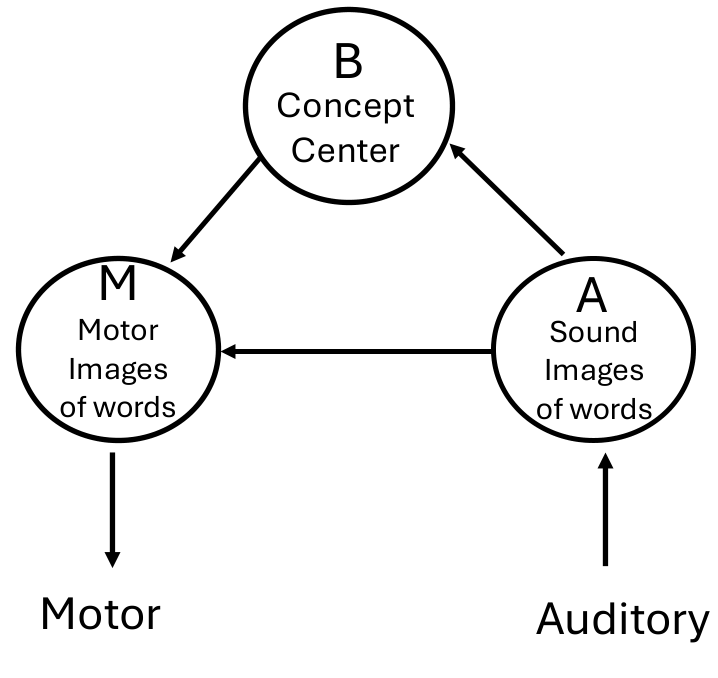
- M: Broca’s
- B: Concepts (distributed)
- A: Wernicke’s
- Disproved because of double dissociation between language comprehension and speech perception
- Deficit in comprehension: posterior STS (superior temporal sulcus) lesions
- Deficit in perception: inferior frontal lesion (and parietal)
-
Dual-Stream Model (Dorsal vs. Ventral pathways)
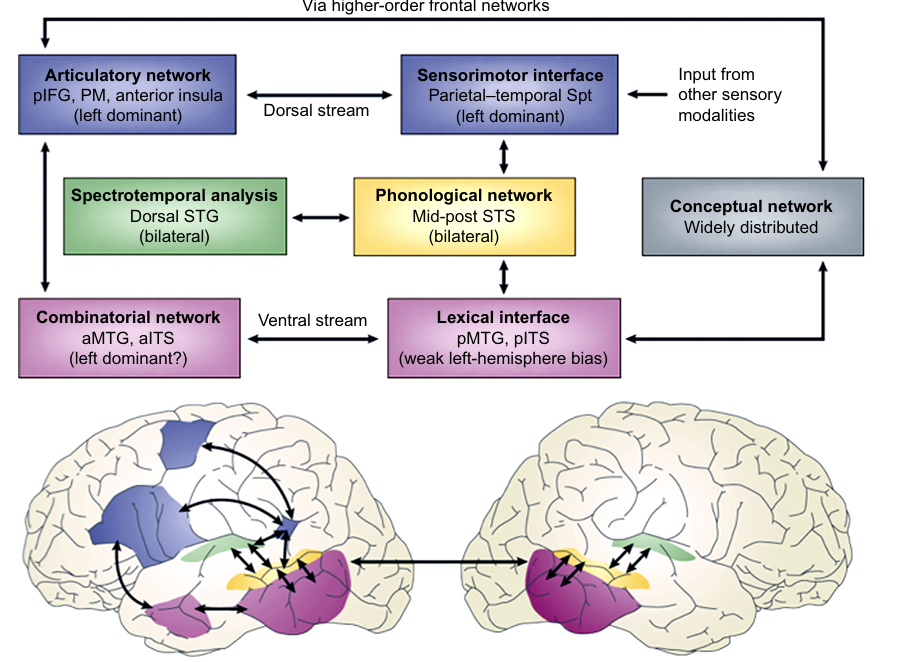
- Split into what and where pathways. Similar dorsal/ventral pathways exist in vision
- Dorsal (upper): Where
- Sensorimotor articulation
- Doing things with language
- Ventral (lower): What
- Lexical/conceptual processing
Key to note: The initial auditory processing steps (spectro temporal analysis and phonological network) are processed bilaterally.
- Lexical/conceptual processing
- Dorsal (upper): Where
- Spectro Temporal Analysis: Dorsal STG (superior temporal gyrus).
- Spectrogram analysis of speech? Key part of converting frequencies to phonemes
- Phonological Network: Mid-post STS (superior temporal sulcus)
- Conceptual Network: WIDELY distributed across cortex.
- Ventral Stream: “Where”. Map sound structure to semantic representations. Forms integrated meanings of complex utterances.
- Combinatorial Network: aMTG/pMTG (anterior middle temporal gyrus), pITG/aITS (anterior inferior temporal gyrus)
- Higher order region thought to implement a combinatorial network that plays an important role in constructing the integrated meanings of phrases and sentences, drawing upon both semantic and grammatical information.
- Left hemisphere dominant
- Not well elaborated on (in the literature)
- Lexical Interface: pMTG, pITS
- A relay station to getting from the phonological structures of words to their semantic structures
- Weak left hemisphere dominance
- Combinatorial Network: aMTG/pMTG (anterior middle temporal gyrus), pITG/aITS (anterior inferior temporal gyrus)
- Dorsal Stream: “How”. From sound to action. Mapping perceptual representations of vocal sounds onto motor representations
- Sensorimotor Interface: Parietal-Temporal Spt? Spt == (Sylvian parietal temporal, located at the parietal temporal boundary, and a subportion of area tpt)
- Appears to operate as a device for coordinating or translating between the sound based phonological network in the lateral temporal lobe and the motor based articulatory network in the posterior frontal lobe
- Articulatory Network: pIFG (posterior inferior frontal gyrus), PM (premotor cortex), Anterior Insula
- Speech production / auditory verbal short term memory (STM) / Speech perception
- Sensorimotor Interface: Parietal-Temporal Spt? Spt == (Sylvian parietal temporal, located at the parietal temporal boundary, and a subportion of area tpt)
- Split into what and where pathways. Similar dorsal/ventral pathways exist in vision
-
The role of Broca’s area, Wernicke’s area, and Middle Temporal Gyrus in language processing
- Broca’s:
- Wernicke’s:
- Middle Temporal Gyrus:
-
The function of the lexical interface and the sensorimotor interface in language comprehension
- Lexical Interface: Sound -> Word representation/Semantic Structures. Bilateral.
- “What does this sound mean?”
- Sensorimotor Interface: Sound -> Motor coordination of speech.
- “How will i move my body to achieve this action?”
- Lexical Interface: Sound -> Word representation/Semantic Structures. Bilateral.
-
fMRI and PET findings on speech perception and comprehension
- Helps us to discover which regions correspond to what stimulus
- Think of a control study for real intelligible vs unintelligible multi word utterances. Will isolate activation to higher level regions (corresponded to meaning)
- This study found activation in left lateral ATL (anterior temporal lobe)
- ATL may serve as a semantic hub binding diverse lexical concepts?
- Think of a control study for real intelligible vs unintelligible multi word utterances. Will isolate activation to higher level regions (corresponded to meaning)
- Helps us to discover which regions correspond to what stimulus
Aphasia and Language Processing
- Characteristics of Broca’s aphasia vs. Wernicke’s aphasia
- Broca’s aphasia
- Wernicke’s aphasia
- Closed-class lexical deficits and their effects on sentence comprehension
- Open-class words - nouns, lexical verbs, adjectives, and adverbs
- Closed-class words - pronouns, determiners, conjunctions, and prepositions
- Do not readily accept new members, have a finite set
- Tests for phonemic discrimination
- Double dissociation between word comprehension and syllable awareness
Sign Language and the Brain
- How signed languages lead to similar aphasia patterns as spoken languages
- Similarities: Left centralized. A case study of right hemispheric damage was able to keep language abilities despite having unilateral neglect.
- Differences
- Differences in left vs. right hemisphere involvement in signed vs. spoken language
- Highly similar areas in left and right hemisphere (BSL and English)
- Spoken:
- Left: Language
- Speech
- Reading
- Right: Spatial information
- Face recognition
- Maps/Route
- Signing:
- Left: Language
- Right: Spatial information
- Left: Language
- The role of spatial syntax in right hemisphere processing
Language Acquisition and Bilingualism
- Critical period hypothesis for second language learning
- Bilingual brain organization: coordinate, compound, and subordinate bilingualism
- Compound Bilingual: L1 and L2 are learned concurrently at home.
- Often mother and father may speak different languages, or family. Language acquired in the same environment
- Coordinate Bilingual: L2 is learned after L1 (after around school age.)
- Languages learned in different contexts, home vs school.
- Subordinated Bilingualism: L1 is dominant and translates in into L2.
- Weaker language is interpreted through the first
- You think in L1, and consciously interpret into L2
- Compound Bilingual: L1 and L2 are learned concurrently at home.
- How brain damage affects bilingual aphasia recovery
- Pitres Law: The most familiar language is the one that tends to be recovered
- Minkowski’s Law: The language with the strongest emotional association is less impaired, and recovers first
- Recovery Trajectories, will use languages A and B as shorthand:
- Parallel (
) - Selective (
) - B no improvement - Differential (
). A recovers faster - Substantial (
) - Initial stagnation, but explosive growth later - Antagonistic (
) - One recovers while the other doesn’t, or even worsens
- Parallel (
- Mixed recovery - Inappropriate and unrestricted blending of languages. Suggested to be cognitive control, role of inhibition in Wernicke’s aphasia. Inhibition to select (suppress) a language. Broken “language switch”
- Factors affecting bilingual brain activation
Neuroprosthetics and Language Recovery
- Neuroprosthetic research (NEJM article): brain-computer interfaces for speech restoration in ALS
- How the neuroprosthetic works: decoding neural signals for speech production
- Components of the neuroprosthetic (implantation sites, neural decoding)
Theoretical and Research Considerations
- The role of exploratory research in neurolinguistics (e.g., discovery of N400 & P600 ERPs)
- N400
- P600
- Exploratory research: Creating theories has been difficult, so a lot of research devoted to exploration
- Importance of falsifiability in scientific theories
- Need to be specific enough to both make predictions and be tested/proven incorrect.
- Being difficult to disprove is bad
- Need to be specific enough to both make predictions and be tested/proven incorrect.
- Use of models in neurolinguistic research
- Guide research, make predictions, allow interesting questions
Self Study / Notes:
Levels of Analysis:
High to Low:
- Linguistic - High level linguistic structures in the brain, phonological, syntactic, etc.
- Psycholinguistic - Architecture and algorithms in brain and language
- Neurolinguistic - Neurobiological machinery enabling algorithms