📗 -> 03/13/25: NPB162-L18
🎤 Vocab
Anosmic - having no sense of smell or being unable to smell certain things
❗ Unit and Larger Context
Small summary
✒️ -> Scratch Notes
Final has a focus on experimental design
- Most cases, answers are right if you justify it
“Imagine this new situation we didn’t study, apply what you learned”
Odor Guided Behaviors
Olfaction is an ancient behavior, navigating through chemicals is as old as bacteria.
Chemicals tell us about:
- Food
- Mates
- Predators
- Navigation (ants)
Two olfactory systems
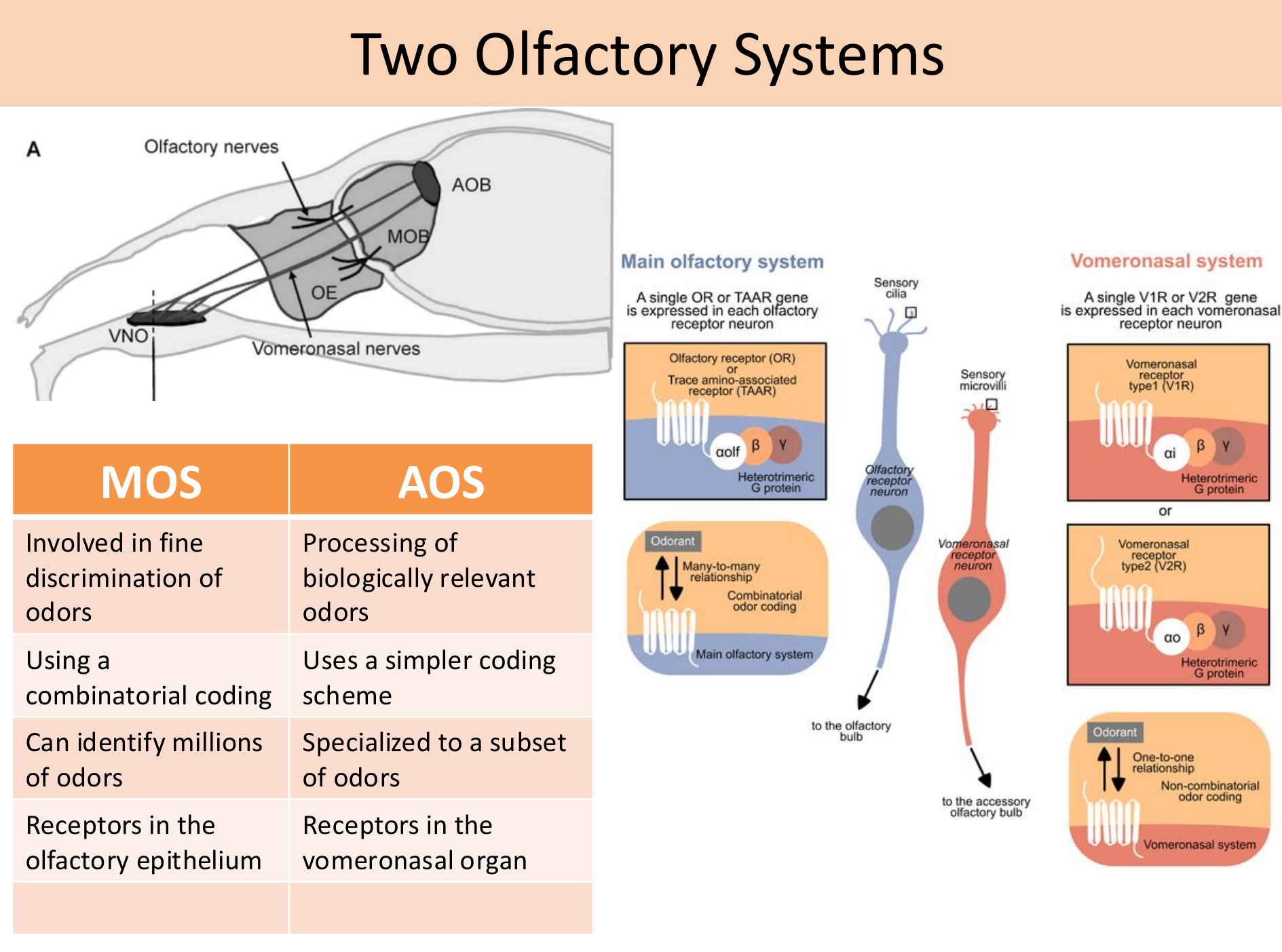
- OB - Olfactory Bulb
- OE - Olfactory Epithelium
- These synapse with mitral cells?
- AOB - Accessory Olfactory Bulb
- VNO - Vomeronasal Organ
- Two receptor families that each project to separate areas of the AOB:
- V1Rs
- V2Rs
- Two receptor families that each project to separate areas of the AOB:
MOS
AOS
Olfaction is the only sensory system that doesn’t go to the thalamus
Some mammals can detect over 10,000 different chemicals and chemical mixtures!
Challenges in study
No distinct encoding/coding pattern has been found in olfaction. Not as simple as add a carbon to chemical, neuron activated is a mm right.
- There is no clear axis of stimuli characteristics to use (in contrast to vision, where you have wavelength, intensity)
- Carbon Length?
- Side groups?
- 3D Size?
- Hydrophobicity/Hydrophilic?
- Odor perception doesn’t correlate to odor chemical structure.
- Odor mixtures are not encoded linearly.
- Concentration changes can impact odor quality.
- Hard to quantify exactly how much of any odor a subject is receiving (odor plumes, mucus solubility, unequal distribution of receptors in the olfactory epithelium)
- etc…
All olfaction research before 1990 is likely wrong. Dogma was that there was a small (7) amount of receptors, not the 1000s that there are
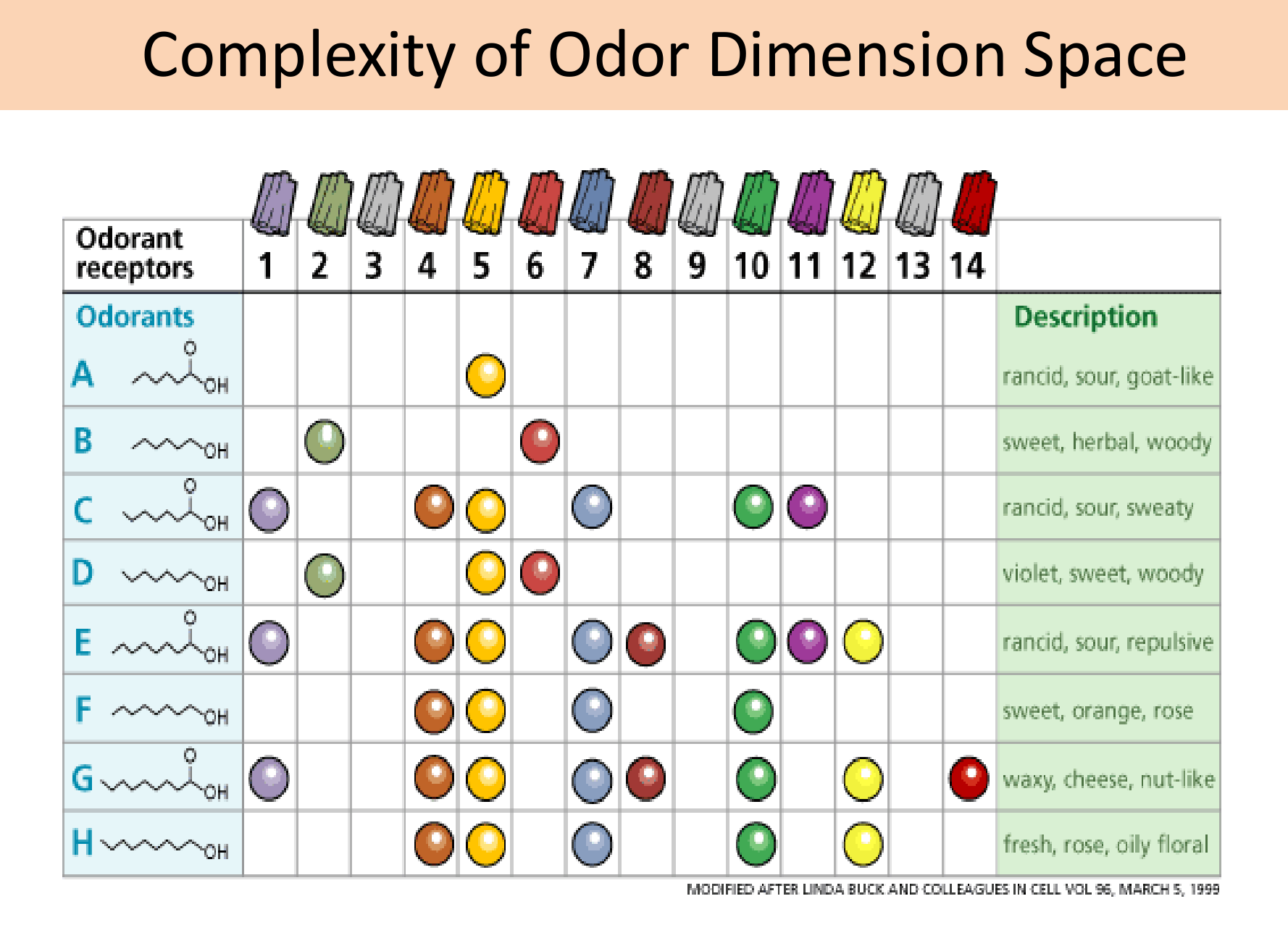
- Combinational coding
Rats can even distinguish stereoisomers!
- We can too apparently for certain stereoisomers, spearmint vs caraway
What causes smell?
Odorant / Pheromone / Allomone
- Odor:
- Not all chemicals are (something to do with volatility?)
- Pheromone:
- Trigger a behavioral or physiological reaction automatically
- Trigger period, etc.
- Allomone:
- a chemical produced by a given species that affects the behavior or physiology of the same species, usually related to social behavior
- a chemical produced and released by an individual of one species that affects the behavior of a member of another species to the benefit of the originator but not the receiver.
- A signal you release so that predators
Pheromone/allomone aren’t necessarily odorous. They can be, but you don’t need to consciously detect it.
Behavior
Salmon
Salmon will imprint on the place where they were born, and migrate 2000-4000km to return to their juvenile home.
Salmon and Odor Imprinting - Attributed to olfaction!
- because of local differences in soil and vegetation of the drainage basin, each stream has a unique chemical composition and, thus, a distinctive odor
- adult salmon use this information as a cue for homing when they migrate through the home-stream network to the home tributary.
Increased neural response to home water
Sheep / Ewes
We can see that mitral cells respond preferentially to the lamb cells after birth
- Then a sub portion of these cells respond preferentially to ewe’s own lamb and an alien lamb
Initially they rely on sense of smell to distinguish their own lamb from alien lambs, (1-3 days), but after 1 month they do not rely on it as much (possibly due to facial recognition?)
- Control vs Anosmic study of rejection of suckling attempts from their own vs Alien lambs
Neuroethology dogma
To study a neural behavior: Record / Ablate / Stimulate
Ants
Necrophoresis - A sanitation behavior found in social insects – such as ants, bees, wasps, and termites – in which they carry away the dead bodies of members of their colony from the nest or hive area
- Caused by a chemical emitted after death, oleic acid
- Painting a live ant with the acid cause it to be kicked out, even though it is alive and resisting
Pheromones in Mammals
Whitetail deer
7 glands that emit pheremones.
- Interdigital gland (feet): substance released that marks path and territory
- Forehead gland: oily substance, marks territory, more significant in dominant bucks
- Tarsal Glands (back knee?): Oily substance that mixes with urine to create an individual specific smell.
Selling Research
“Nobody cares about what you did, they care about the question you set out to answer. When I talked to peers about my research, I wasn’t measuring how much a rat ate in different conditions, I was studying the nature of individuality”
Interesting Phenomena in Rodents (maybe mediated by pheromones)
Lee-Boot - When female mice housed together, their estrous cycles slow and stop.
Whitten - If the group of females is exposed to odor of male, they start cycling again in synchrony.
Vandenbergh effect - Acceleration of onset of puberty in female rat when exposed to odor of male.
Bruce effect - Failure of recent pregnancy of female rat when exposed to male who is not the father.
Coolidge effect - Restorative effect of introducing a new female sex partner to a male that has apparently become “exhausted” by sexual activity” (Cannon).
TRP2 KO mice are affected in their sexual behavior?
Questions
What causes animals to smell different?
🧪 -> Refresh the Info
Did you generally find the overall content understandable or compelling or relevant or not, and why, or which aspects of the reading were most novel or challenging for you and which aspects were most familiar or straightforward?)
Did a specific aspect of the reading raise questions for you or relate to other ideas and findings you’ve encountered, or are there other related issues you wish had been covered?)
🔗 -> Links
Resources
- Put useful links here