📗 -> 05/15/25: NPB173-L12
🎤 Vocab
❗ Unit and Larger Context
Lecture 14 overview
- Psychiatric disorders
- Neurodevelopmental disorders
- Prolonged brain development in humans
- Fragile X syndrome overview
- Epigenetic regulation of protein expression
- Molecular mechanisms of Fragile X syndrome
- Fragile X syndrome and synaptic plasticity
Lecture 14 overview
- Neurological vs. psychiatric disorders.
- Neurodevelopmental disorders.
- Cognitive development and associated neural plasticity.
- X-linked inheritance and X-chromosome inactivation.
- Epigenetic regulation.
- Fragile X syndrome genetics and inheritance.
- Fragile X syndrome epigenetics.
- FMRP: regulator of protein expression and synaptic plasticity.
✒️ -> Scratch Notes
Neurology vs Psychiatry
Neurology tends to have more salient signs of disease in the brain (neurodegeneration in Alzheimer’s e.g.)
Psychiatry deals with disordersof thought and behavior with less salient signs of disease
- This makes it hard to understand the neural mechanisms of psychiatric disorder
Neurodevelopmental disorders
Def: Disorders that manifest in individuals as they grow through childhood and adolescence
- During this time, the brain is undergoing large-scale changes that do not occur in adulthood
- Neurdev. disorders tend to be more psychiatric than neurological
Examples: - intellectual disability (ID), autism spectrum disorders, fragile X syndrome, attention-deficit/hyperactivity disorder, and schizophrenia.
r/K selection
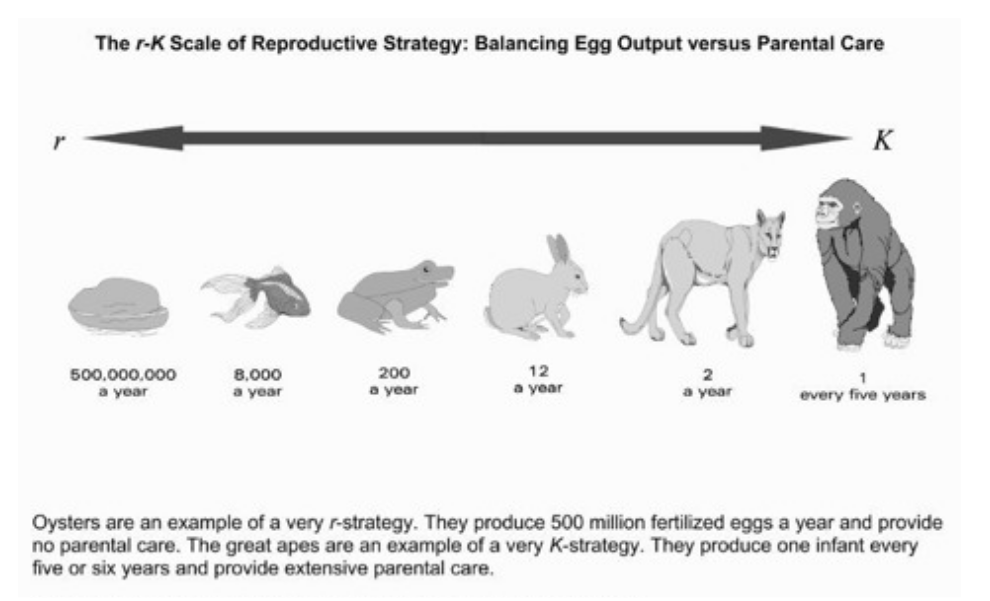
- r-selection: More offspring, faster growth rates, less parental care
- K-selection: fewer offspring, slower growth rates, more parental care
- Humans are extremely K-selective
Cognitive development
- Human development proceeds through childhood and adolescence
- Many aspects of cognition diminish with aging
- Normal deterioration is called senescence
- Abnormal/extreme deterioration is MCI
Synaptic changes
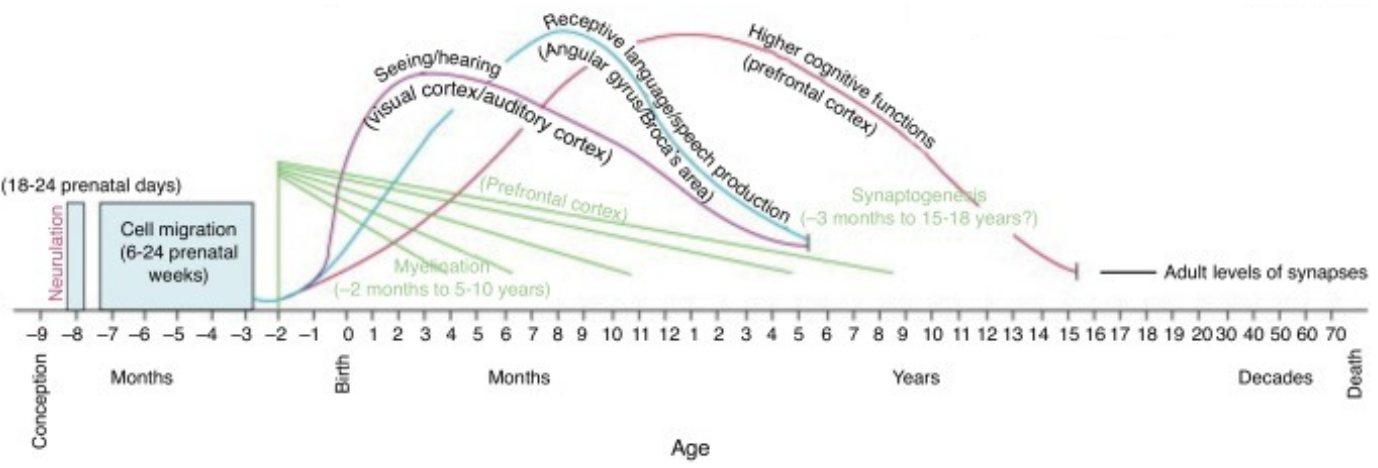
- Little post birth neurogenesis, but lots of synaptic changes
- Synapses rise in early childhood and falls through adolescence into adholhood
- Changes in synapse number correlate with functional changes
Fragile X Syndrome (FXS)
Fragile X Syndrome (FXS) is a genetic and neurodevelopmental disorder caused by a mutation in the fragile X mental retardation 1 (FMR1) gene on the X chromosome.
- Name comes from “fragile sites” on X-chromosome
- Fragile X mutation present in 1/5000 individuals
- More severe in males than females
Inheritance
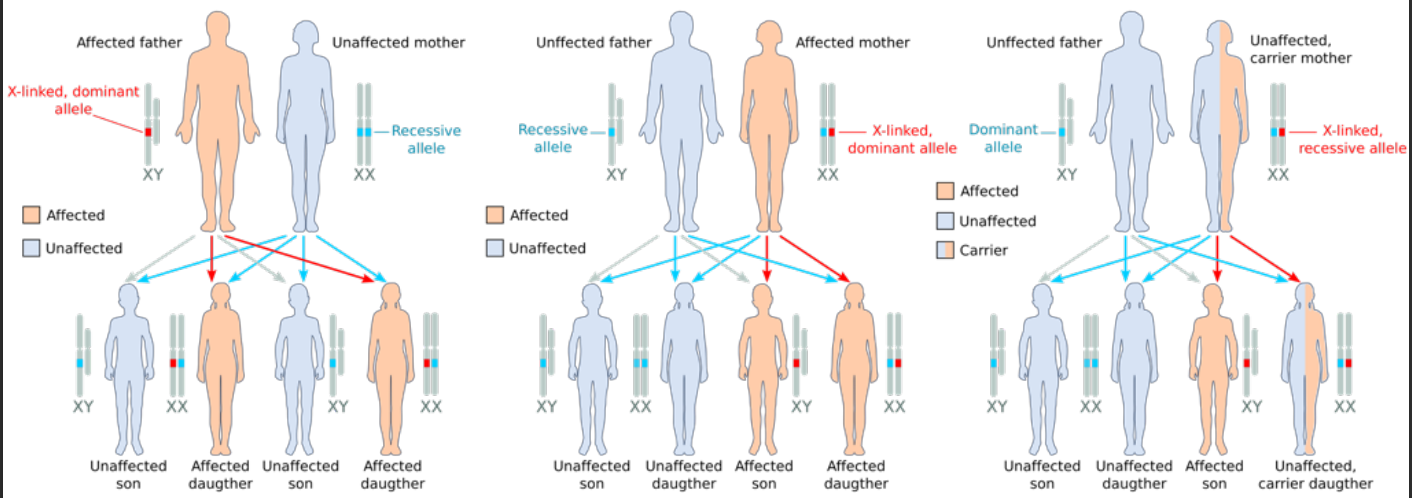
- Females have two X chromosomes, male an X and Y
- A father with an X-linked allele passes it to daughters but not sons.
- A mother with an X-linked allele passes it to daughters and sons with 50% probability.
- A recessive X-linked allele can still affect a male carrier.
X Chromosome Inactivattion
In females
Epigenetics of Fragile X Mutations
- Fewer than 45 CGC repeats in FMR1 is typical, normal expression of the FMRP and no FXS
- More than 200 CGC repeats is a full mutation, leads to epigenetic modifications that reduce transcription of FMR1, reduced levels of FMRP, and symptoms of FXS. This is mediated by a loss of function of FMRP.
- Middle ranges of CGC repeats is considered a permutation. Inreases epigenetic modifications that increase transcription of FMR1. Through a gain of function RNA toxicity of FMR1 mRNA, this leads to a different set of impairments from FXS.
- “Primary ovarian insufficiency, fragile X-associated tremor ataxia syndrome (FXTAS) and psychiatric disturbances due to excess mRNA”
Effects of full fragile X mutation on protein translation
Role of FMRP in modulation of protein expression
-
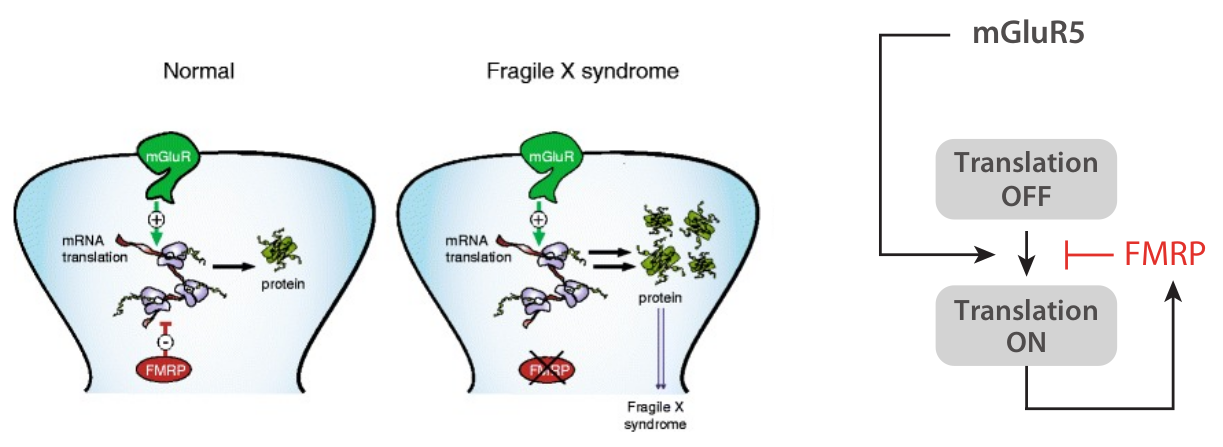
The excitatory neurotransmitter glutamate can also have metabotropic effects through mGluRs (metabotropic glutamate receptors). Among other effects, mGluRs can increase protein translation through their signaling cascades. Post-synaptically, FMRP counters the influence of mGluR-mediated protein translatior enhancement through inhibition of translation of similar sets of proteins
-
mGluR5 and FMRP work together to allow fast control of protein expression.
-
In FXS, the proteins regulated by FMRP and mGluR5 are constitutively expressed at high levels.
🧪 -> Refresh the Info
Did you generally find the overall content understandable or compelling or relevant or not, and why, or which aspects of the reading were most novel or challenging for you and which aspects were most familiar or straightforward?)
Did a specific aspect of the reading raise questions for you or relate to other ideas and findings you’ve encountered, or are there other related issues you wish had been covered?)
🔗 -> Links
Resources
- Put useful links here
Connections
- Link all related words