📗 -> 04/15/25: NPB173-L5
🎤 Vocab
❗ Unit and Larger Context
Overview
- Cellular neuroscience: neurons as building blocks of neural systems
- Action potential biophysics - “if a neuroscientist could understand something reeally well, it should be this”
- Synaptic transmission
- Mechanisms of seizures and causes of epilepsy
- From understanding to treatment: translational neuroscience in epilepsy
Lecture 5 learning objectives
- Action potential biophysics.
- Synaptic transmission.
- Types of epilepsy and seizures.
- EEG.
- Interictal spikes and potential causes.
- Epileptogenesis
- Possible mechanisms of overexcitability.
- Avenues for translational neuroscience in epilepsy
✒️ -> Scratch Notes
Cellular Neuroscience - The study of individual neurons and their properties
- Classifying neurons into distinct types
- Use of cell cultures to study plasticity
- etc.
Useful lens for understanding epilepsy
Ion - Molecule with an electrical charge. The membrane is not permeable to central ions
Ion Pumps - Use energy to maintain concentration gradients of Na and K. High Na outside, high K inside
Ion Channels - Selectively permeable channels that allow some specific ions to diffuse through it (down its gradient)
Resting Membrane Potential - Static electrical potential across its membrane in the absence of synaptic input
- Set by the net flow / equilibrium of passive ion difussion
Mechanism of Action Potential
- Resting state - Gates on Na+ and K+ channels are closed, membrane is at resting potential
- Depolarization - A stimulus pens the activation gates on some Na+ channels, causing depolarization
- Rising phase of action potential - This is the big jump. Depolarization opens the activation gates on most Na+ channels, while K+ channels remain closed. Na+ influx makes the inside of the membrane positive with respect to the outside.
- Falling phase of the action potential - Inactivation gates on most Na+ channels close, block Na+ influx. The activation gates on most K+ channels open, permitting K+ efflux which makes the inside negative again
- Undershoot - Both gates close, but the activation gates on some K+ channels remain open. As these gates close on most K+ channels and the inactivation gates open on Na+ channels, the membrane returns to its resting state
Propagation of action potentials
- Action potentials are usually initiated at the neuron’s cell body (soma)
- Depolarization spreads along the axon. In myelinated parts of the axon, the spread is “passive” with electrical orces moving positive ions inside the axon
- At un-myelinated parts of the axon (could be Nodes of Ranvier, or just no myelin at all) the depolarization triggers an action potential at that part of the membrane
- This continues down the axon
The refractory period precludes reversal of direction during action potential propagation ?
Neuron Communication
Neurons are connected in a variety of ways
In cortex, reverberating connections are most common
Synapses:
- Communication between neurons mediated by synapses
- Can be electrical or chemical
- Electrical - gap junctions allowing ions to pass directly
- Chemical - Transmission via neurotransmitters
- Generally connect to dendrites or cell bodies
Excitatory and Inhibitory Synapses
- The presynaptic neurotransmitter and the postsynaptic receptors determine the effects of neurotransmitter release
- Not one size fit all, sometimes depolarization can be inhibitory
- By and large, a neuron uses the same neurotransmitter at all of its presynaptic terminals, but has multiple receptors (postsynaptic).
- Excitatory synapses - Increase the probability of postsynaptic action potentials upon neurotransmitter release
- Inhibitory synapses - Decrease the probability of postsynaptic action potentials upon neurotransmitter release
- The most common excitatory neurotransmitter is glutamate. Most common inhibitory neurotransmitters are GABA and glycine
Measurement
Intracellular recordings allow measurement of a neuron’s membrane potential
- Action potential and sub threshold fluctuations can be directly measured with intracellular recordings
Extracellular recordings allow detection of action potentials, but not subthreshold changes in membrane potential - Signatures depend on electrode placement and activity from other nearby neurons
Non-invasive measurement of brain electrical activity
EEG (electroencephalography)
- Result of brain activity filtered through large amounts of tissue
- EEG patterns are related to state of the brain, with major differences depending on level of wakefulness/alertness
- EEG signals result from synchronous activity across many neurons
- When it occurs at rhythmic intervals, it is considered oscillatory activity
Epilepsy
Epileptic seizures often involve “hypersynchronous” neural activity
Seizures are the signs and symptoms related to bouts of abnormally excessive and/or synchronous neural activity in the brain
- Can involve motor responses or none at al
Epilepsy is the diagnosis given to the condition of exhibiting seizures
Convulsive seizures involve uncontrolled shaking of the body
Impacts of epilepsy
- Epilepsy affects 50 million people worldwide.
- In USA, incidence (number of new cases per year) is 40-70 per 100,000 people.
- More than double in developing countries.
- In USA, prevalence (number of people with a disorder at a given time) is 5-10 per 1000. The lifetime prevalence (number of people with a disorder at some point in their life) is 3%.
- Sudden unexpected death in epilepsy (SUDEP) is estimated to occur in 1 out of every 10,000 new diagnoses of epilepsy.
- Estimated to cost U.S. economy around $15.5 billion per year (about 1% of costs of all disorders of brain function).
Classification of seizures and epilepsy
Clasification:
- Seizures - Classified by their signs and symptoms
- Epilepsies - Classified from the perspective of their inferred cause
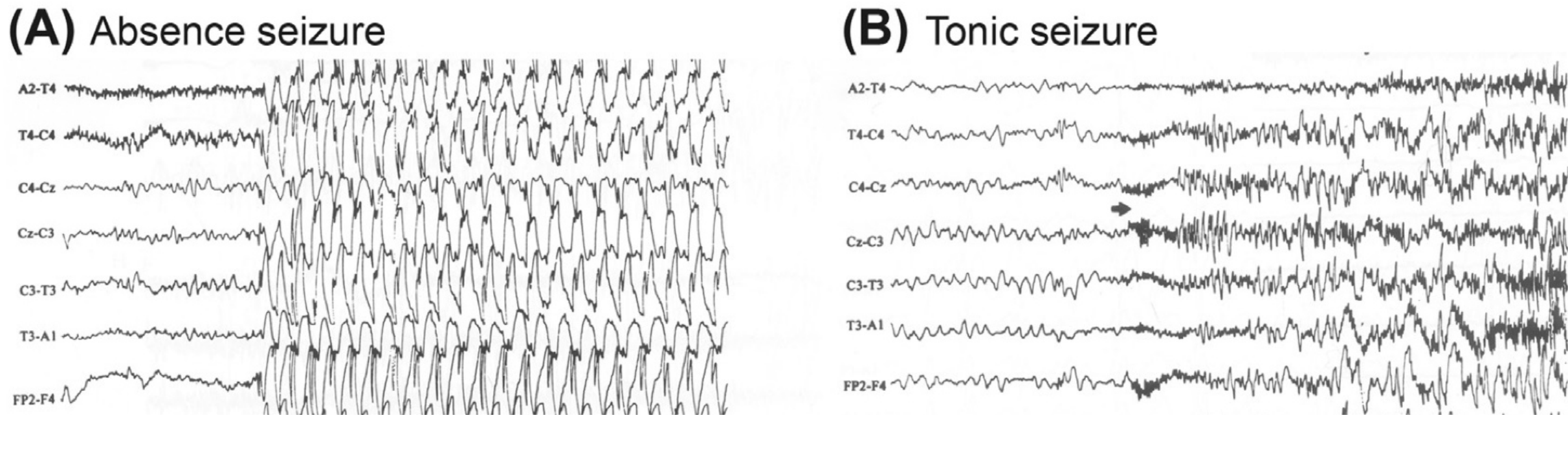
Seizures are often distinguished as focal (occurring one area of the brain) versus generalized (occuring in multiple brain areas, usually in both hemispheres)
Seizures are also distinguished based on behavioral characteristics
- Tonic Seizures - Involve rigidity from persistent extensor muscles
- Clonic Seizures - Involve rhythmic muscle contractions and relaxations
- Tonic-clonic Seizures / Grand mal seizures - Involve both
- Atonic Seizures - Involve loss of muscle tone )often causing a fall or loss of posture
- Absence Seizures / Petit mal seizures - Involve staring and unresponsiveness
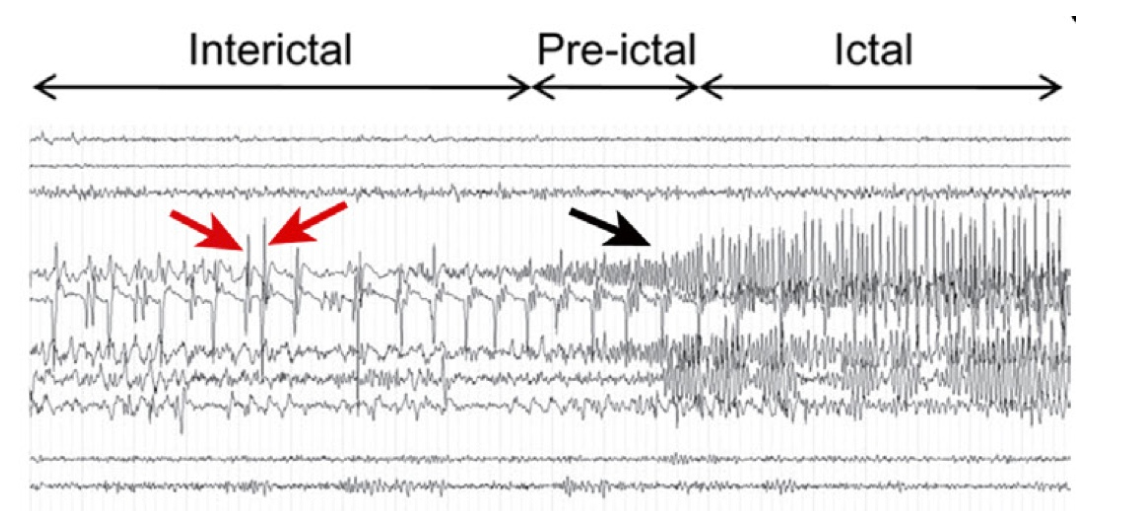
- Ictal Period - When it occurs
- Interictal Period - Between seizures. Majority of the time for those with epilepsy. May still exhibit epilepsy signs
- Interictal spikes - Shown in red arrows, are one sign of epilepsy
- Preictal period - Just before a seizure is triggered
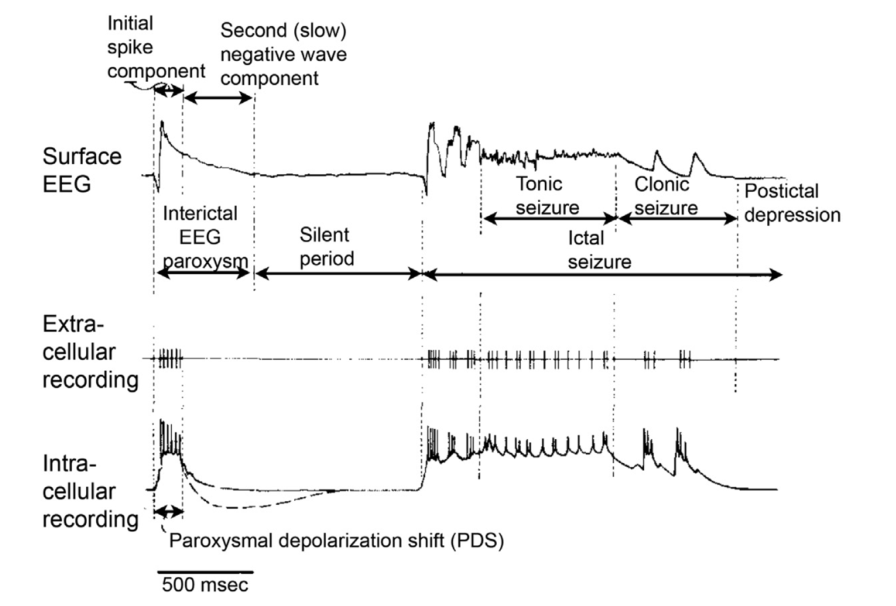
- Interictal spikes are associated with a paroxysmal depolarization shift (PDS) for many individual neurons.
- A sudden large depolarization of a neuron with multiple action potentials produces
- Two competing hypotheses for PDS to consider:
- Epileptic neurons - Encompasses the idea that neuronal properties are overexcitable (IE altered NA channels, or )
- Giant synaptic potentials - Encompasses the idea that synaptic transmission can lead to overexcitability (IE altered glutamate receptors)
Over-excitability
Epileptic Neuron Hypothesis - Encompasses the idea that neuronal properties are overexcitable (IE altered NA channels)
Giant synaptic potentials - Encompasses the idea that synaptic transmission can lead to overexcitability (IE altered glutamate receptors)
Changes in neural circuits could also lead to overexcitability, excitatory/inhibitory balance as a result of altered number of GABA input.
Developing Epilepsy
Most forms of epilepsy are not present at birth and instead emerge during the lifetime
- Emergence is called epileptogenesis (the process through which a non-epileptic brain become epileptic)
- Seizures often increase in severity during epileptogenesis
Kindling model - Epilepsy is induced and worsened through repeated brain stimulation. Theorized that seizures have a causal role in worsening
Translational Neuroscience
Antiseizure drugs (ASDs) are the first line of treatment for epilepsy
Surgery is often needed for ASD resistant epilepsy. EEG and invasive neural recordings can be used to localize seizure focus for potential removal
🧪 -> Refresh the Info
Did you generally find the overall content understandable or compelling or relevant or not, and why, or which aspects of the reading were most novel or challenging for you and which aspects were most familiar or straightforward?)
Did a specific aspect of the reading raise questions for you or relate to other ideas and findings you’ve encountered, or are there other related issues you wish had been covered?)
🔗 -> Links
Resources
- Put useful links here
Connections
- Link all related words