📗 -> 11/6: Memory 2
🎤 Vocab
❗ Unit and Larger Context
Small summary
✒️ -> Scratch Notes
Hippocampal System
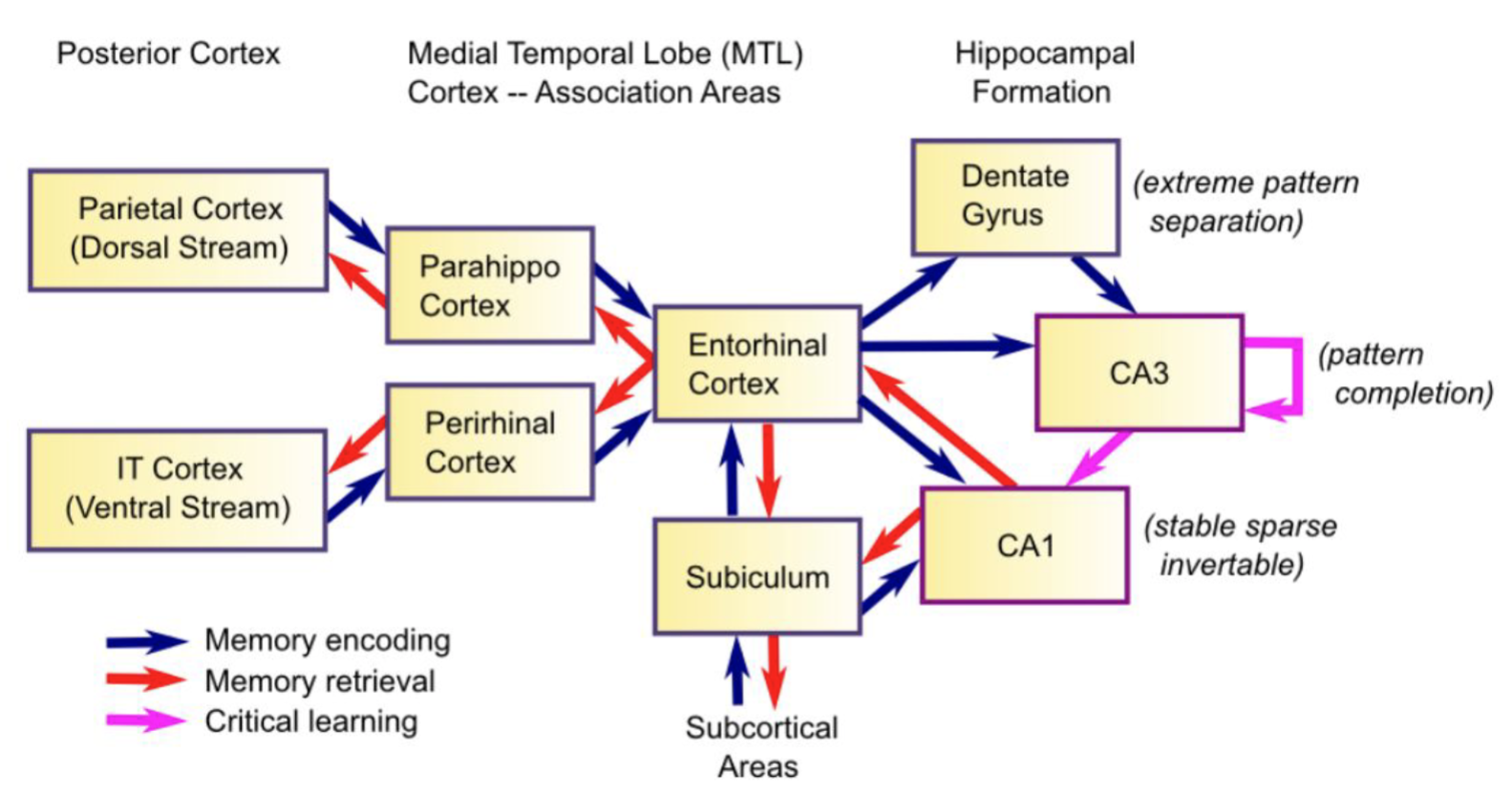
Association Areas -> Hippocampus Proper (Dentate Gyrus / CA3 / CA1)
Hippocampus Proper (Dentate Gyrus / CA3 / CA1)
- Form sparse representations
- Don’t suffer from as much interference
- Overall activity lower than other brain regions
- CA3 - Recurrent excitatory connection.
- When neurons become active, send input to other units in that layer (pattern completion, filling in missing gaps in information)
- Super useful for completing incomplete memories, in the form of cues
- When neurons become active, send input to other units in that layer (pattern completion, filling in missing gaps in information)
- CA1 - Forms an invertible representation. Can be used to feed into entorhinal cortex, or from.
- Entorhinal Cortex - Rich contextual information
- Subiculum -
- Generalized Memory: Cortical, the posterior cortex, frontal lobe
Sparse Activity
CA1CS, CA3CS: Sparse and selective
Entorhinal Cortex, Subiculum: Very active, very distributed. Hard to decode.
Complementary Learning Systems Framework
Remember Specifics:
- Separate representation
- Fast learning (encode immediately)
- Learn automatically (encode everything)
- Hippocampus
Extract Generalities
- Overlapping reps
- Slow learning (integrate over days)
- Task-driven learning (extract relevant stuff)
- Neocortex
Moving Forwards
Reflect on the brain secreting the mind question. Think about why we couldn’t switch the brain regions
The hippocampus with its episodic memory couldn’t be switched with the ventral visual processing stream’s object recognition
- Sparse self completing memories
General attractor dynamics in object recognition
Two forms of neural memory
Activation
Activation
- Neurons continue to fire action potentials, ‘remembering’ what you were just seeing, thinkin
- When firing stops, you forget
Features - Transient, easily lost
- Very flexible: mental arithmetic, etc
Synaptic Changes
Synapses change strength (“weight”) as a result of LTP / LTD (learning): this encodes long-term memories that last even after your activation switches to something new.
Features:
- Long lasting, persist over distraction, etc
- Very high capacity
The Brain IS Memory
Memory is located in every single synapse in the brain
There are as many different kinds of memory as there are neurons and synapses and brain areas.
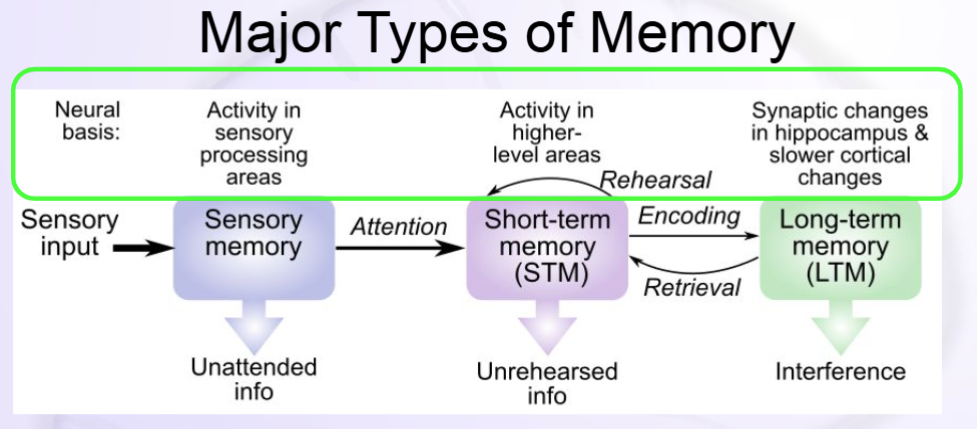
Sensory Memory
Just neural firing in sensory brain areas – those neurons just keep on firing away (briefly)
STM
Neural firing in higher level brain areas that represent specific thing you’re remembering – those neurons just keep on firing away (briefly)
Usually requires contribution from PFC to keep neurons firing longer (extra ‘holding power’)
LTM
It is in the relevant brain area(s) that encode the specific information! LTM is the sum total of all those synaptic weight changes!
🧪-> Example
🔗 -> Links
Resources
- Put useful links here