📗 -> 11/19: Executive Function
🎤 Vocab
❗ Unit and Larger Context
Small summary
✒️ -> Scratch Notes
Who is in charge of your brain?
Prefrontal Cortex does active maintenance
Cognitive Control
- Maintained activity drives top-down biasing
Planning - Think about things that are not there (future)
Motivation - Maintain goals
Reward processing - Maintain possible outcomes
Decision making - Maintain alternatives
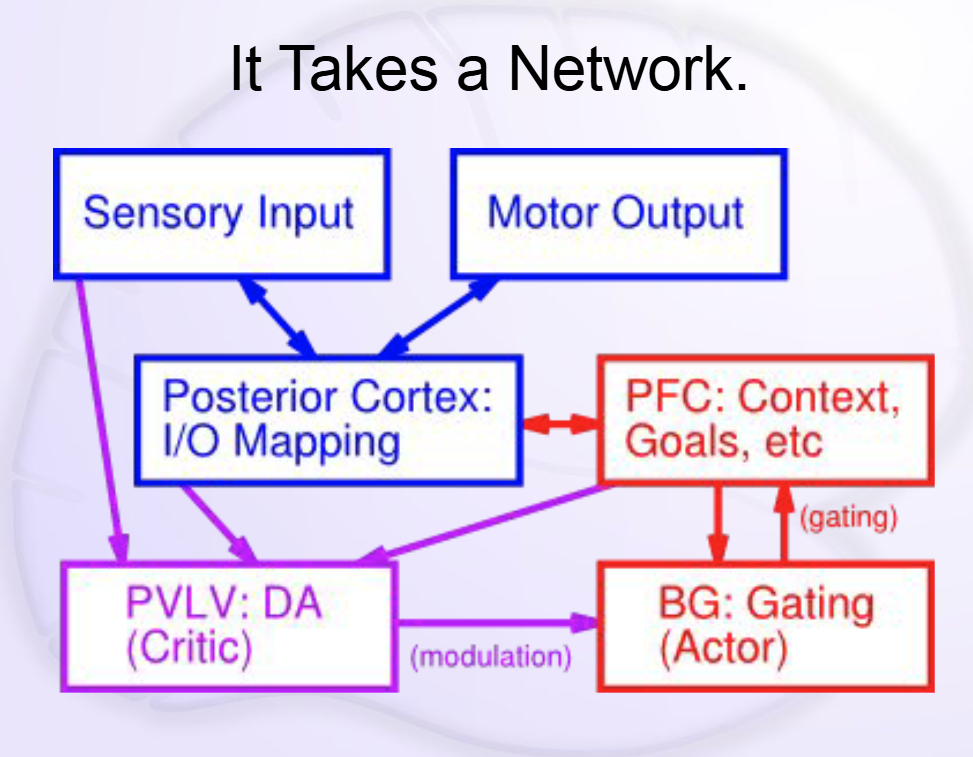
Solving the homunculus problem
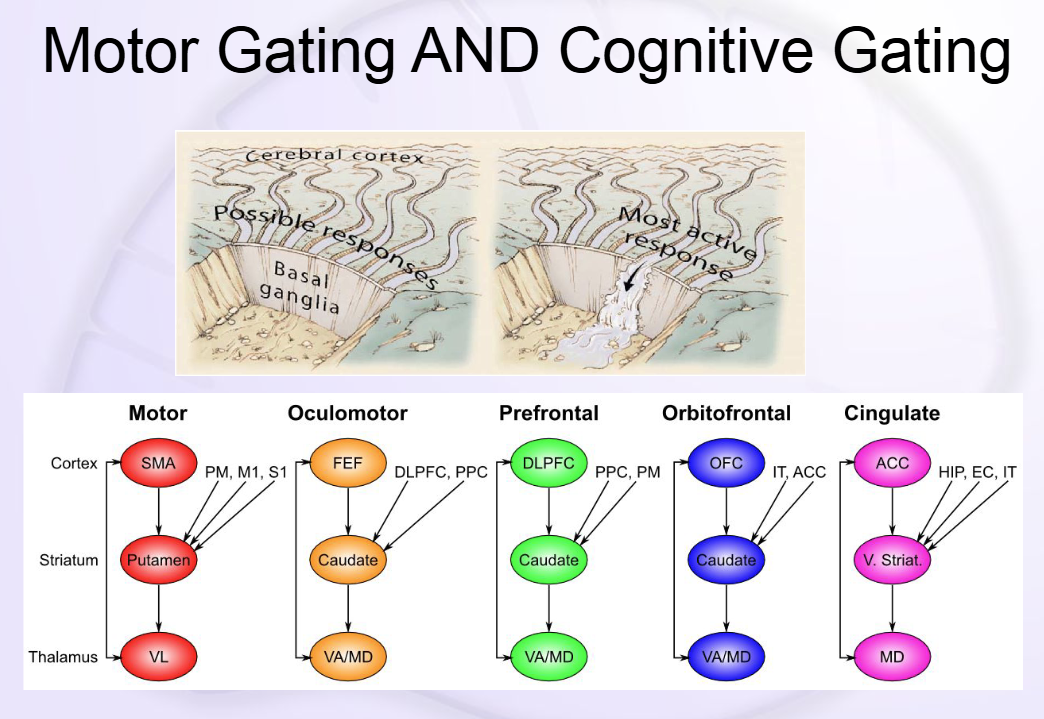
- Basal Ganglia involved in activity selection in motor functions, and in higher thinking
- OFC selects reward evaluation
- Make burrito or buy it? Reward to both
- Cingulate calculates effort associated
- How hard to make burrito / buy it
- OFC selects reward evaluation
What would happen if the tonic baseline of dopamine levels were higher?
Go pathway increases weights (D1 receptors), No Go pathway decreases (D2 receptors).
In higher cognition, having a higher go pathway and being more likely to do everything is analogous to the experience of ADHD. Don’t differentiate options as well, be more impulsive, high task switching.
🧪-> Example
How do we go from being perseverating babies to become these amazing planners and problem-solvers and multi-taskers etc.? What are your thoughts from a computational cognitive neuroscience perspective?
We build associations and train our expectations to be able to become planners and problem solvers. To be able to make plans we need to learn what causes good outcomes, and what we need to change to make to induce them.
Intuitively, I would think that a baby would be more persevering because there is great advantage to a baby learning as fast and as hard as it can. They might learn information, and not be as well adapted to changing their preconceptions and worldview. On top of that, they might not understand exactly why picking the A location no longer yields results, and just associate A with reward blindly and have little incentive to switch.
As an adult, we have a lot of the groundwork laid down from when we were younger and can afford to slow down our learning rates. Now, it might be easier to fine tune our reactions and expectations to things. On top of that, we have a more well tunde sense of what leads to reward and what doesnt't. Additionally, our PFC is one of the last regions of the brains to develop, and with it our ability to task switch and organize higher level planning.
🔗 -> Links
Resources
- Put useful links here