📗 -> WATOLINK SSVEP BCI (NTX22 Competition)
left off the videa at 6:50
1. Overview
Author(s): {{author_name(s)}}
Original Publication/Source: Link to the project
2. Project Summary
Briefly describe the project, its objectives, and its main outcomes.
Objective
- The project aims to use the SSVEP or Steady State Visually Evoked Potential (which are brain responses from staring at visual stimuli)
- 12hz stimuli -> 12hz response
- Use these to create a system of communication
- Information transfer rate is one of the biggest bottlenecks (150 bits/min
9 words/min compared to 135 words/min for verbal speech)
- Information transfer rate is one of the biggest bottlenecks (150 bits/min
Key Achievements:
- {{achievement_1}}
- {{achievement_2}}
Domain:
{{link domains (e.g., BCI, ML, robotics)}}
3. Methodology
Describe the methods and techniques used in the project.
The project uses the SSVEP to get responses, and uses a LLM to generate options. No need for a speller, when you can just speak through an AI lmao. It is effective though.
- Experimental Setup:
- Data Collection:
- Rigid experimental procedure, highly researched
- Sent into a csv with trial markers, clean and validate
- Processing Pipeline:
- Perform PCA across each of the channels
- Look at the spectogram of that, and treat it as a new channel
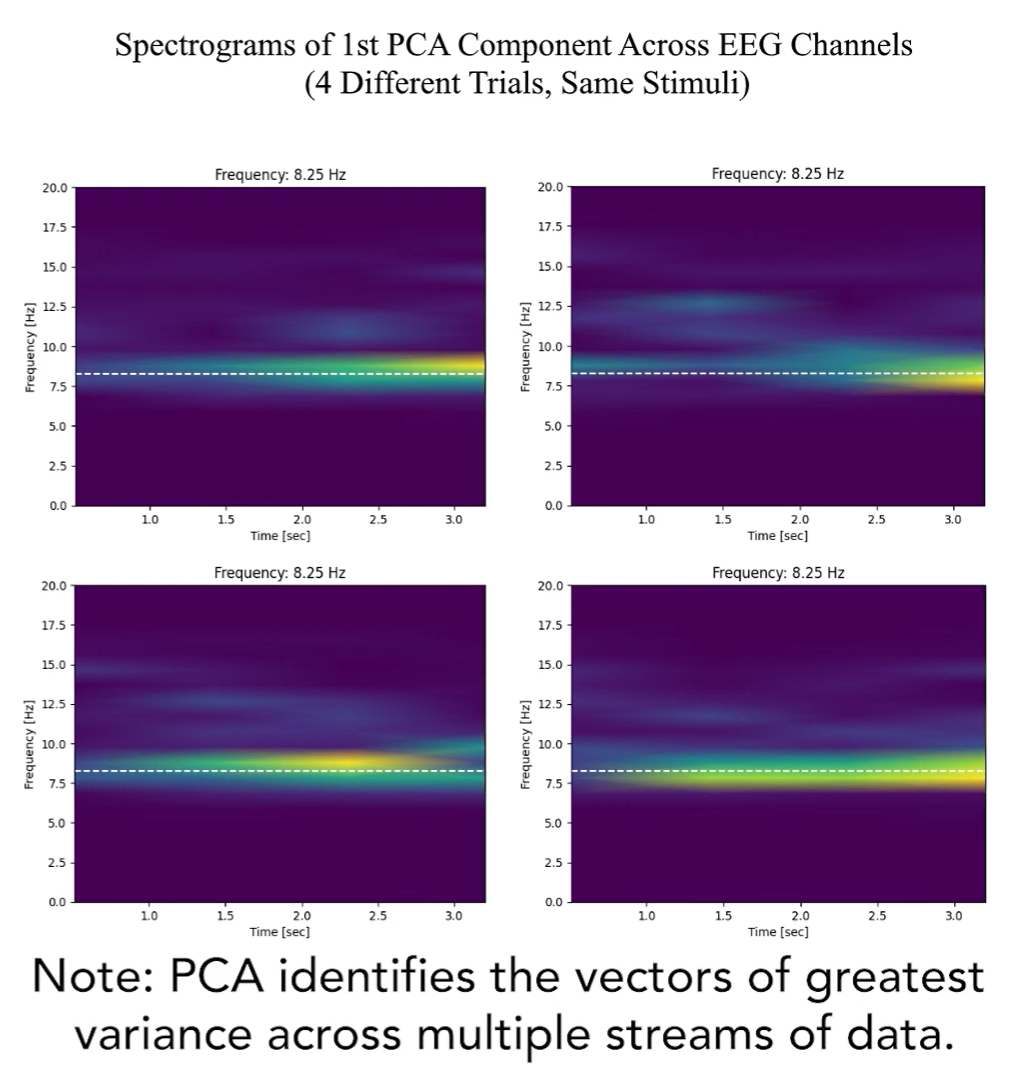
- Perform FFT on each channels response, and average across channels
- Algorithms/Models Used:
- BCI
- EEG Streaming layer
- Receiving EEG from board and sending to the next layer
(once 250 samples are collected it will send to the next layer)
- Receiving EEG from board and sending to the next layer
- Data processing and AI Layer
- Receive EEG data and send frequency predictions.
- Also receives the UI dictionary
- User interface layer
- Displays the widgets, and sends data back to the Data processing layer
- Data Collection:
- Evaluation Metrics: {{metrics_used}}
4. Key Insights and Innovations
Highlight what stands out about the project and why it is impactful.
- Unique Approaches:
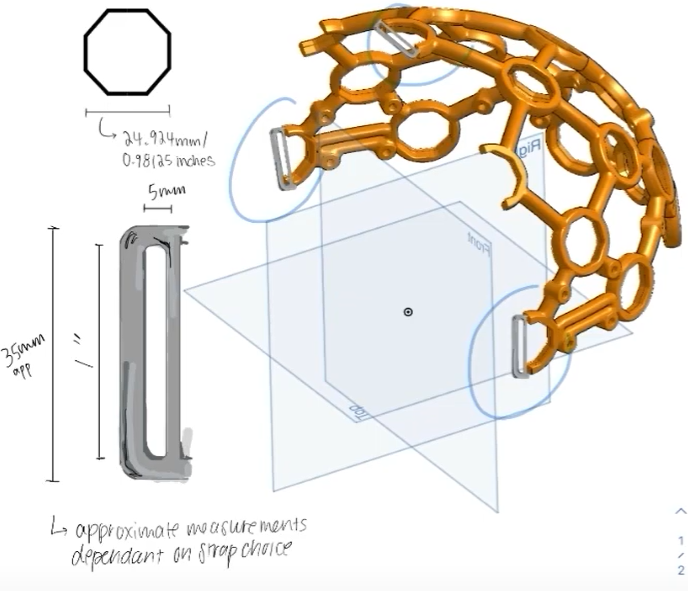
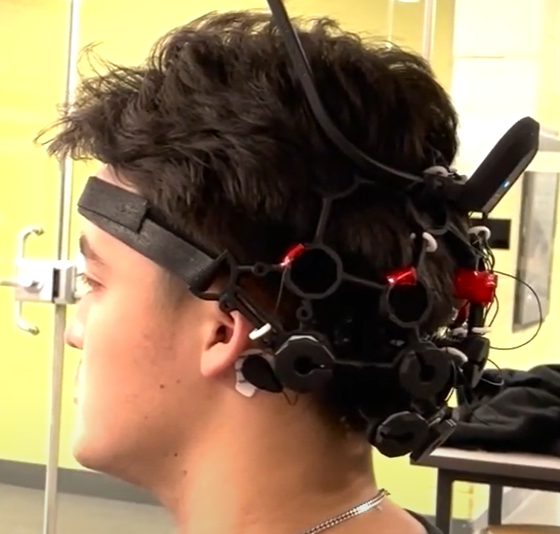
- Create their own electrode mold/cap
 |  |
|---|
- {{unique_approach_2}}
- Innovative Solutions: {{brief explanation}}
- Strengths:
- {{strength_1}}
- {{strength_2}}
5. Challenges and Limitations
Discuss the main challenges faced in the project and any limitations.
- Challenges:
- A number of factors go in, ranging from:
- Display distance, stimuli size, color, frequency, ISA
- Length of trials, stimuli exposure, breaks
- {{challenge_2}}: {{description}}
- A number of factors go in, ranging from:
- Limitations: {{limitations}}
6. Results and Conclusions
Summarize the results obtained and the conclusions drawn from the project.
- Results:
- {{result_1}}: {{brief description}}
- {{result_2}}: {{brief description}}
- Conclusions: {{summary of the project’s findings}}
7. Potential Improvements
Identify areas where the project could be enhanced.
- Suggested Enhancements:
- More research minimizing experimental fatigue
- Better cap that minimizes noise, hightens STN (signal to noise) ratio, and is reproducible
- {{improvement_2}}: {{details}}
8. Takeaways for Future Projects
List the key takeaways that could inform your own work.
- Lessons Learned:
- {{lesson_1}}
- {{lesson_2}}
- Applicable Techniques: {{techniques you plan to adopt}}
- Inspiration Points: {{specific elements to explore further}}
9. Related References
Provide additional resources or related work that may be helpful for further understanding.