📗 -> 02/09/26: ECS150-L14
🎤 Vocab
❗ Unit and Larger Context
Picking up from last week, we’re we covered:
- Race conditions: (unexpected/undesirable) results of concurrency
- Synchronization strategies: Peterson’s algorithm with busy waiting and locks
✒️ -> Scratch Notes
Locks
A sync variable that provides mutual exclusion
- 2 states: locked and free
- API: lock/acquire and unlock/release
void thread(void) {
	lock(&lock);
	if (!milk)
		milk++;
	unlock(&lock);
}
Naive Uniprocessor Implementation:
Race conditions come mostly from indeterministic scheduling
Solution: disable the interrupts
Issues:
- Very sensitive operation, user applications can’t be given this permission
- Only works on uniprocessor system
- Dangerous to have unpreemptable critical section
- Distinct critical sections protected by the same lock (bottleneck)
- Oh want more granularity with locking then just disabling interrupts
Hardware Support:
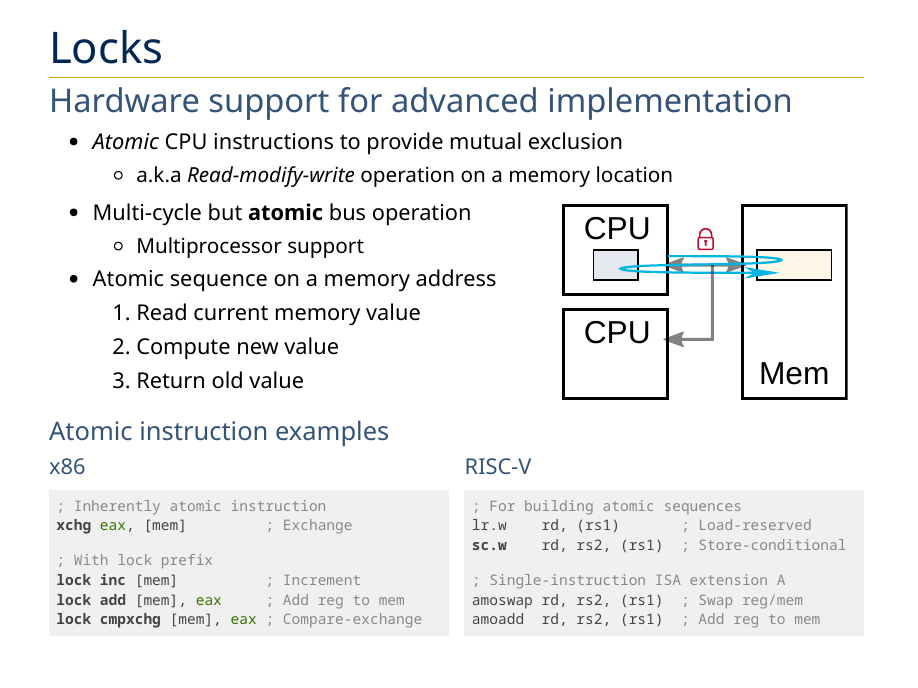
- IE allows a CPU to dominate/ensure that memory read/modify/write operation is safe, despite hardware implementation regarding interrupts/competition
Test-and-Set primitive
In order to take advantage of hardware support, we can write inline assembly
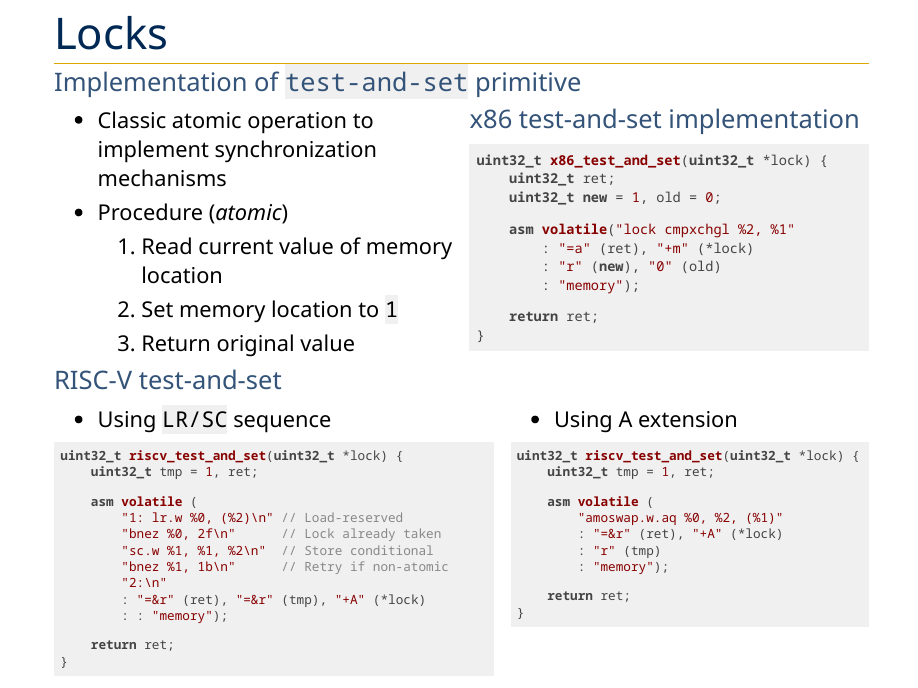
To implement synchronization, use this atomic procedure
- Read current value of memory location
- Set memory location to 1
- Return original value
Now, we have an atomic procedure to probe the memory of a
Implementation
void spinlock_lock(int *lock) {
	/* spin until old value was 0 */
	while (test_and_set(lock) == 1);
}
void spinlock_unlock(int *lock) {
	*lock = 0
}
Issues
Busy-waiting wastes CPU cycles
- Only to reduce latency
Solution
Cheap Busy waiting: - Yield/sleep when unable to get the lock
while (test_and_set(lock==1)) { thread_yield() }
Cons:
- Yielding still wastes cpu cycles
- Sleeping impacts latency as well
Better: Block thread until they can proceed
while (test_and_set(lock==1)) { thread_block(lock) }
Examples:- Semaphores
- Mutexes
Semaphores
Invented by Dijkstra in the 60s
Semaphore:
- A generalized lock
- Used for different types of synchronization (including mutual exclusion)
- Tracks an arbitrary resource count
- Queue of threads waiting to access resource
Kind of a line with posibililty for multiple resources to share
Like a line for a restaurant. A queue for multiple spots.
API
Initial count value (not a maximum value)
sem = sem_create(count)down()orP()- Decrement by one, or block if already 0
up()orV()- Increment by one, and wake up a waiting thread if they exist
🔗 -> Links
Resources
- Put useful links here
Connections
- Link all related words