📗 -> 01/16/26: ECS150-L6
🎤 Vocab
❗ Unit and Larger Context
Discussion:
- Covering project 1.2
Lect:
- Sys Calls and Signals
file_descriptors.c- Demo, showing file descriptors- Linux, everything is a file. Writing to term
echo hello > dev/pts/23- Inside
/proc/617894/fd/?
- Inside
- He also includes
file_descriptors.txtto describe the code in words
- Linux, everything is a file. Writing to term
- Starting on lec4, OS structure
✒️ -> Scratch Notes
Signals
Form of interprocess communication (IPC)
About 30 diff signals (man 7 signals)
OS Structure
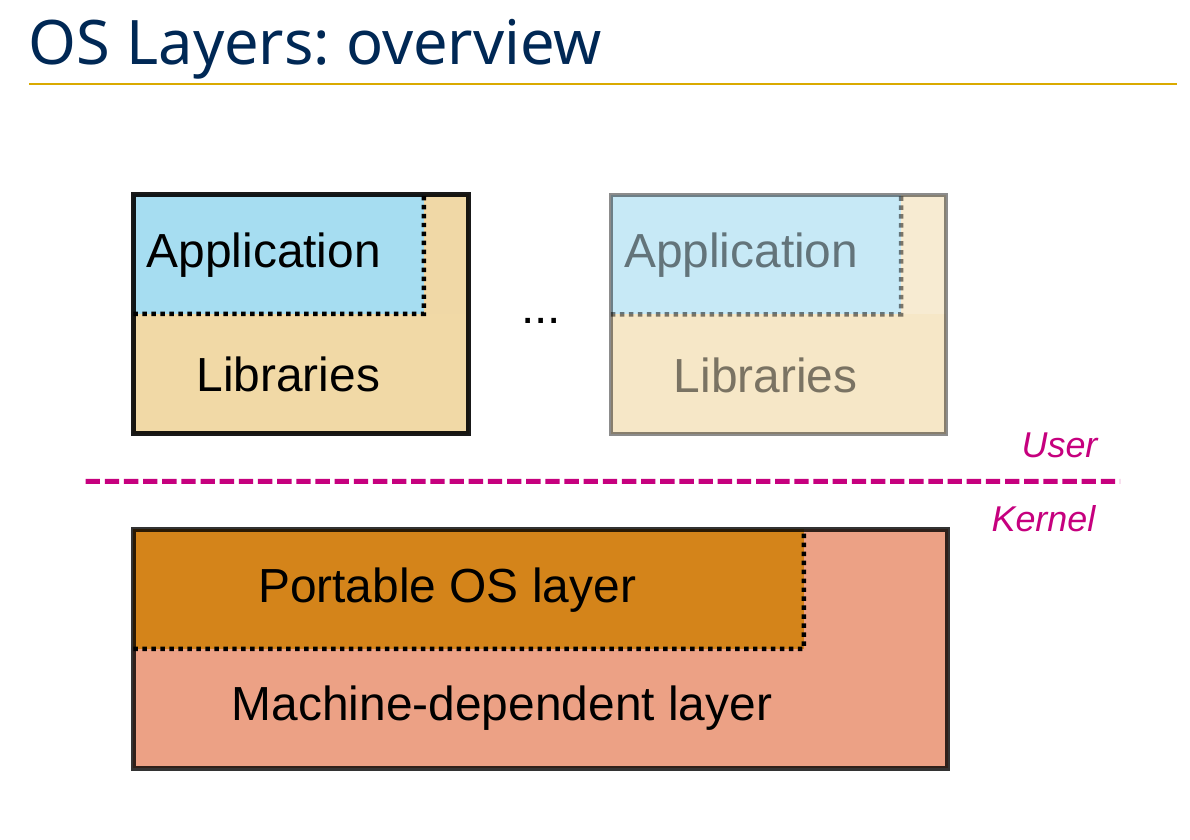
Apps:
User function calls, by programmers (int main type things)
Libraries (in C)
Declaration:
- via standard headers
Definition - pre compiled objects (
libc.so.6,libc.a,libm.so) - input to linker (
gcc -lc -lm)
Code inclusion - included in exec directly (
gcc -static) - or resolved at load-time
Compilation
GCC can pre-process, compile, assemble and link together
- Preprocessor (cpp) transform program before compilation
.c -> .iscript.i
- Compiler (cc) compiles a program into assembly code
.i -> .s- Assembly, readable but obtuse
script.s
- Assembler (as) compiles assembly code into relocatable object file
.s -> .o- Binary, not human readable
script.o
- Linker (ld) links object files into an executable
script(ora.out)
Linking
Generally loaded dynamically (unless compiled statically)
Can check dependencies:
$ ldd a.out # outputs libraries it needs
Aside:
.sofiles are shared object files. They are compiled library files. The same as Windows DLL
Dynamic:
$ gcc cos.c -lm
$ ldd a.out
	libm.so.6
	libc.so.6
	/lib64/ld-linux-x86-64.so.2
$ ls -sh a.out
16K a.out
$ ./a.out 2.0
-0.416147
Static
$ gcc -static cos.c -lm
$ ldd a.out
not a dynamic executable
$ ls -sh a.out
852K a.out
$ ./a.out 2.0
-0.416147
Static compilation MASSIVELY increased the file size
🧪 -> Refresh the Info
Did you generally find the overall content understandable or compelling or relevant or not, and why, or which aspects of the content were most novel or challenging for you and which aspects were most familiar or straightforward?)
Did a specific aspect of the content raise questions for you or relate to other ideas and findings you’ve encountered, or are there other related issues you wish had been covered?)
🔗 -> Links
Resources
- Put useful links here
Connections
- Link all related words