📗 -> 10/18/25: PSC140Y-VL10
[Lecture Slide Link]
🎤 Vocab
✒️ -> Scratch Notes
Motor Development Part 1
Coordinated movements of the muscles and limbs
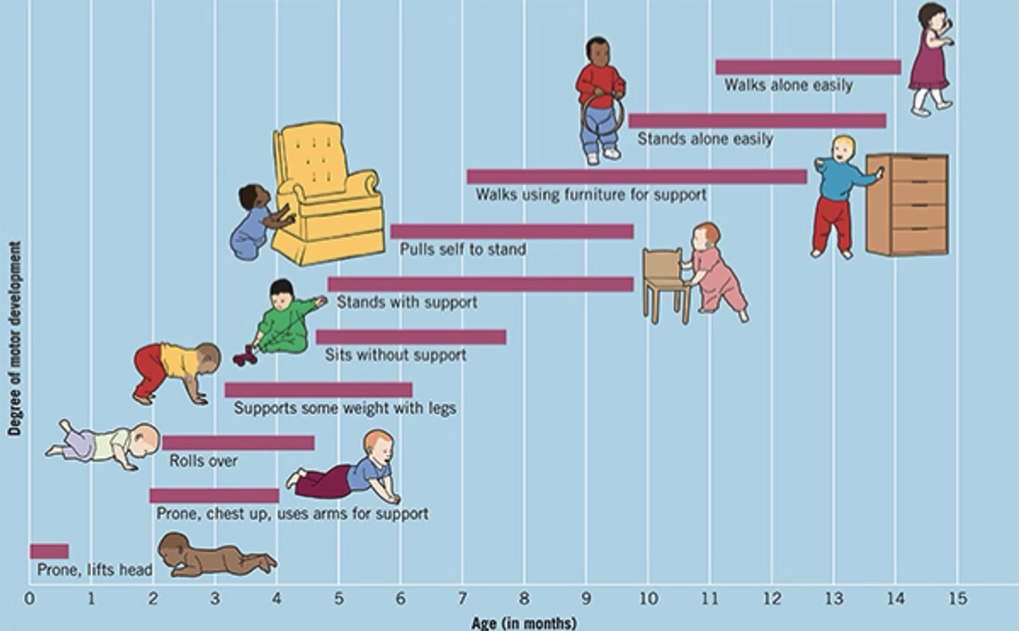
Milestones:
1 - Ability to hold up own head
2 - Ability to sit (trunk strength to hold pose)
3 - Ability to crawl
4 - Walking (Usually around first birthday)
Problems with focusing only on infancy
- Motor development dosent stop at infancy
- Motor development varies with experience
Motor development beyond infancy
Newborns can’t keep head elevated, or control arms and legs
However, beyond learning to walk:
- In 2nd year infants learn to walk backwards, up stairs, stack blocks, put on clothes
- 3 or 4 - jump in place, cut w scissors, draw
- Beyond that - Walk down stairs, ride a trike, skip, use a knife
In infancy: Motor milestones seem to be universal, regardless of experience
However in childhood: seem specialized to culture and context (not everyone learn trikes or stairs)
Motor focused in infancy because these are more universal
Motor development varies with experience
Gesell’s maturational view - motor development reflects biological maturation
- There is a biological program or ‘blueprint’ for motor development
Recently, this view is less supported
At 5 months:
- Depending on country of origin percent of time sitting independtly varies
- In italy, none of the children sat independently while observed (1hr)
- In kenya, many children sat independently, some up to half the time observed
- OPPORTUNITY to sit also varied
- In italy, far more common to be in mothers arm
- in kenya, a lot more time on floor
Tajik Children Observation
- Effect of early motor opportunity/development in late development
- Across many different Tajik children were generally very similar to US, and when not extremely similar to themselves (when comparing early/late Tajik learners)
🧪 -> Refresh the Info
Did you generally find the overall content understandable or compelling or relevant or not, and why, or which aspects of the content were most novel or challenging for you and which aspects were most familiar or straightforward?)
Did a specific aspect of the content raise questions for you or relate to other ideas and findings you’ve encountered, or are there other related issues you wish had been covered?)
🔗 -> Links
Resources
- Put useful links here
Connections
- Link all related words