Dataview
LIST
FROM #Collection
WHERE file.name = this.Entry-For
📗 -> John Nadra Neurotech Talk
❗ Information
How John Nadra became John Nadra PHD
Academics
AA in Psych and Soc at CC
BA in Psych from Sonoma State
- Cog neuro lab
- presented posters
Ph.D. and Masters at Davis - Publish papers, TA, fellowships
Post Doc and Lecturer at Davis - Papers, teach, fellowships
Non Academic
Grew up in Stockton and NY, did not know/like academia. No academics in life.
✒️ -> Scratch Notes
Electrophysiological Correlates of Willed Attention
What do you do? - from family over & over again
Attention
William James 1890 quote. “Everyone knows what attention is.”
Operational Def:
- Attention is the ability to focus one’s awareness on relevant events and objects while ignoring distractions
Background: Voluntary attention
Posner task:
- Primary way to test voluntary attention
- Attend right or left
- Cue -> SOA -> Target -> REsponse
- SOA -
synchronousstimulus onset asynchrony?
He doesn’t think this is a good way to study attention
Willed attention
- Cue -> SOA -> Target -> Response -> SOA -> Report
- Bengson et al. 2014
In posner task you aren’t making a choice. Doing what told.
Instead, generate your own decision. This is the crux of willed atention
Self-initiated attnetion, in the abscence of external cues
MInimized external influence, pushing for internally-driven attentional shift
Known neural mechanisms of willed attention (EEG)
Predictive alpha-band activity precedes the onset of a cue
- Signal in the brain is biasing decision to attend before the prompt to choose occurs
(-800 - 0) Found a significant difference in the brain predicting their choice. See what their brain is going to choose on a trial by trial basis.
(-1700 - -900) Found that this effect vanishes
Why study?
- BCI
- Could predict choices before their presented? didn’t understand
- Free will
- Libet’s work about intention to act originating before conscious awareness of wanting to move finger
Electrophysiological Correlates of Willed Attention
- Temporal dynamics of covert willed attention
Overt willed attention in visual searchColor-willed attention
Experiment 1 - Temporal dynamics of covert willed attention
- Filly willed attention
- Participants directing and redirecting attention whenever they wanted. Not being directed by experimenter
- Decision to shift attention when and where
- Analysis focused relative to button press
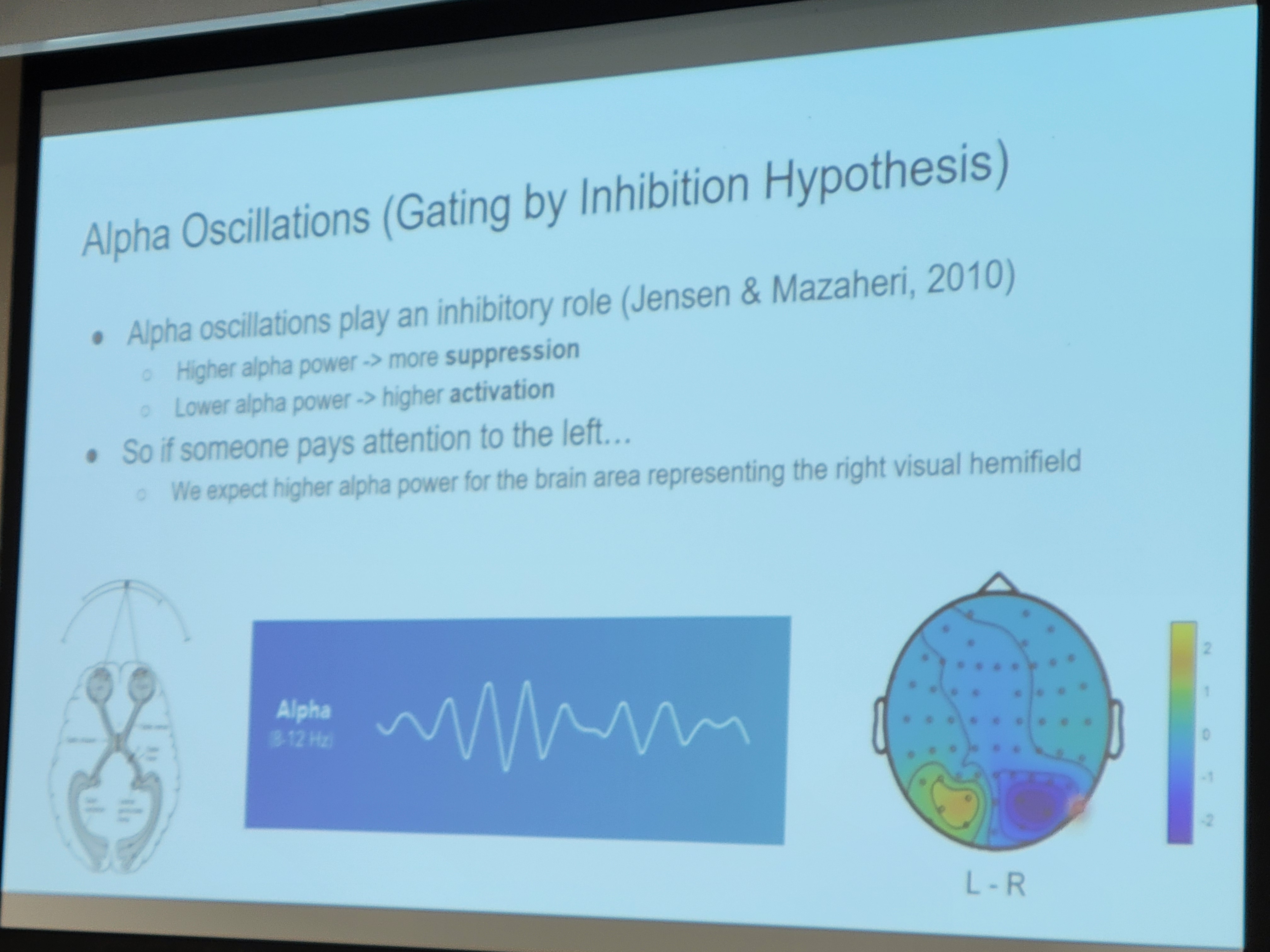
- Signaling active attention
Alpha - To pay attention in right, you have to inhibit left
- You will see more alpha band power when you are inhibiting something
- More in left, less in right
SVM Decoding
- Feed in classes of data.
- Provide a set ratio of data to training an test.
- SVM distinguishes between classes (hyperplane).
- Cross-validation (shuffle train and test and run again).
- Compare true labels with predicted labels.
- Compare test against chance.
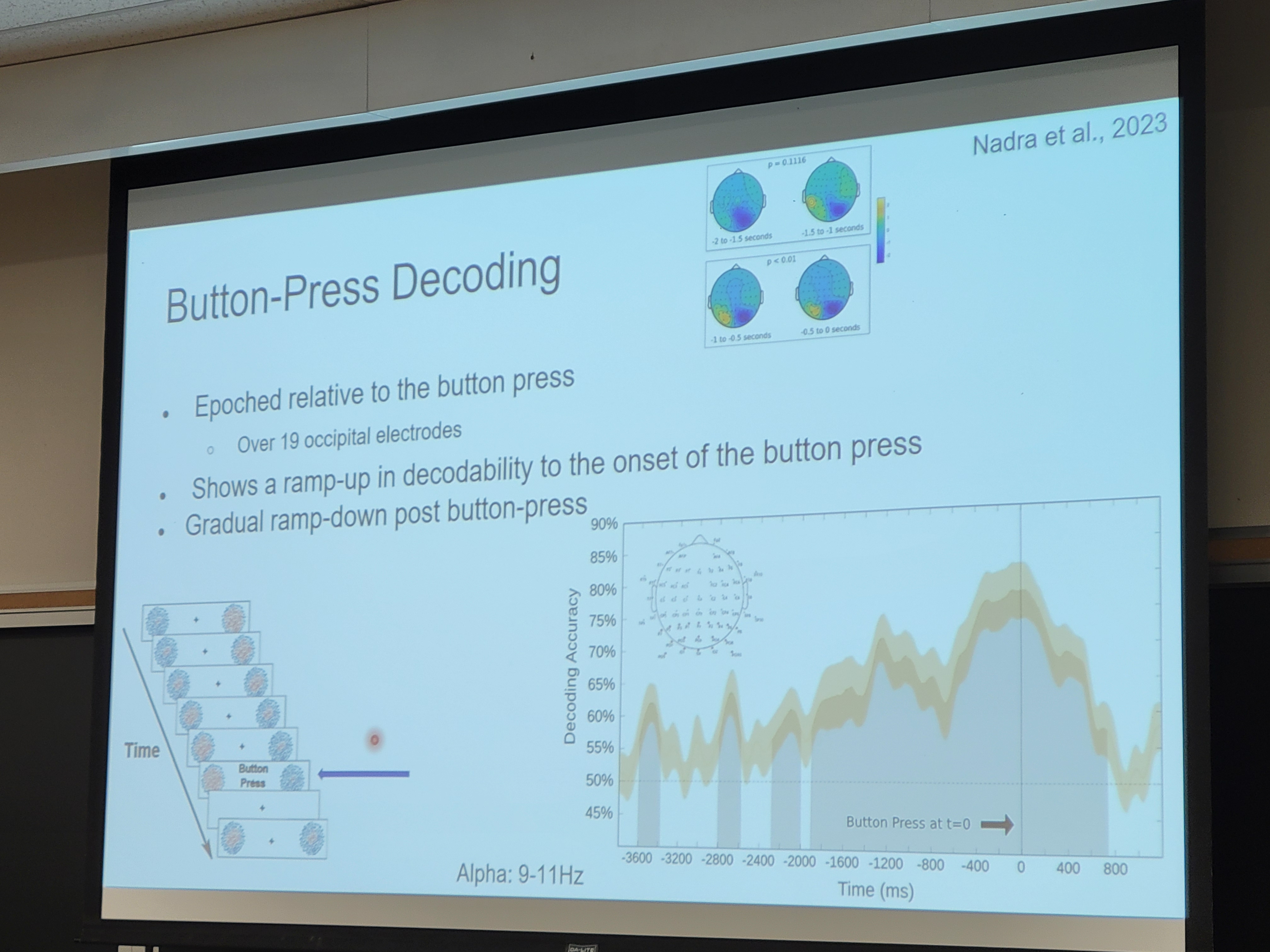
Button Press Decoding
- Epoched relative to the button press
- Over 19 occipital electrodes
- Shows a ramp-up in decodability to the onset of the button press
- Gradual ramp-down post button-press
CSD Analyses
- Alpha band CSD topographic maps
- Alpha band CSD posterior electrode decoding
Mu rythm over motor cortex predicting button press? - Did a control, did not find highly significant findings
Conclusion
- Developed a unique paradigm that breaks out of the cue-to-target standard
- Replicaed the classic alpha-lateralization found in cued attention without cues
- First study to do so; important for future BCIs
Research is EXPENSIVE. Running a lab burns money. Land space, equipment, participants…
Q&A
Pressing a button small enough for no artifact. Motor signal in brain is a factor though.
Rock Paper Scissors intention study.
Decision network stuff?
Ron Mangun and Mike Gazzaniga (Michael S. Gazzaniga) best neuroscientists
🔗 -> Links
Resources
- Put useful links here
Connections
- Link all related words