Dataview
LIST
FROM #Collection
WHERE file.name = this.Entry-For
Laminar Circuit Motifs for Language (Precursors) and Mind: From Cells to Systems
🎤 Vocab
❗ Information
Description
Chris Petkov is Professor and Vice Chair of Research in the Department of Neurosurgery at the University of Iowa, USA where he is now based. He is also Professor of Comparative Neuropsychology at Newcastle University Medical School in the UK. Chris leads an international research program focused on understanding neuronal system mechanisms for human language and memory functions grounded in fundamental comparative research with a primate model the laboratory has developed. The program of work relies on combining advanced neurophysiological and neuroimaging techniques with causal neural system perturbation. Chris trained at the National Institutes of Health, USA prior to completing his PhD in systems neuroscience at the University of California, Davis, USA. He was an Alexander von Humboldt fellow at the Max Planck Institute for Biological Cybernetics in Germany after which he established his comparative neuropsychology laboratory at Newcastle University Medical School in the United Kingdom. The laboratory is now transatlantic thanks to and in partnership with Dr Yuki Kikuchi who leads the UK funded work at Newcastle University (MRC and BBSRC). He has held Wellcome Trust and European Research Council awards, and the research program is funded by joint UK, National Institutes of Health and National Science Foundation initiatives.
✒️ -> Scratch Notes
Talk Sections
- System perturbation & functional imaging (es-fMRI)
- Laminar circuit motifs for language (precursors) & mind
- Sequences for memory & prediction (comparative human and nonhuman primate work)
Human Language and Memory System
Hagoort (2019) Science has a good diagram for the language relevant connectome
- Arcuate fasc. (long)
Ventral Pathways - Semantic Knowledge, Concepts and Identity
- Perrodin et al 2015 TiCS review
Dorsal Pathways - Combinatorics and Sequencing
Comparative Systems Neuroscience
Do humans and primates have similar methods of cognition?
Auditoy Prototype for Arcuate Fasciculus was found in 2020
- Auditory localizers + diffusion MRI
Mnemoni cand Communication System Effective Connectivity - Combined electrical stim + fMRI
- stimulate the brain during functional imaging, and watch as connected areas light up
- Chart network connectivity step by step
Hypothesis 1: Species Differences
Stronger VLPFC (Areas 44/45) and hippocampal effective connectivity in humans
However, elicited area reactions didn’t seem that different from humans. “Symmetrical” connectivity when stimulated
Electrical Tractography - Stimulate along a ---- and record what it induces in the rest of the brain
- Can also do it the other way, check if connection is bidirectional or not
- Measure component peak latencies
- “Normalized Laplacian amplitude”
Hypothesis 2 Supported: Species Correspondence
Laminar circuit motifs for language & WM
System wide imaging (fMRI) Plane Routes between countries
Neuronal Circuits City Highways
The brain’s vehicles and gene expression == Individual cars
Laminar Circuit Motif Hypotheses
Models between cortex layer. Do they inhibit each other? Excite? Where does each project to?
Laminar DLPFC recordings - DBS (deep brain stim) patients
(DLPFC - Middle frontal gyrus: Brodmann 46/9)
Record using a tiny rod/thread thing (250 microns)
- Challenging to target useful areas, but you can target person specific areas by doing fMRI screening and aiming for ‘language blobs’
Record from the area during a WM task (maintain a two word pair “blue car”, and alphabetize it). Results in 4 conditions (grammatical ordering | shift required)
- Raster plots taken of Listen period, Delay period, and Answer period
- Interesting population level rhythmic activity in Delay period
Different connectivity from layer to layer, we see different patterns in different conditions (for example, layer 6b which is super deep is very active in speaking, net inflow)
Laminar fMRI - prelim results
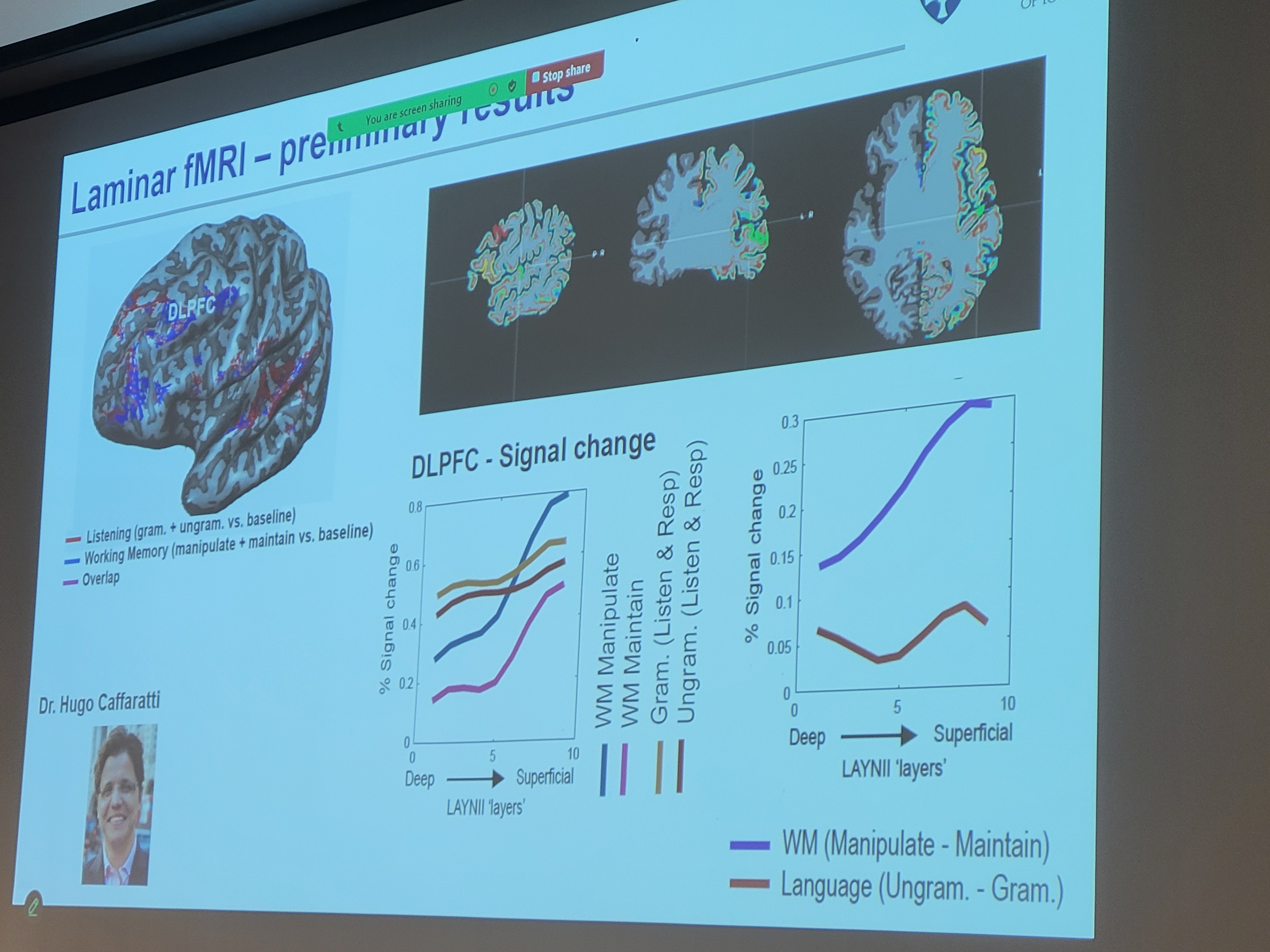
Ended before sequential behavior
🧪 -> Refresh the Info
Did you generally find the overall content understandable or compelling or relevant or not, and why, or which aspects of the reading were most novel or challenging for you and which aspects were most familiar or straightforward?)
Did a specific aspect of the reading raise questions for you or relate to other ideas and findings you’ve encountered, or are there other related issues you wish had been covered?)
🔗 -> Links
Resources
- Put useful links here
Connections
- Link all related words