Dataview
LIST
FROM #Collection
WHERE file.name = this.Entry-For
Insert entry name
🎤 Vocab
❗ Information
Abstract
The human brain undergoes dramatic shifts in cellular composition, activity, and connectivity across the lifespan. This talk will showcase new research on network dynamics supporting memory and control processes in children, young adults, and older adults. A common theme is the role of rhythmic theta networks underlying cognitive performance. Theta rhythms mature from childhood into young adulthood, mirroring changes brain structure, and strengthened theta networks explain developmental improvements in memory. In young adults, theta rhythms support multiple cognitive processes associated with different brain networks. In older adults, manipulating theta networks improves cognitive performance and intervention efficacy reflects individual brain structure. Understanding lifespan neurophysiology carries broad impact for early detection of dysfunction and the design of therapeutic interventions.Bio
Dr. Johnson directs the Dynamic Brain Laboratory at Northwestern University. She studies the brain dynamics underlying memory encoding, retrieval, and use across the human lifespan, from neurons to large-scale networks. Research combines methods from cognitive psychology and human neuroscience, including invasive and noninvasive electrophysiology, electrical stimulation, structural neuroimaging, and eye tracking. Research outcomes advance basic science and translate to better quality of life by revealing how, and in whom, cognitive decline may be prevented or remediated. She holds a PhD in Cognitive Neuroscience from the University of California, Berkeley, and a BA in Psychology from the University of Chicago
✒️ -> Scratch Notes
Land more on the basic science, aim to be “leveraged”
when no stimulus presented to visual cortex, high tonic fluctuating iEEG presents itself.
HFB (high frequency broadband)
Brain rythms (BRs) coordinate local spiking and interregional connectivity
- BRs change across development
10Hz freq, (adult freq) around age 12
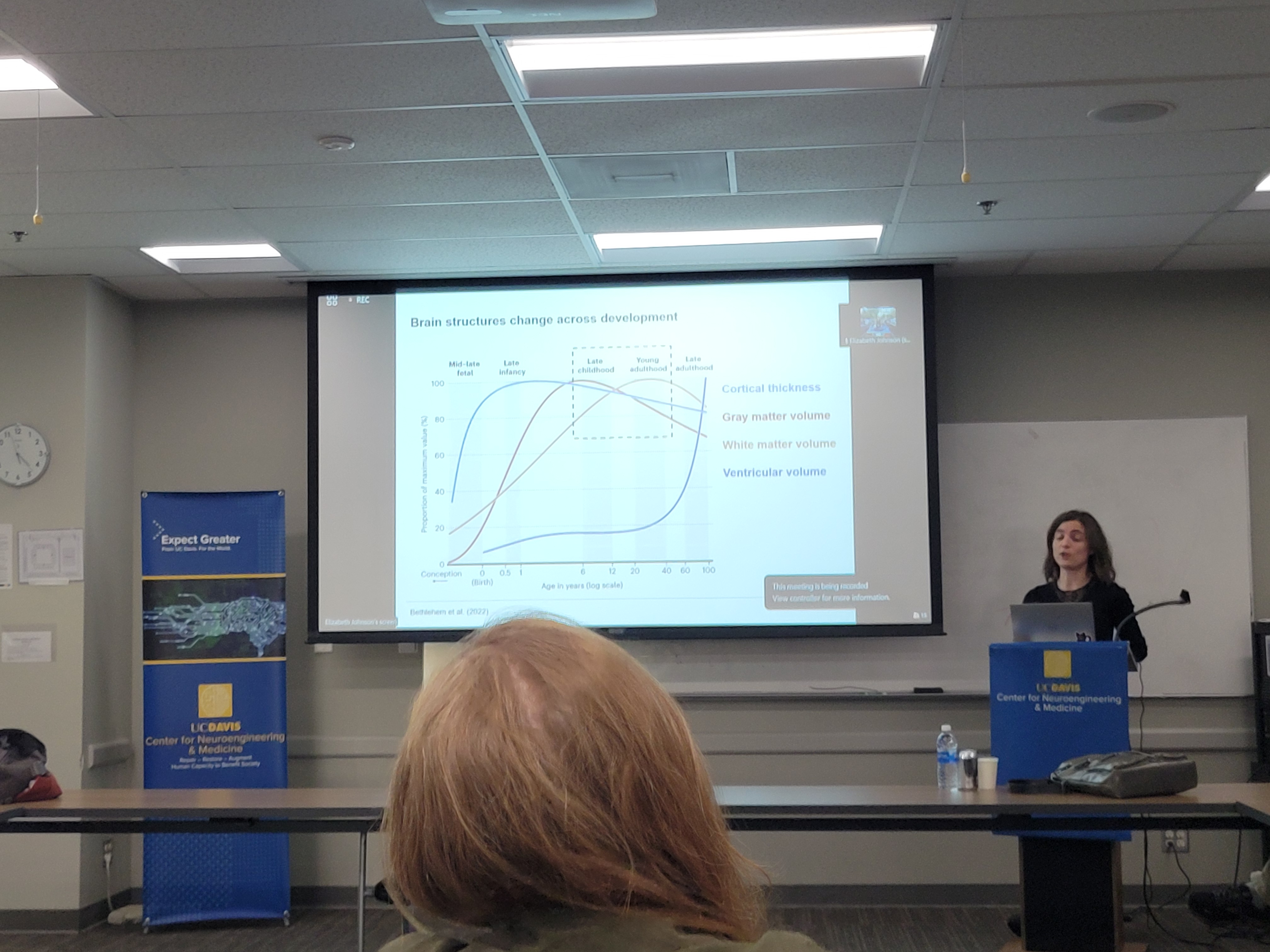
- white matter mirrors thinking behaviors. Peak in young adulthood
What is DTI? Connectivity?
- EDIT: diffusion tensor imaging
iEEG is great access to brain
- high spatial and temp res
- High SNR (signal2noise ratio)
Theta band seperates across development
- Seperate into key regions
- e
Frontotemporal connectivity predicts developmental gains in memory
cingulum/uncinate most plasuable canditates of connectivity?
- from grey to white matter?
Top performing adolescents had strong cingulum development
MTL and PFC interact through distinct mechanisms, that predict memory formations
Late adolescence and young adulthood associated with top performance
REgions of interest:
- Hip - Hippocampus
- PHG - parahippocampal gyrus
- ACC - anterior cingulate cortex
- dlPFC - dorsolateral pfc
- pPFC - polar PFC
Focus on High-frequency brodband (HFB) that tracks local neuronal activity - Align data to HFB peaks in single trials
- Compute memory effects in interregional synchrony
- Remembered vs forgotten?
- illuminantes dynamics of memory encoding
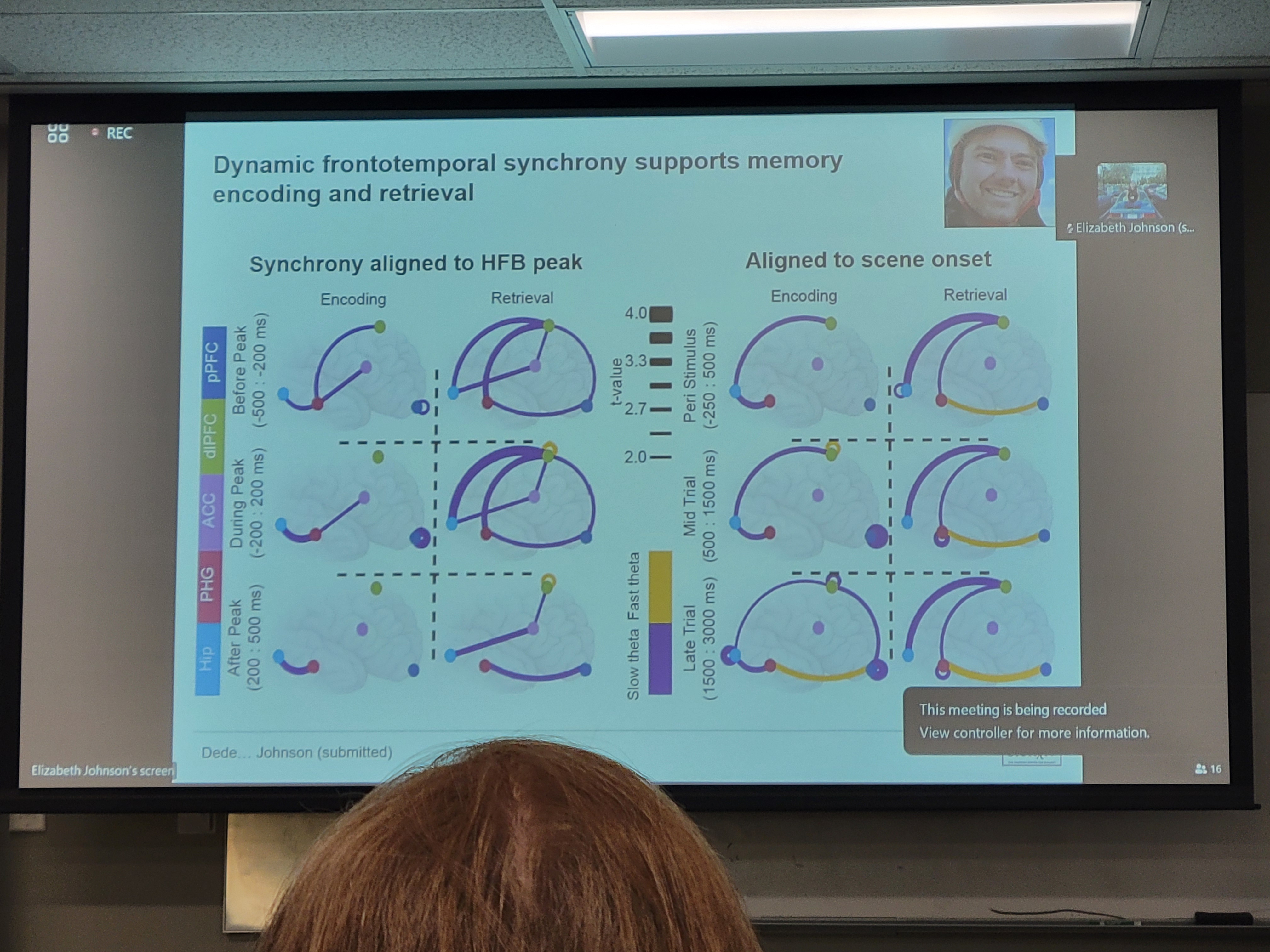
- regions of MTL are synchronzied in slow theta band regardless of data alignment
- others can vary (pfc?)
during retrieval, they are desyncrhonized
based on results, memory dynamics dependent on alignment.
- Specific connections matter more than more general connections.
- Challenging dominant theory that more = better
new task about WM and task relevant info
theta rythms hypothesized to gate info, selectively letting info thru
hypothesis: theta rythms dually accumulat etask-relevant info in and …block?
default mode netwrok synchs with limbinc network to close the gate and filter information
shiftign theta networks filter in relevant and block irrelevant info
- previosuly attributed to striatum
- ventral attention blocks
- dorsal attention allows
- default mode?
so far: cortical theta rythms iff across development and reflect maturation of brain
young adults
investigate whether manipulating networks, imporves older adult performance
- neurostimulation
- eeg
- DTI - diffusion tractography?
- EDIT: diffusion tensor imaging is DTI. Diffusion Tractography is a similar analysis. Both use dMRI, Diffusion MRI
older adults performed a WM task with anodal and control stimulation
theta network enhancement tracked working memory enhancement
tACS - transcranial alternatice stim
Q&A:
Lot of theta, it can overinterefere too, what is sweet spot?
- Hard to say, lots of trial by trial differneces. More connectivity not always better, and thats what theta can do.
- If hit a spot with enough white matter connectivity to hit rest of brain, it can do its job helpfully. “Handwavy” according to her, but its what we see.
- A frequency that helps your brain, hit the right spot. good outcomes
lot of nuance in brain regions.
- could not measure hip driectly, iEEg are strips ontop of cortex directly
- not enough n to sepearate the hip
- hip vs parahip can be studied
- Big theta response in both when u remember, not so much when you dont
- age: para shows higher age effects that hip
- Mirrors structural maturation of brain
schizophrenia and WM?
- none of patients are psychiatric.
- research can serve as a baseline though!
- understanding network basis of memory is necessary for seeing how they go wrong
🧪 -> Refresh the Info
Did you generally find the overall content understandable or compelling or relevant or not, and why, or which aspects of the reading were most novel or challenging for you and which aspects were most familiar or straightforward?)
Hmm still feels like i'm getting closer to understanding what talks are about, but I need to specifically study graph literacy. The keywords they use still escape me, and the utility of graph metrics again escape me.

Very interesting work on the utility of network level analysis though, the fact that stimulation can enhance task performance has exciting implications.

Also, the idea of specific connections being more important than general connections, and the idea of overconnection being bad are both interesting. I wonder why that is, and how those can be studied.
Did a specific aspect of the reading raise questions for you or relate to other ideas and findings you’ve encountered, or are there other related issues you wish had been covered?)
🔗 -> Links
Resources
- Put useful links here
Connections
- Link all related words