Dataview
LIST
FROM #Collection
WHERE file.name = this.Entry-For
📗 -> 10/4/24: Lexical representation and access
Details
Link
Alfonso Carramaza, Ph.D.
- Daniel and Amy Starch Professor of Psychology
- Harvard University
Lexical representation and access: The indispensable contribution from neuropsychology
How is knowledge of words – their form, their meaning, their grammatical properties – organized and represented in the mind/brain? The received view in psycholinguistics draws a distinction between a modality-neutral level of lexical representation (lemma) that is intermediate between lexical-semantic representations and a modality-specific lexical representation (Lexeme). I review evidence from disorders of lexical processing that are problematic for this theory and propose an alternative that dispenses with the lemma level of representation. This alternative model assumes that the first stage of lexical access involves the selection of semantically and syntactically specified modality-specific lexical forms (lexemes) followed by a second stage that involves the selection of specific phonological or orthographic content for the selected lexemes.
🎤 Vocab
Lexical - Of or relating to the vocabulary, words, or morphemes of a language.
❗ Information
Small summary
✒️ -> Scratch Notes
Central Challenge in Psycholinguistics and Neurolinguistics
A Pipeline:
- Recognition Processes
- Semantics
- Lexicon
- Segments
- Articulatory Processes
A central challenge concerts the relationship among meaning and grammatical and form properties of words and their neural instantiation
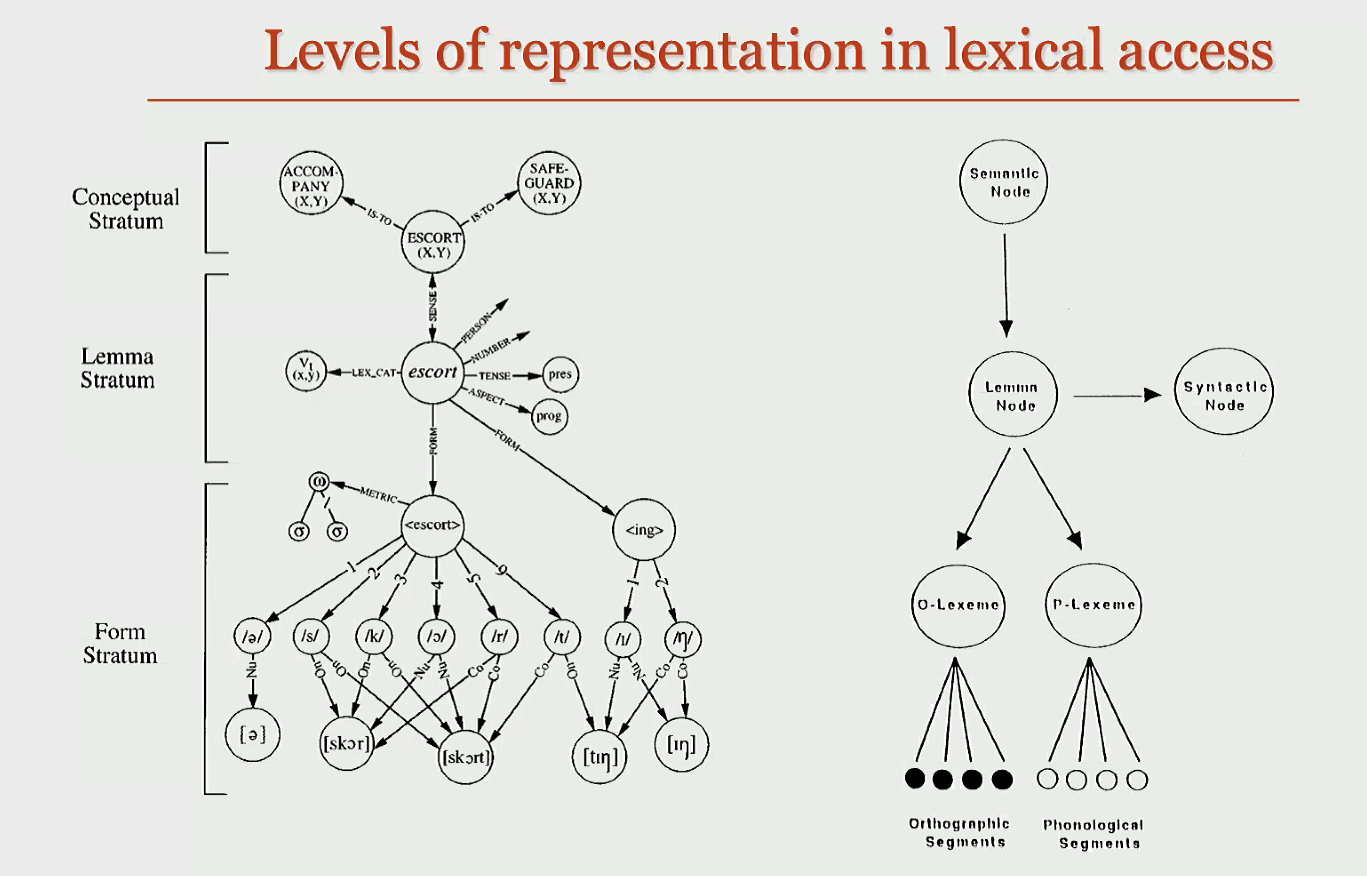
Conceptual Stratum - Semantics:
Knowledge of what a word is meant to capture. The entirety of what a chair could and does mean
Lemma Stratum - Abstract Rep. that is Syntactically Specified
Represents that a car is a noun?
Form Stratum - A Lexeme:
Phonological representation / link to components of representation
What evidence do we have for hypothetical representations?
Not much, in cog sci they must be inferred, not observed. Abstract observations like reaction times (RT).
Is there a better way to get a peek inside?
We look into grammatical class and modality
Cognitive Neuropsych as a window into the mind
Brain damage sometimes results in hihgly informative dissociations between cogntiive modules or operations helping reval the components and strucutre of the system
A person who has brain damage might
- Maintain grammar but no meaning (colorless dreams furious…)
- Maintain meaning but not
- grammar
- writing
- phonology
- Ties with my NPB 100 class: damage to Wernicke’s, Broca’s Area
Striking Dissociation
Patient 1 has perfect grammar, but cannot recall specific nouns (he’s grabbing the thing, she’s looking at something)
Patient 2 has nouns but not verbs (The boy is, his cookies, he is uh, his sister, the stool.) (He might write down “The wife is --- the dress”, “The boy --- the fence”, “the boy is move the wood box”)
Warning to research about abilities
You can only observe the output, the failure or success in producing something. Be very careful of the conclusion you draw from it, the results could be explained by any number of errors in the pipeline. Run control tests, and explore avenues of failure.
… continued examples of dissociations of patients having difficulty with noun / verbs.
Interesting technique used!
- Used homonyms, ‘play’ as in playing an instrument, and ‘play’ as in going to the theater play. Saw patients struggle with one and not the other, and distinctions between written and spoken for nouns and verbs separately.
Language production in a primary progressive aphasic: MML
MML Progressive Aphasia
🔗 -> Related Word
- Link all related words