Dataview
LIST
FROM #Collection
WHERE file.name = this.Entry-For
📗 -> 11/6: Neurotechnology to promote long-term recovery after brain and spinal cord injury
🎤 Vocab
Transcutaneous Stimulation - The current passes the skin, not necessarily puncturing
Intra-spinal Micro-Stimulation (ISMS) -
GAP-43 - synaptogenesis marker
Spasticity - A symptom and characteristic of certain neurological conditions. It causes certain muscles to contract all at once. It ranges in severity and can affect movement and speech. There are several treatment options for spasticity, including physical therapy, medication and botulinum toxin injections.
❗ Information
3 Approaches to Restore Function
- Brain-Spinal Interfaces for Reanimation
- Spinal cord optogenetics for plasticity and recovery
- Transcutaneous spinal stimulation for functional recovery
Advantages of Spinal Stim
- More natural recruitment order of motor units
- Smooth grading of force
- Fatigue-resistant contractions
- Cats walked a kilometer instead of less
- Elicit functional muscle synergies or reflex circuits from single stimulating electrodes, reducing number of electrodes and controllers
Cervical ISMS can evoke graded movements
- Small elbow extensions, or large ones
- Not all or nothing
Brain Controlled Spinal Interface (BCSI)
Decode intent via implanted computer <-> Wireless data and power link
Restore muscle function
Spinal stim
spinal injury
decoding movement intention and trigger stimulation on ‘implantable’ device
Promoting Recovery
What if we could make the brain grow and adapt to injuries?
Optogenetic stimulation after spinal cord injury
Light stimulation can cause animal recover to near pre-injury levels with optogenetic stimulation
- Lots of animal models and studies so far
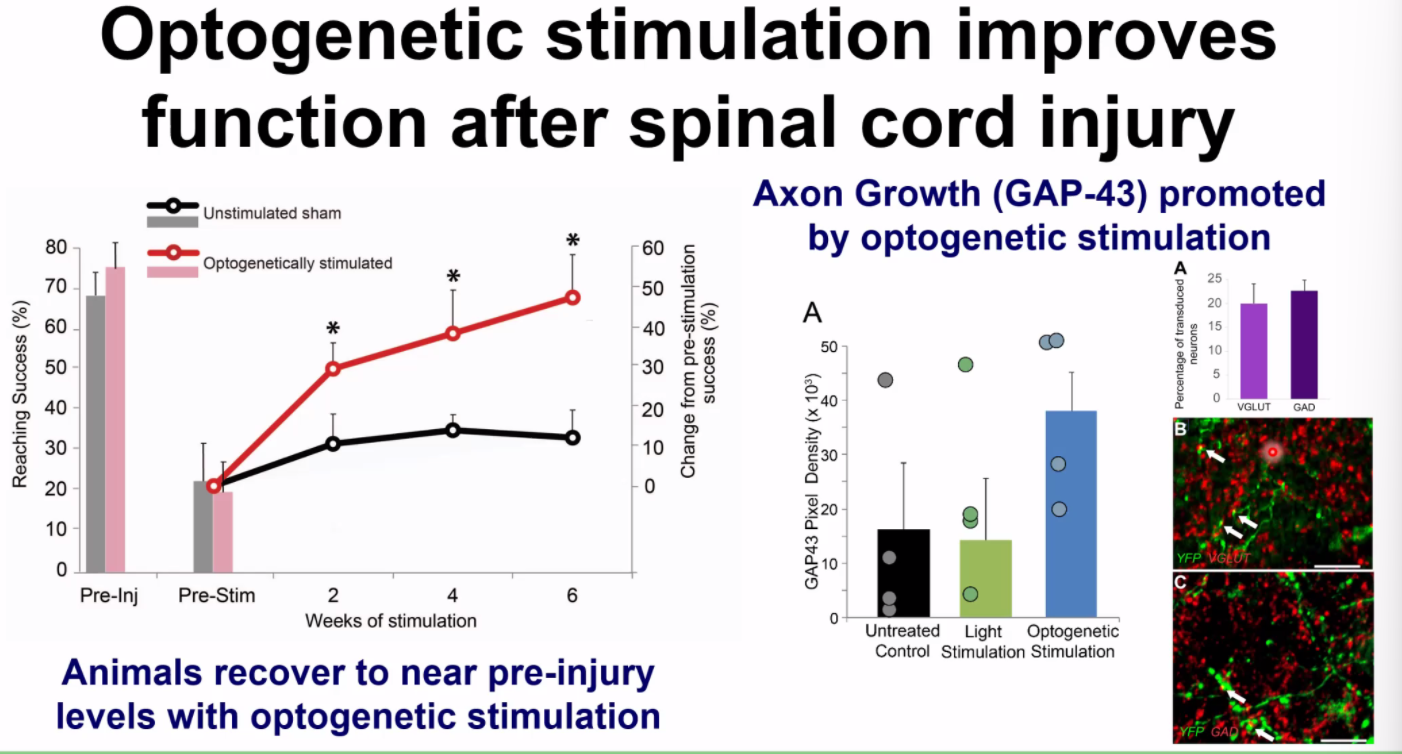
- Synaptogenesis seen to increase
- More axons synapsing
Why so good?
Optogenetics > Epideral
Studies in progress to prove this
Theories:
-
We know its neuron specific
-
Electrical stimulation activites neurons/axons AND astroctyes (other glia too?)
-
Hypothesis 1)
- Something useful about neuron specific stimulation and not glia
Therapy + Transcutaneous spinal stimulation following cervical injury
Very high carrier frequency
- 10kHz carrier frequency permits 5-fold more stimulation to be applied through the skin over the cervical vertebrae
- Empirical studies showing this, but not all gets there. Some gets dissipated, has to get through spine/skin and more
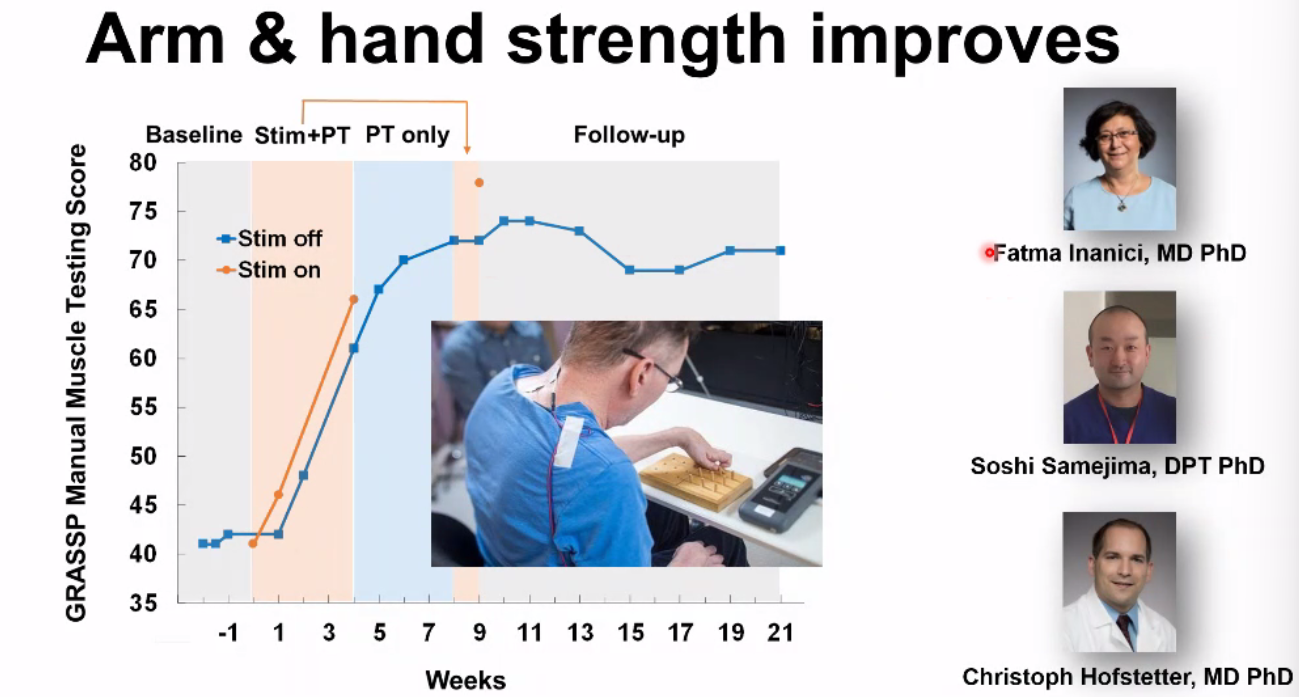
- Empirical studies showing this, but not all gets there. Some gets dissipated, has to get through spine/skin and more
- Patient maintain benefits post therapy
Patients experience:
Patients know its on, so blinding is difficult
“They feel ready to move, like a racer at the start of a race waiting for gun to go off”
“Stimulation is like training wheels”
How?
- Simulation activates spinal networks via sensory afferents below the level of injury
- Simulation permits volitional control of movement and participation in therapy
- Occupational and physical therapy lead to neurplasticity and long-term recovery of function
Theory goes that it gets neurons closer to threshold, and are primed to go off. Make it easy to fire and pair the motor neurons, and practice that until its natural.
72% of patients responded to treatment, compared to FDA 50%
Q&A
What is the market for motion recovery?
Grant funding / Orphan disease fund.
Hand function is the number one priority for people with spinal cord injuries. People with wheelchairs will report this.
Maybe not a ‘market’ question, but there is a high demand.
Secret Sauce of Stimulation. Positive and Negative control with the carrier frequency.
Haven’t done the studies. Allows for a double blinded device.
- People didn’t want it, ‘not innovative enough’
Too early to know, but there are papers both ways. Independent research has suggested yes, but no treatment studies.
Stimulators not easy to get a hold of.
Spasticity?
kind of hand wavy, but…
Inducing action potential in 1A afference, but not enough for motor neurons to fire. Summating, but not going over threshold into somebody wants to move
- Homeostatic plasiticity
- Stretching a muscle makes plasticity better,
“we don’t know, but empirical results show it does”
✒️ -> Scratch Notes
- Log as you go through entry
🧪-> Example
- List examples of where entry contents can fit in a larger context
🔗 -> Links
Resources
- Put useful links here
Connections
- Link all related words