Topics Covered
Chapters
- 1, 2, and parts of 5 in the Harris & Harris book
- Ch.1 - Basics (binary, gates, etc.)
- Ch.2 - Combinational Logic design
- Ch.5.2 & 5.3 - Arithmetic circuits & Number systems
- Some other reading material to give context for K-maps, gates, number systems, etc.
Topics
Technology
What is a CMOS gate? How does it work?
- MOS transistory are buit from silicon, and they allow electrones to flow. Silicon has 4 electrons in its valence shells, and forms lattice bonds, in a 3D crystal structure.
- It becomes a better conductor when dopant atoms are added
- 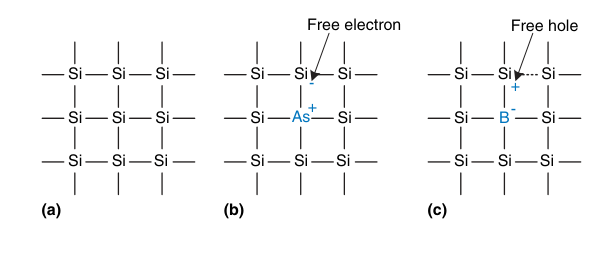
a) Silicon lattice
b) Arsenic (5 e-) lattice with free electron
- Electron creates a negative charge, so this configuration is a n-type dopant
c) Boron (3 e-) lattice with a free hole
- Electron creates a positive charge, so this configuration is a p-type dopant
- The junction between a p-type and n-type silicon is called a diode.
- P-type region is called the anode
- N-type region is called the cathode
- When the voltage on the anode is greater than the cathode, current flows from the cathode to the anode
- Otherwise, no current flow.
- “In summary, CMOS processes give us two types of electrically controlled switches, as shown in Figure 1.31. The voltage at the gate (g) regulates the flow of current between the source (s) and drain (d). nMOS transistors are OFF when the gate is 0 and ON when the gate is 1. pMOS transistors are just the opposite: ON when the gate is 0 and OFF when the gate is 1”
How would I make a NAND or NOR gate using CMOS?
- CMOS-Diagrams
What is the power density problem?
- As components get smaller but have the same amount of power flowing through them, the power density goes up. This makes things run hotter.
Boolean Logic Basic gates and operations
AND, OR, XOR, NOT, NAND, NOR, etc.
- Duh
What is a functionally complete set of gates?
- Being able to express any boolean equation
- Can be simply proved with AND, OR, and NOT
Boolean Algebra - ECS154A-L2
Identities
Axioms
Theorem (DeMorgans)
-
-
Truth Tables
- Duh
Minterms, Maxterms
- Minterm: Where the functions is one (1)
- Maxterm: Where the functions is zero (0)
| A | B | f(a,b) | |
|---|---|---|---|
| 0 | 0 | -> | 0 |
| 0 | 1 | -> | 1 |
| 1 | 0 | -> | 0 |
| 1 | 1 | -> | 1 |
SOP, POS forms of equations
- SOP: Sum Of Products form canonical form.
- the sum (OR) of products (ANDs forming minterms) for which the output is TRUE
- “If its any of these cases/rows, function evaluates to true”
-
- POS: Product Of Sums form canonical form.
- Effectively the DeMorgans negation of SOP. Its just the negation of the false rows ANDed together, with each case linked by AND
- “This function is true only if it avoids all the false cases”
-
- Derivation:
-
-
-
- Both
Minimizing equations
- Use K-Map and circle the largest components.
Karnaugh maps
What they are
How they are related to Truth tables
How and why they are used
Standard Combinational Circuits
Decoder
Encoder
Multiplexer
Demultiplexer
Adder (with and without Carry-lookahead)
Timing of combinational circuits (gate delays)
Designing Combinational circuits
Using basic gates
Using ROMs
Using decoders
Using Multiplexors
Synthesis of Combination Circuits
Adders
Half-adders
Full adders
Ripple-carry adders
Adders using carry-lookahead
ALU’s (Arithmetic Logic Units that do more than just add) (P’s & G’s)
Codes
Hamming distance
BCD Code
One-hot code
Error Detection/Correction
Parity
M-detection N-correction concepts
SECDED