📗 -> 11/4: Function Call Visualization and Matrix Addition in C
🎤 Vocab
❗ Unit and Larger Context
Small summary
✒️ -> Scratch Notes
Leal
Provides an address, does not dereference memory. Copies the address.
Leal d(o,i,s), register
LEA = Load Effective Address
Function Calling
The caller will push args to the stack in reverse order (so the first arg is on top, f(a,b,c) => push c, b, a)
- It also pushes a return label/address to continue execution from
The callee then deals with the EBP, ESP, and maintaining registers
Prologue
Establish the stack frame for the current function
EBP holds the pointer to the start of the stack frame
Stack frame is everything between EBP and ESP
The stack frame gives you a fixed location for accessing locals and arguments
ESP keeps changing throughout the runtime of your function so it makes really hard to keep accessing locals and args through it because it keeps changing
push %ebp
movl %esp, %ebp
subl $num_locals * ws, %esp
Push those registers
EBP Offsets for args:
Positive offsets are function arguments
Negative offsets are local variables
After the prologue of fun1(a,b,c)
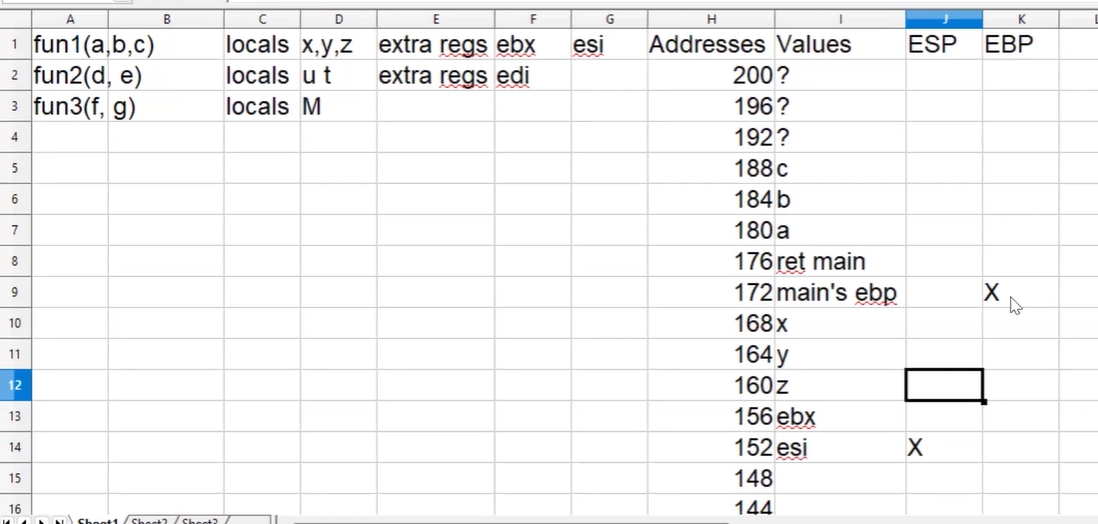
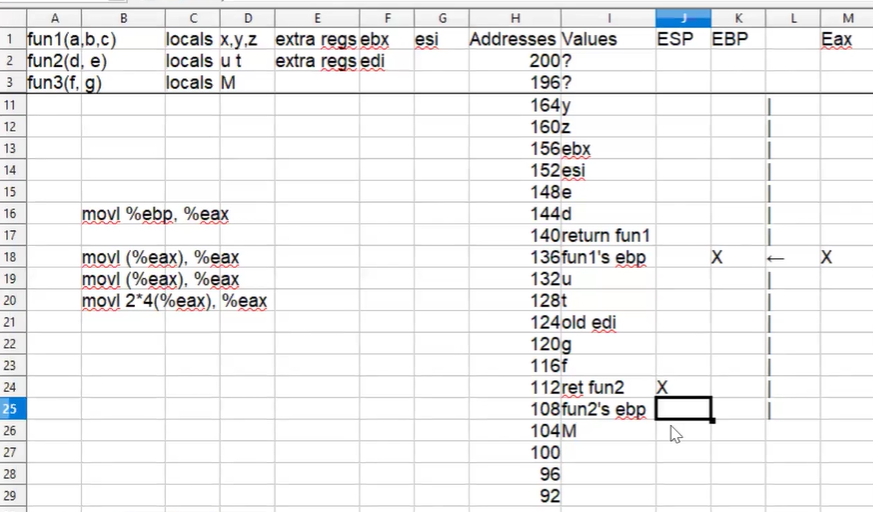
Can move up to a future by following the ebp pointers of call stack
movl %ebp, %eax // ebp into eax
movl (%eax), %eax // following the ebp pointer (fun3->fun2)
movl (%eax), %eax // following the ebp pointer (fun2->fun1)
movl 2*ws(%eax), %eax // accessing the 1st fun1 arg, a
Epilogue
Undoes the prologue
Restore saved registers
Remove the locals
Restore the old stack frame
Pop the saved registers off the stack or move them off the stack
movl %ebp, %esp
pop %ebp
After the epilogue of fun3(f,g)
Calling Malloc
A function, like any other. Feed it args through stack
- Can multiply by 4 (ws) fast with
shll $2, %eax (shift left 2 bits)
push %eax
call malloc        # return value is in eax
movl %eax, C(%ebp) # moving it to our local C variable
addl $1*ws, %esp   # remove our arg from the stack
🔗 -> Links
Resources
- Put useful links here
Connections
- Link all related words