- Review homeworks
- Review midterms
- Review slides
Topics:
Midterm 1
- Intro to course and behavior (basic things like ethogram)
- Orienting movement
- Toad feature localization x2
- Bat echolocation x2
- Barn Owl Sound Localization x2
Midterm 2
- Birdsong x2
- Locomotion
- Crayfish x2
- Fish
NPB162-Midterm2-Prep
Post Midterm
- Navigation and Place Fields
- Olfaction
Midterm 1:
Course Intro
Neuroethology - Neural basis of natural behaviors. Neuro + ethology.
Tinbergen’s Four Questions:
- Ontogeny - How does it develop in an individual
- Mechanism/Causation - What mechanistacally causes the trait
- Phylogeny/Evolution - Evolutioary history?
- Adaptive Significance/Survival Value - How have trait variations influenced fitness
Choosing model system
- Characterize animal - Ethogram: Entire behavioral reportoire of an animal species
- Best model:
- Behavior that is: simple, robust, readily accessible, ethologically relevant
- Animal should be: inexpensive, suitable for lab study, easy to maintain, easy to breed
Ethogram - Entire behavioral reportoire of an animal species
FAP:
- A complex behavior with multiple steps
- Continue to completion despite interruption
- An innate behavior
- Triggered by a sign stimuli
- Releasing value. Bigger means more reliable in eliciting FAP.
Orienting
More FAP
Applying Tinbergen’s Qs
Orienting Movements
C. Elegans:
- What is AFD?
- AIY promotes thermophilic behaviors
- AIZ promotes cryophilic behaviors
- RIA is a controller
Toad Prey Localization
How does a toad recognize prey?
Toad Prey Capture
- Orienting -> Binocular fixation -> Snapping -> Swallowing -> Wiping mouth
Toad Visual System - Projections from the retina to the optic tectum and thalamic pretectum (TP) through the optic nerve
- Cross at chiasm
Receptive Visual Fields & Responses
- Cross at chiasm
- RGCs and LGNs
- On/Off surround
- Responds to ERF, inhibited by IRF (_ Receptive Field)
- Thalamic pretectal neuron, Type TH3m aka TP3
- Activated by stimuli eliciting evasion
- Square > Antiworm > Worm
- If lesioned, toads will respond to any stimulus. Unable to inhibit for non-prey.
- Tectal Neuron Type T5 (1)
- Longer stimulus in the direction of movement: strongest response
- Square > Worm > Antiworm
- Tectal Neuron Type T5 (2)
- Response biggest with size in axis perpendicular to direction of movement
- Worm > Square > Antiworm
- BEST MATCH TO BEHAVIOR
- Stimulation in thalamic pretectum causes inhibition to these cells
Pathway, involved cells, etc.
Optic Tectum
- Stimulation of a certain part causes turning to a part of the visual field
“The Neural Basis of Visually Guided Behavior” Paper
Bat Echolocation Part 1
Recap of Innate/Learned Behavior
Active vs Passive Sensory Systems
Sound Equations:
- Speed=Freq x Wavelength
- Resolving Power - Sound reflects:
Wavelength trade offs
FM vs CF-FM
Bat hunting: stages and chirps
Pulse echo
Acoustic Fovea
Doppler Shift - Doppler compensation?
- When does a bat experience them?
- Flutter?
“Biosonar and Neural Computation in Bats” Paper
Bat Echolocation Part 2
Moth resistance - sonar jamming
Bat neuroanatomy
- Outer ear, tympanic membrane, middle ear, oval membrane, cochlea
- Topographic representation
- Acoustic Fovea
- Neural Correlates - NPB162-L5
- REALLY MEMORIZE THIS
Barn Owl Sound Localization (1)
Azimuth vs. Elevation
Intensity Cues - Elevation?
- IID
Timing Cues - Azimuth - ITD
Combining maps?
Neural Correlates - Inferior Colliculus (bats have Inferior Colliculus too?)
- ICC, ICX, ICCls
- Pathways
- Neurons receiving ITD vs ILD
Barn Owl Neural Processing (2)
Neural Pathways - NPB162-L7
- Neurons receiving ITD vs ILD
Jeffress Delay Line Model
Phase Ambiguity
Correlates: - IID
- LDDp
- ITD
- ?
- Inferior Colliculus (bats have Inferior Colliculus too?)
- ICC, ICX, ICCls
Optic Tectum
Prism Experiments
- ICC, ICX, ICCls
“Listening with Two Ears” Required Reading
Midterm 2:
Communication
What’s considered communication?
- Visual Signals (jewelfish, crab claw)
- Acoustic signals (frog)
- Chemical signals (ants)
- Tactile signals (monkeys)
Components of language
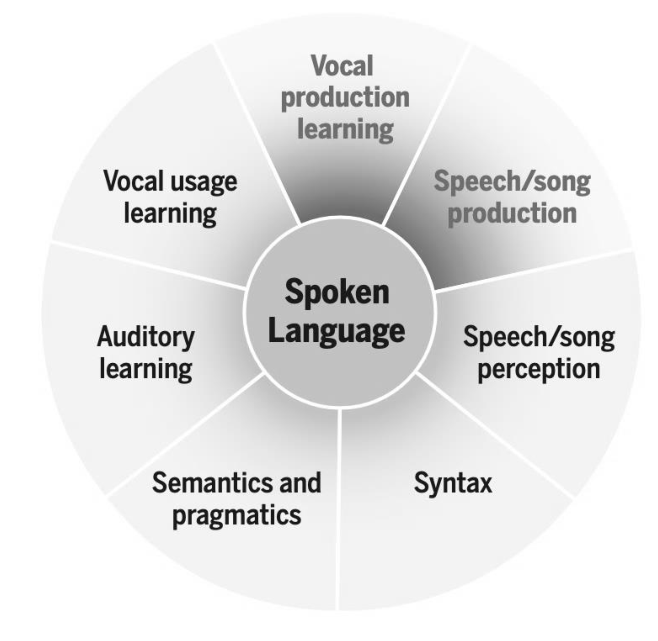
Birdsong 1
Evolution of communication
- Convergent evolution
Songbirds
Song Development - Songbird learning timeline
- Song development timeline
Song-control system pathways (2)
Sexual Dimorphism? (zebra finch)
Hormonal effects: organizational vs activational
Song Development
Zebra Finch song - Structure
- Innate vs Learned
- Directed vs Undirected
Birdsong Motor Control (2)
Review: Song pathways and dimorphism
Neural Correlates
- UVA, HVC, RA, nXllts, Syrinx
- REALLY review HVC
What does: - Sound production
- timing
- stimulating muscles
- song control
- respiration
- vocalization
Birdsong Song Learning (3)
Song Learning is a social process, study different negative outcomes (deprival, etc)
Neural Correlates
- HVC, RA, LMAN, AREA X, DLM
What does: - babbling
- song variability
HVC structure?
So, HVC is:
- A sensory area,
- Involved in Song Production
- Also Involved in Song Learning
Locomotion
Locomotion and rhythmic motor patterns
What are the questions involved in locomotion?
What are the levels of motor complexity in locomotion
Locomotion gait cycle
Reflexes?
Reflex Chains?
CPGs?
Half Center Model
Leeches / Lamprey
Crayfish (1 and 2)
Escape response types
- What are the different flips, and what muscles activated each
Main neuronal players - MG, SG, FF, LG, MoG
Steps of escape response
God awful circuit diagram
LG Circuitry
MG Circuitry
LG Command Neuron tests and Command Neuron def
LG inputs, different types - alpha, beta, gamma
- Short term plasticity and depression
- PAD
Corollary Discharge?
Command derived inhibition
A whole bunch of slides at the end I don’t understand
- PAD
How is escape modulated?
What circuits modulate?
What are the effects of the modulation?
Serotonin
Fish
Overview?
C Response
M-Cells:
- Properties?
- Inputs?
- Cells involved?
M-Cells as command neurons
Social Modulation
Post Midterms:
Navigation and Place Fields
Different modes of navigation
Tools to study spatial navigation in rats
- Why rats?
- What tasks used to investigate spatial learning?
- What strategy do rats actually use to navigate
Effects of hippocampus lesion on performance?
Short introduction about the hippocampus
What is the tri-synaptic circuit? What’s in it?
What about other circuits?
Spatial maps in the hippocampus: place cells - Different recording methods?
- Characteristics of place cells?
- Where in hippocampus are place cells found?
- How do place fields react to rotation?
- Additional properties?
Spatial maps outside the hippocampus: grid cells, head-direction cells, border cells - Areas involved in localization?
- Model of info flow?
- Head cells
- Border cells
- Time cells
- Speed cells
- Grid cells:
- Where found?
- What do they do / how are they organized?
- How can they be characterized?
Olfaction
- Differences and similarities between the Main Olfactory System and the Accessory olfactory system. Included the structures involved.
- Salmon spawning behavior (but not the life cycle in detail)
- Olfactory Imprinting in Ewes. (evidence of imprinting and the importance of olfaction)
- Necrophoresis. Be able to explain what it is and the impact of oleic acid.
- Importance of TRP2 to the accessory olfactory system (Don’t worry about the other molecules)
- Phenotypes/Findings when examining the TRP2 KO, het and WT males.
- Why olfaction is hard to study.