- Table of Songbird Brain Areas and function
LG Circuitry in Class.pdf: NPB 162 001 WQ 2025 - Diagram circuitry
- Does not include the Fast Flexor Inhibitor neuron
Communication
Visual
Jewelfish - Change colors
Fiddler crab - One claw bigger, wave it
Acoustic
Frog - Vocal sac
Chemical
Ants - Secrete trail substance
Touch
Monkeys - Grooming
Spoken Language
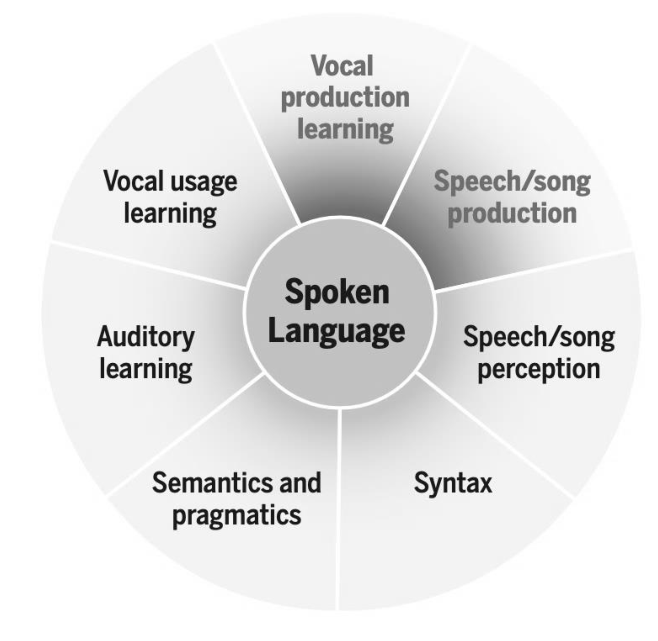
- Auditory Learning - Dogs recognizing words
- Vocal Usage - Dogs barking for food
- Vocal production learning - Songbirds imitating songs
Vocal production learning and speech/song production are the rarest among vertebrates
Birdsong:
UVA - Nucleus uvaeformis, only input to HVC
- Also key to prod
HVC - High Vocal Center - Controls song rythm, cooling heating up experiment
- Sparse encoding
- Does not affect babbling
- Responds to own song
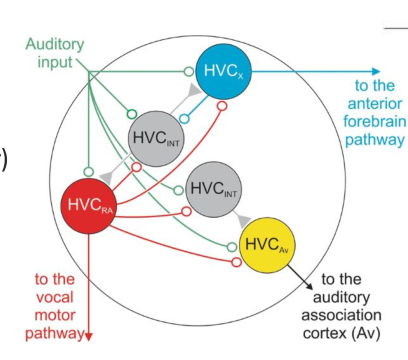
RA - Robust nucleus of the arcopallium - HVC command RA to fire.
- RA determines which muscles combos to fire, combinational coding
nXIIts - Control muscles of vocal areas
Syrinx - Muscles used in song prod
LMAN - Lateral magnocellular nucleus of the naterior nidopallium - Shows premotor activity to babbling, seems to drive subsong prod
- Not needed plastic phase onward for babbling
- LMAN drives song variability! (necessary for learning through trial and error)
Lesioning DLM, or Area X in adults have little effect on already-learned songs, lesions of these areas before song crystallization lead to abnormal songs - Area X - Striatum area x
- DLM - Medial subdivision of the dorsolateral nucleus of the anterior thalamus
Locomotion
Levels of complexity:
- Reflexes
- Reflex chain using sequenced sensation
- CNS generated patterns/rhythm
- Central Pattern Generators
Reflexes - A somatic reflex is an involuntary response to a stimulus, such as pulling one’s hand away after touching a hot stove (external stimulus) or stretching of a muscle as sensed by the muscle spindle (internal stimulus, proprioception).
- Knee jerk
Reflex Chain - a theory that proposes that a cycle of:
- stim -> CNS -> Motor -> Stim -> CNS -> Motor
drives motion. Think of continuously adjusting your balance.
Half center model - A CPG from mutual inhibition central neurons, that fire the flexors and extensors respectively
- “two groups of spinal neurons reciprocally organized and mutually inhibiting each others that are capable of producing the basic rhythm and pattern for stepping.”
For this Model (rhythmic activity) to work you therefore need:
- Something that triggers activation (external excitatory input, spontaneous activity or pacemaker mechanisms)
- Reciprocal Inhibition
- Some mechanism that will turn down/off the inhibition from one neuron to the next after X amount of time (“fatigue”)
This method seems to be very common, lamprey swimming and salamander gait, leech wriggling.
Crayfish
Escape response well studied
![[Crayfish-Escape-Main-Neuronal-Players.png|]]
Main players:
- Medial Giant Neuron/Axon (MG)
- Segmental Gian Neuron (SG)
- Fast Flexor Motor Neurons (FF)
- Lateral Giant Neurons/Axon (LG)
- Giant Motor Neuron (MoG)
Two Giant Cell Escapes:
- MG Flip - If a threat comes from the front, tail flex and shoot animal backwards
- LG flip - If a threat from the rear, flexion between thorax and abdomen so they jack-knife. Animal shoots upwards and forwards.
Big difference between tail flexing in MG and abdomen in LG.
Three steps
- First response
- mediated by Giant interneuron.
- it is very fast and moves animal away from stimulus – but not particularly directed (this is a reflex).
- Second step
- is a slower re-extension of the tail, triggered by a sensory input (water disturbance).
- This returns abdomen to a position where it could flex again for further evasive action. (chain reflex)
- Third step -Swimming behavior
- involving alternating activation of flexors and extensors in an oscillatory circuit.
- Triggered by non-giant interneurons.
- This is a guided steering that completes the evasive maneuver.
Circuitry
When activated, the LG axon (chain of segmental neurons) can activate
- MoGs (giant motor)
- SG (segmental giants)
- Recruit non-G motor and premotor units
- LG neuron circuit inhibits caudal fast flexors (FFs) so that SG will not cause bending at caudal joints during LG flips.
When activated, MG neurons can activate:
- MoGs (giant motor)
- SG (segmental giants)
- Recruit non-G motor and premotor units
- No inhibition compared to the LG circuit. More recruitment of muscles
LG Neurons:
- Correlated
- Time locked, also electrical
- Sufficient
- Fake stim test, innervate directly
- Necessary
- Inactivate, see that it fails to cause motor activity
This makes them a command neuron
- Inactivate, see that it fails to cause motor activity
- The rest of crayfish notes in here, describes synapses and circuits
Modulation
Escape threshold - propensity to fire escape response
- Crayfish change their escape threshold depending on context (e.g. free or restrained)
Test: cut the connective between the brain and the LG.
Result: crayfish fail to modulate their threshold after cut
Social status also modulates tail flip threshold.
- The subordinate animal shows a significantly reduced propensity to execute LG-mediated tail-flips, compared to the dominant, when the two are in the same vicinity.
Serotonin reduces both the α and β components of afferent-induced LG EPSPs in subordinate crayfish (left), but enhances them in dominant crayfish (right).
- Thus, changes in serotonin responsiveness may underlie the behavioral changes
Fish
- Zoom class,
didn’t pay great attentionfell asleep half way through, but have some notes
M Cells:
-
Large neurons, one per half of body in several fish and amphibians
-
Play a role in the C-start escape response (where they flinch, curl away, and then orient away after straightening again)
Properties: -
High threshold
-
Low input resistance (makes it harder to activate)
-
Very negative resting potential
-
Exceptionally short time constant
-
Two large dendrites:
- Lateral
-
Ventral
Large Myelinated Club Ending (LMCEs) afferents
- synapse between the auditory hair cells and the M-cell dendrite.
Commissural Passive Hyperpolarizing Potential (PHP) interneurons
- Feedforward inhibition
- Sound stim input
- The PHP neurons themselves inhibit both the contralateral and ipsilateral M-cells through an electrical inhibition (mediated by electric fields, see next slide) + chemical inhibition (glycine).
Axon Cap: it is a thick, sheath-like
capsule, composed of glial cells and
connective tissue, which surrounds
the axon hillock and which has very
high electrical resistance.
Fish has multiple fast escapes, but M-cell escape is the FASTEST
Crayfish and fish, dominant are more escape prone
- The dominant males become brightly hued, and subordinates look greyish. This
attracts both females and predators (so dominants need a stronger escape
response to balance the enhanced risk of predation that accompanies elevated
social status).