📗 -> 02/06/25: NPB162-L10
🎤 Vocab
❗ Unit and Larger Context
Small summary
✒️ -> Scratch Notes
Convergent evolution: creates analogous structures that have similar form or function but were not present in the last common ancestor of those groups.
40% of birds are songbirds
- Many birds sing to attract mates, but songbird songs are special because they are depend on auditory and vocal experience
- Songbirds learn their communication, making them similar to humans. (songs not innate)
Why study Birdsong?
- easily observed and measured behavior
- clearly dependent (like many complex behaviors) on internal state and motivation
- there’s nice specialized circuitry to produce and represent song
- neural control of motor behaviors
- good model system for vocal and motor learning, too.
- Mammals: humans, cetaceans, some bats
- Birds: songbirds, parrots, some hummingbirds
Songbird brains are different from non-songbirds (more complex, diff areas)
Songbirds Learning
- They have a sensitive period where they can absorb song, and it is then crystallized in adulthood (in zebra finch, 25-80 days)
- Subsong → first vocalizations (~30-40 days after hatching) (babbling)
- Plastic Song → a song that resembles the tutor song (more than the subsong) but can still be altered (starts at ~50-70 days old).
- Crystallized Song → Finalization of learning. It resembles the tutor song (~90-100 days old)
Control Pathways
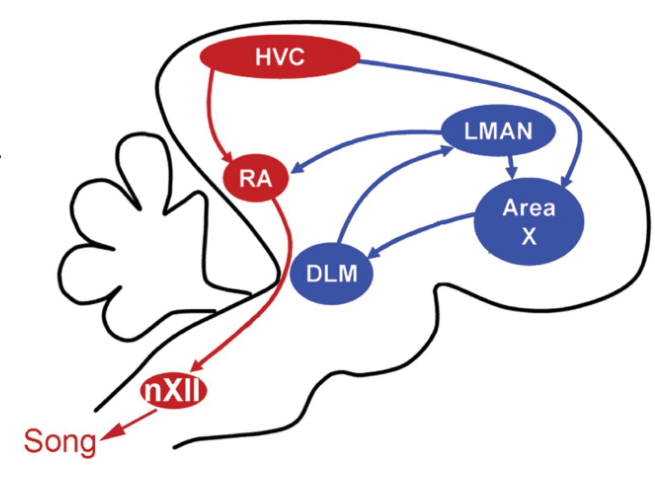
- Direct motor pathway (red)
- Production of song
- Anterior forebrain pathway (blue)
- Sensory motor learning of song
- HVC may be considered part of both pathways
Sexual Dimorphism
- Birdsong production is sexually dimorphic in zebra finch and many other songbirds
- Dimorphism also exists in neuroanatomy
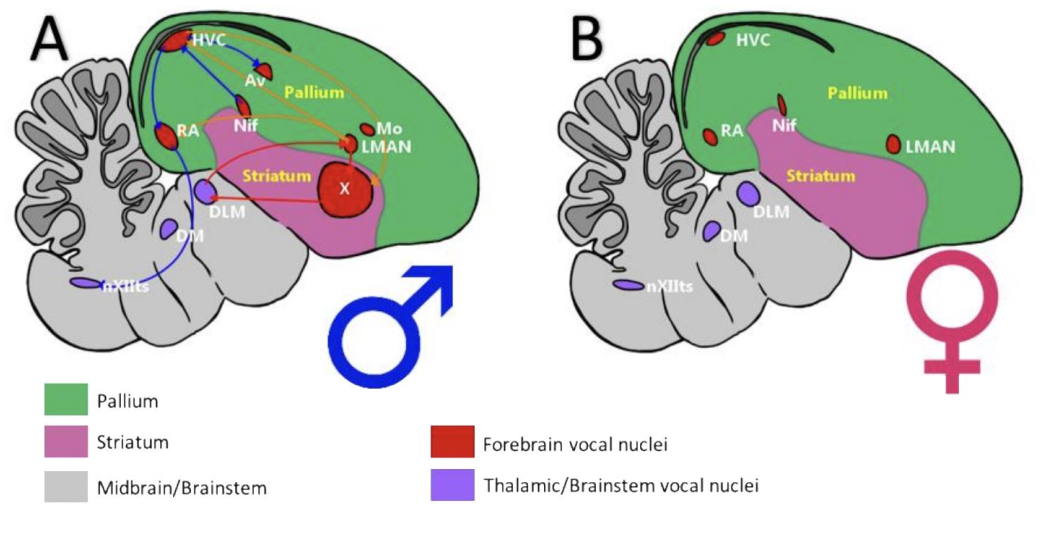
Two types of hormonal effects:
- Organizational effects - build the system early in development
- Activation effects - trigger immediate behavior later in life
Testing the hypothesis that dimorphism in HVC and RA are caused by elevated androgen (male estrogen) in development
- DHT and estradiol (E2) are androgens in birds
E2 and DHT in just-hatches birds will cause singing in females (normally no singing)
- This is an organizational effect, causing behavior later in life
Song Development: Zebra Finch
They only sing one song, and it is extremely stereotyped
-
Gaps and syllable length are the same
-
Same spectral structure to each syllable
-
Same temporal sequence
-
Elements/Note: a unit of uninterrupted song that has a coherent time / frequency structure that distinguishes it from neighboring elements/notes.
-
Notes combined to form syllables (a,b,c..), separated by breaths
-
Syllables: basic element of a conspecific song. They develop and crystallize (a, b, c, d, … ).
-
Motifs: introductory notes (i) followed by a sequence of syllables. They develop and crystallize.
-
Bouts: sequence of motifs not necessarily stereotyped even in adult.
Innate or Learned?
- Lacking the auditory exposure to any adult tutor during the critical phase of sensory learning, led to abnormal and quite simple songs.
- As they develop, they will imitate the song of an adult male tutor
Some birds are more complex and have seasonal songs, zebra finches are a very simple case.
Songs
-
Undirected song - not accompanied by the dance, produced when the male is with other males, alone, or outside a nest occupied by its mate
-
Directed song - accompanied by a courtship dance and is addressed almost exclusively to females
-
Variability in syllable structure is greater in the undirected condition. (like they are rehearsing)
-
Also, less number of introductory notes
Task was created were time a female spent in a box was measured, comparing:
- Unfamiliar directed motif
- Mate’s directed motif
- Mate’s undirected motif
Females showed a strong preference:
- Mate’s directed >> Unfamiliar direct
- Mate’s directed >> Mate’s undirected
🧪 -> Refresh the Info
Did you generally find the overall content understandable or compelling or relevant or not, and why, or which aspects of the reading were most novel or challenging for you and which aspects were most familiar or straightforward?)
Did a specific aspect of the reading raise questions for you or relate to other ideas and findings you’ve encountered, or are there other related issues you wish had been covered?)
🔗 -> Links
Resources
- Put useful links here
Connections
- Link all related words