📗 -> 02/20/25: NPB162-L14
🎤 Vocab
❗ Unit and Larger Context
Small summary
✒️ -> Scratch Notes
Crayfish Escape
- First response
- mediated by Giant interneuron.
- it is very fast and moves animal away from stimulus – but not particularly directed (this is a reflex).
- Second step
- is a slower re-extension of the tail, triggered by a sensory input (water disturbance).
- This returns abdomen to a position where it could flex again for further evasive action. (chain reflex)
- Third step -Swimming behavior
- involving alternating activation of flexors and extensors in an oscillatory circuit.
- Triggered by non-giant interneurons.
- This is a guided steering that completes the evasive maneuver.
MoG - Giant Motor Neuron
MG - Medial Giant Neuron/Axon
SG - Segmental Giant Neuron
FF - Fast Flexor Motor Neurons
LG - Lateral Giant Neurons/Axons
- LF also used, because Lateral Libers
Components
Coded blue -
Coded red -
- The sensory input to these interneurons is through chemical synapses (nicotinic receptors), while the interneurons (A & C) form rectifying electrical synapses with LG.
- Higher latency and leads to larger responses in LG
Direct connections with LG through electrical synapses.
- shorter latency, smaller amplitude and lower threshold for activation.
Synaptic connections can lead to short term depression/habituation or short term facilitation/sensitization
Researchers found that MSI (an afferent connection to LG) is a depressing synapse
- This would prevent the activation of this pathway in the presence of REPEATED, INNOCUOUS stimuli.
- Notice that this stimuli may activate this pathway but would not necessarily lead to the whole LG response.
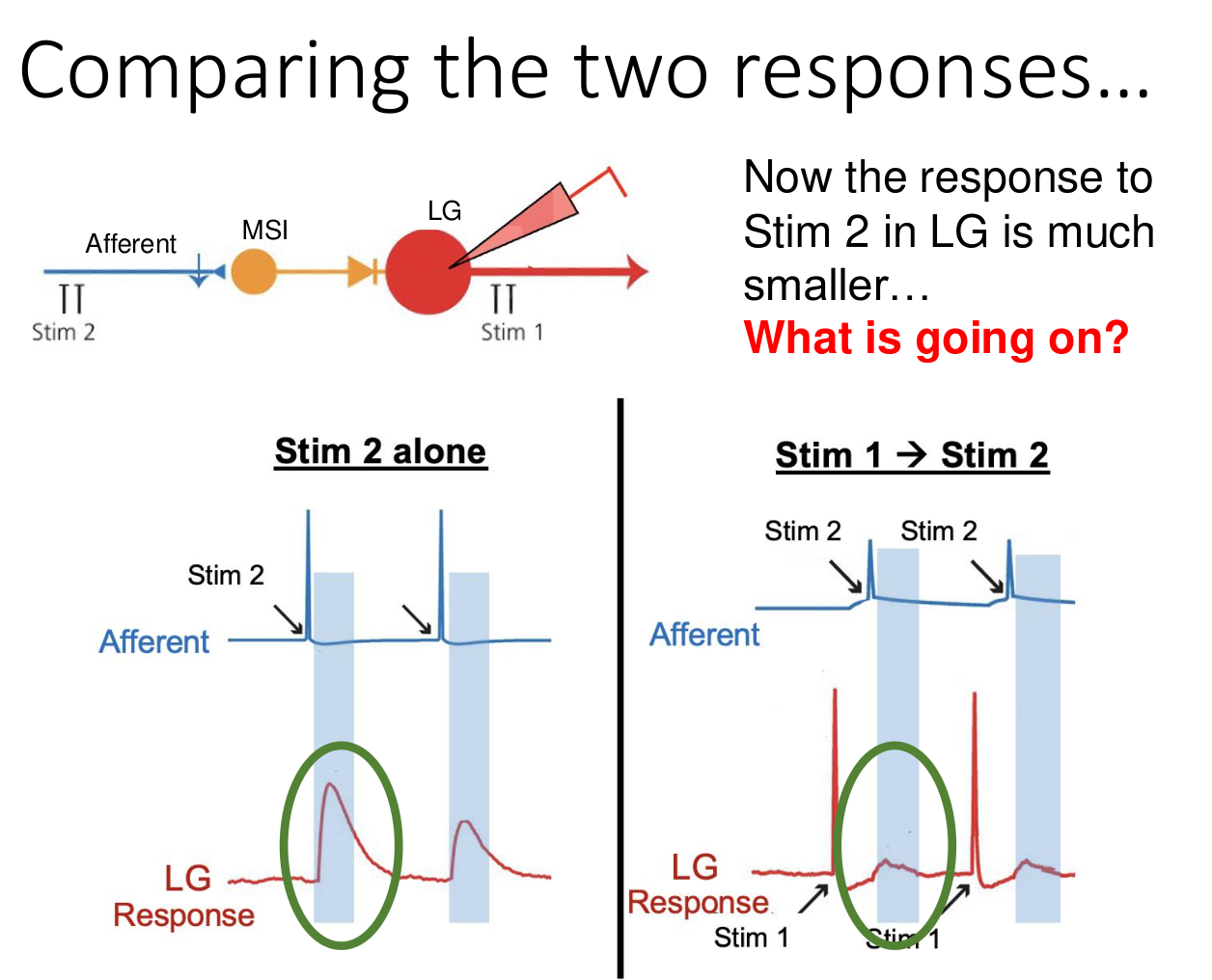
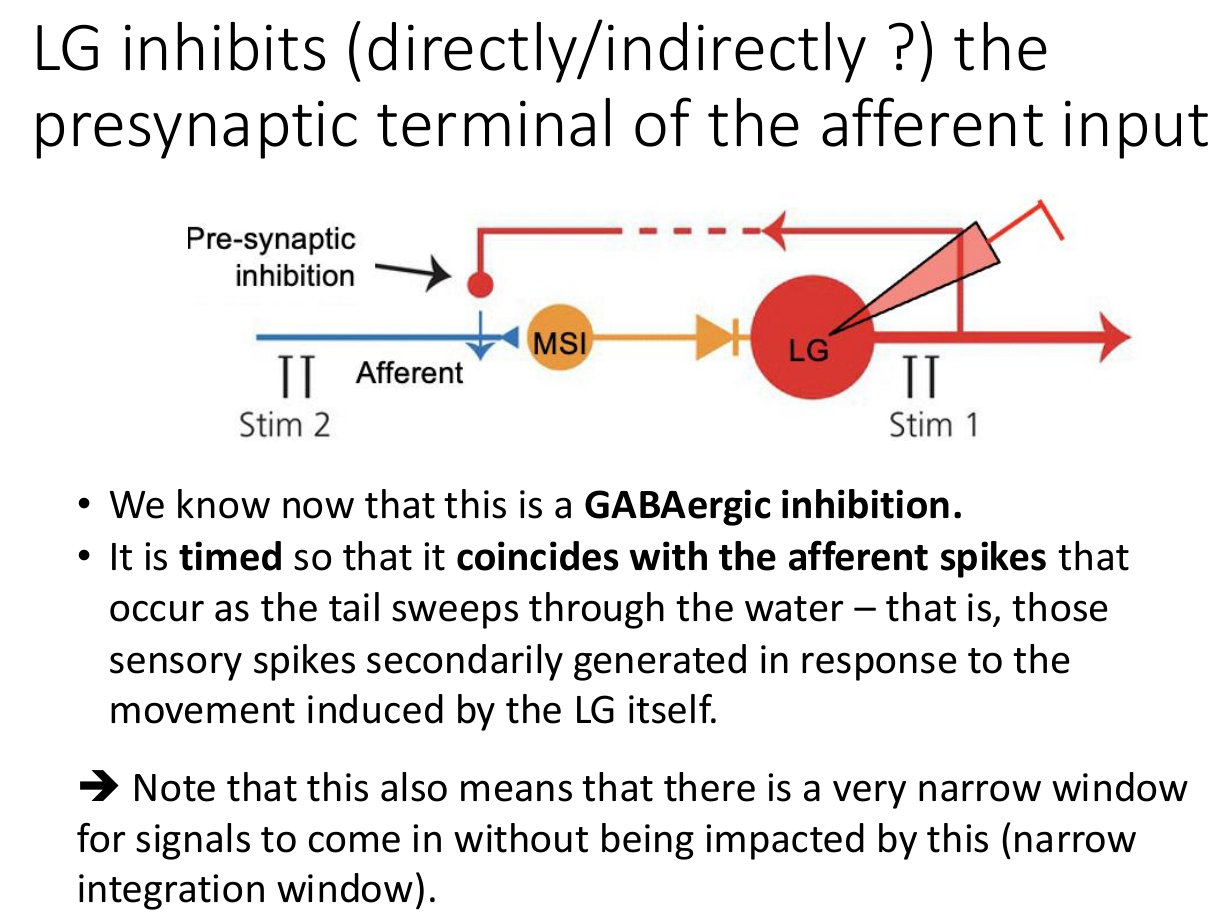
- When activated by the first sensory input (stim 1), LG pre-synaptically inhibits the afferent terminal (directly or indirectly)
- Presynaptic inhibition is mediated by GABA in this circuit, it hyperpolarized the axon terminal charges leading to a smaller depolarization when the action potential arrives, reducing the number of VG Ca2+ channels that open and synaptic release.
Depolarizing inhibitory inputs:
- Whether a synapse is excitatory or inhibitory depends on the relationship between the synapse’s reversal potential and the threshold for firing an action potential.
- A synapse is inhibitory if the Rev Potential for the Synapse is lower than Threshold.
- Whether a synapse is depolarizing or hyperpolarizing depends on the relationship between the synapse’s reversal potential and the neuron’s resting potential.
This is why GABA is depolarizing in infants, the reversal potential is different in childhood vs. adulthood
Primary Afferent Depolarization (PAD)
- Although it is a depolarizing input, it is actually inhibitory
- PAD results in a smaller depolarization in the presynaptic terminal upon arrival of the spike in the B afferent, thus causing a smaller release of neurotransmitter and smaller LG response.
- A delayed inhibitory input onto the LG neuron
- This indirect inhibitory input is initiated by the LG neurons itself
- While it depolarizes the neuron, it clamps it below threshold preventing it from firing
PAD/PADI input that inhibits the beta component before MSI
Corollary Discharge
- A corollary discharge is a neuronal signal that that allows animals to distinguish external from self-generated signals, which is critical to sensorimotor coordination.
- Depending on the organism, it can involve complex interconnected circuitry or be as simple as sending an additional signal that inhibits sensory neurons.
- In the case of the crayfish, they prevent tail flips in response to the animal’s own movement. (The PAD negative feedback from LG)
Inhibition of Antagonistic Muscles
Upon detection of a threatening stimulus and triggering of the LG mediated reflex, inhibition is rapidly exerted in the extension side of the circuit, to prevent competition with the initial rapid flexion response.
This involves:
- Inhibition of the muscle receptor organ (MRO), a stretch receptor (proprioceptor) that reflexively triggers extension of the abdomen
- (brief) Inhibition of the fast extensor motor neurons
- (brief) Inhibition of the fast extensor muscles
🧪 -> Refresh the Info
Did you generally find the overall content understandable or compelling or relevant or not, and why, or which aspects of the reading were most novel or challenging for you and which aspects were most familiar or straightforward?)
Did a specific aspect of the reading raise questions for you or relate to other ideas and findings you’ve encountered, or are there other related issues you wish had been covered?)
🔗 -> Links
Resources
- Put useful links here
Connections
- Link all related words