📗 -> 03/31/25: Systems Neuroscience Intro & Techniques
- Will likely be updated in the future
🎤 Vocab
❗ Unit and Larger Context
Quick intro, Ditterich will be leaving until Week 5. Until then, with Chen.
✒️ -> Scratch Notes
Neuroscience at various scales and levels
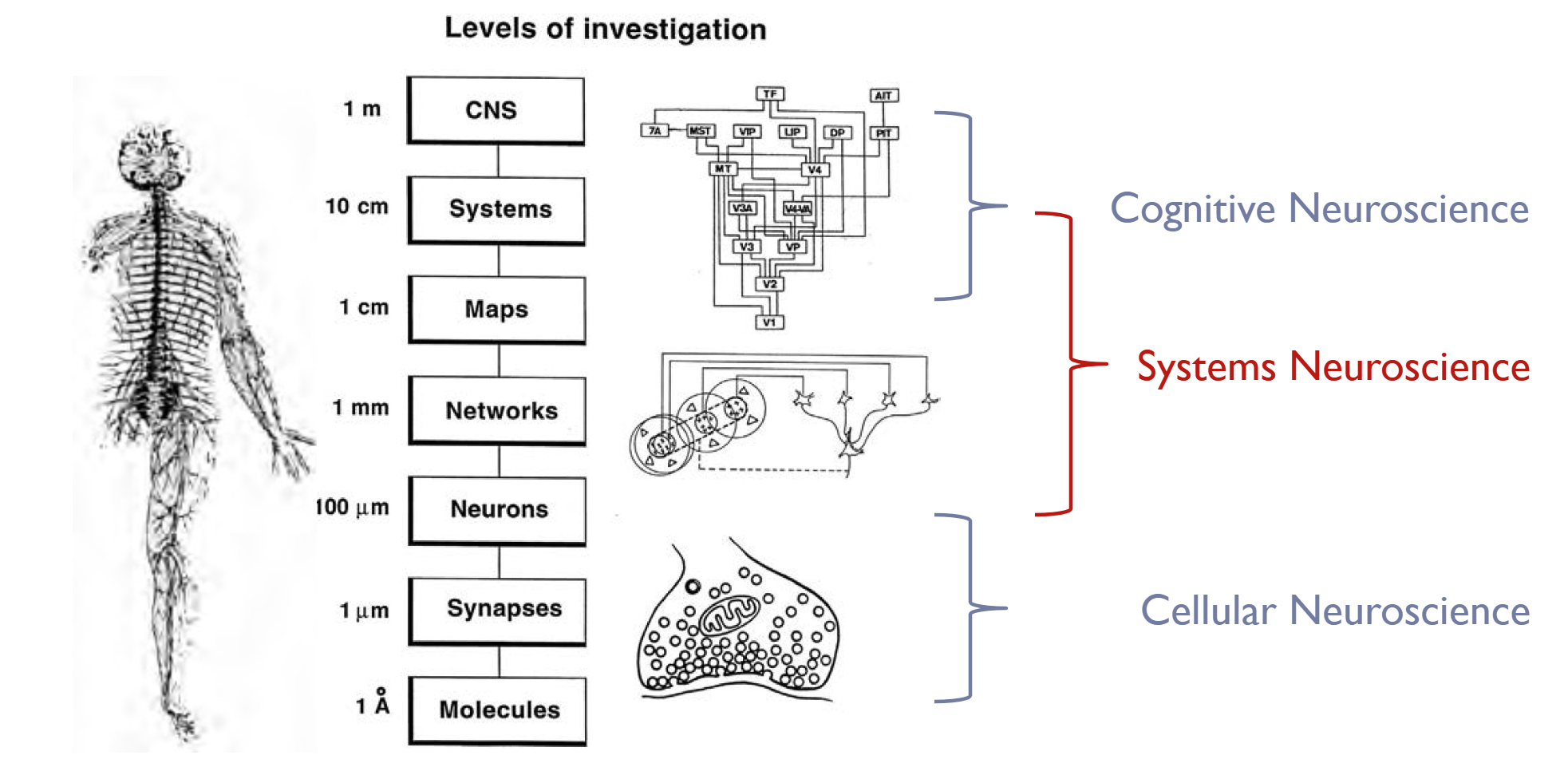
Systems Neuroscience:
- Systems Neuroscience asks questions about the relationship between structure and function of the nervous system and
- How the nervous system is able to give rise to perception, control action, etc.
- How does the nervous system code information about sensory events or planned actions? How does it “process information”?
- Systems neuroscientists therefore analyze the relationship between patterns of neural activity and sensory stimuli, behavior, etc
Two big approaches to inference:
- Measuring neural activity: EEG, fMRI, etc.
- However, this is merely correlational
Invasive Techniques:
Focus on:
- What does it measure?
- What is its spatial resolution? (single / multi unit, populational, etc. )
- Single neuron, neuron in an area, whole brain, etc.
- Temporal resolution? (Measuring a precise action potential, or more like a BOLD activity? )
- Proper situation to employ activity?
- Is invasiveness necessary?
Spatial resolution vs Spatial coverage
Cov - How many neurons / structures
??- Single neurons, or a large group of single neurons
- Is invasiveness necessary?
- Extracellular recording
- Intracellular recording
- ECoG / iEEG
Extracellular Recordings:
-
Invasive techniques, electrodes with a metal core and an insulating layer surrounding the metal core are introduced into neural tissue, only a sharp tip is expose, voltage between electrode and a reference electrode is measured
-
Mostly an animal recording technique, but sometimes done in humans in serious cases (epilepsy surgery, DBS, etc.)
-
If the electrode tip is close enough to an individual neuron, action potentials can be recorded from a single cell. This is called “single-unit recording”
-
How strong the recording is depends on distance from soma and size of neuron
- This can cause a sampling bias from larger neurons.
-
Individual action potentials are isolated using a window discriminator or more modern software-based spike sorting techniques
-
Single-unit data are often presented in the form of raster plots or peri-stimulus time histograms (PSTHs)
- PSTH - Histogram that maps time relative to some event (e.g. stimulus onset) with firing rate
Ways to distinguish between different neuron firings:
-
Amplitude of spiking/response
-
Duration of spike/response
- One could rebound quickly while the other does not
- Overall time from resting potential, to depolarization, hyperpolarization, and back to resting potential
-
This gives you a 2 dimensional feature space you can use to cluster spikes (Voltage and Duration)
Other signals obtainable from extracellular recordings:
- Multi-unit activity (MUA) when it is not possible to isolate single neurons. Thresholding is recorded when group voltage activity exceeds a certain threshold. Used as a proxy for spiking activity of a population of neurons
- Local Field Potentials (LFP) are slower fluctuations in the electric potential. A low-pass (band-pass) filter removing the higher frequency components from a signal
LFPs are not as popular as single-unit recordings because it is less clear what exactly is being recorded. LFPs are an aggregate signal that is thought to mostly reflect synchronized synaptic currents across a local population of neurons.
LFP is thought to reflect more the inputs to a neural population or local processing. Contributions a probably made by neural tissue within several hundred microns of the electrode tip.
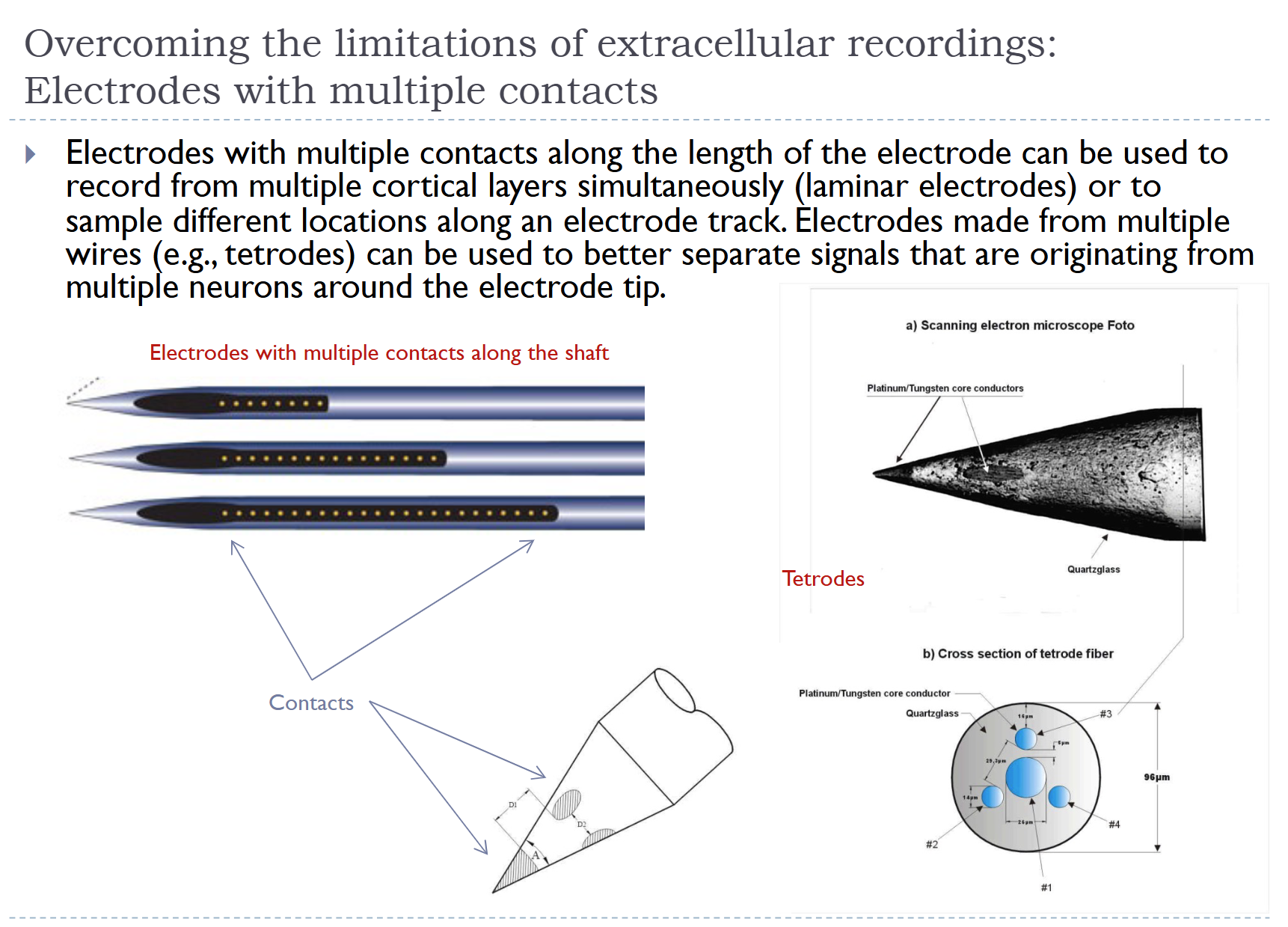
Recent advancements:
Improvements with multiple contacts:
- Recent trend: high-density silicon probes, e.g., Neuropixels probe (approx. 1,000 contacts; about 400 can be selected for simultaneous recording)
- Two part device, with a base and a shank. The base is the needle/probe that’s inserted and records
Improvements with multiple electrodes:
- Two part device, with a base and a shank. The base is the needle/probe that’s inserted and records
- Microdrive’s that allow the manipulation of several electrodes at once or implanted electrode arrays
- Utah Arrays for example
- Imagine an iron maiden looking square chip
Intracellular recordings
Intracellular recordings have the advantage that the membrane potential can be tracked and that subthreshold events like EPSPs and IPSPs can be seen, but are extremely difficult to do in vivo (due to movement in the tissue caused by cardiac and respiratory pulsation)
- Are not common practice due to these issues
Electrocorticography (ECoG) / intracranial EEG (iEEG)
An electrode grid is placed directly on the cortical surface
Provides LFP-like signals from different areas along the cortical surface.
This is an example of a technique with high spatial coverage, but low spatial resolution.
- Can cover a large amount of cortex
- However, less accurate spatial resolution recording an aggregate voltage at each electrode
Optical imaging
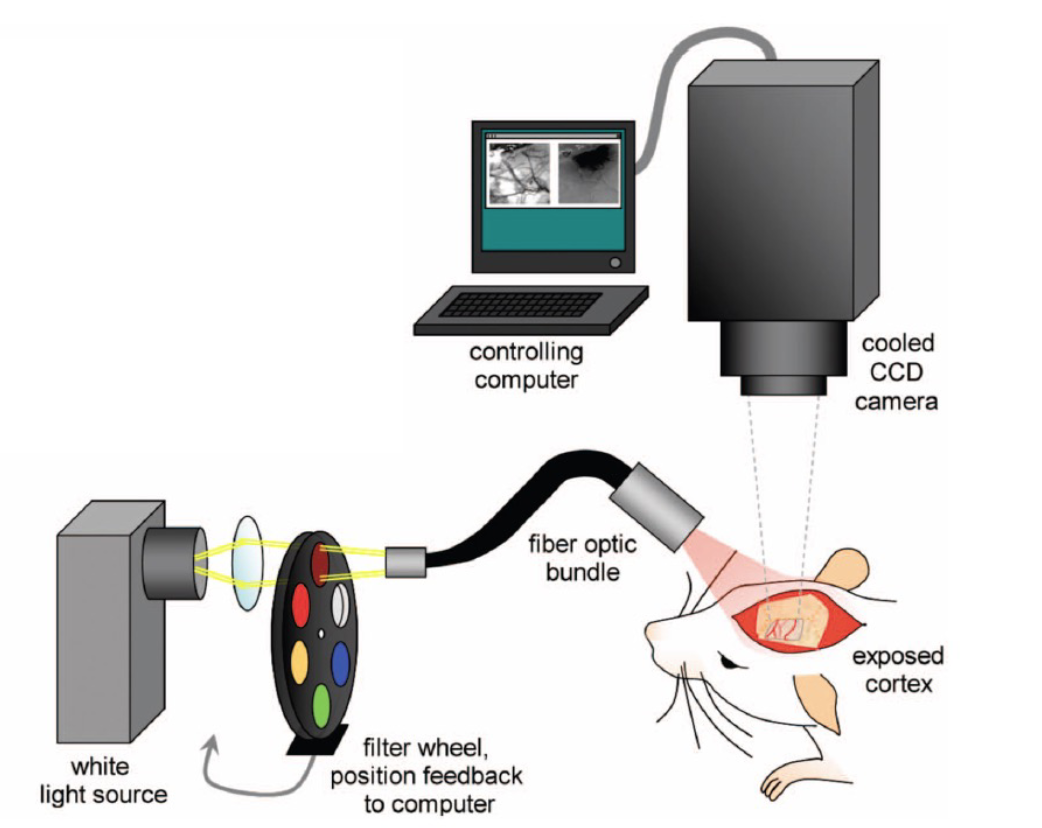
Part of the skull is removed to allow imaging of part of the cortical surface with a CCD camera to obtain a measurement of the distribution of neural activity across the cortical surface (has been influential in obtaining “maps” of visual cortex)
Review
Relies on light absorption properties of oxy- and deoxyhemoglobin (HbO2 and HbR) and is therefore an indirect, metabolic measure of neural activity
Voltage-sensitive dye (VSD) / calcium-sensitive dye (CaSD) imaging
VSD
- VSD predated optical imaging, but alternatives developed due to toxic nature of dye
- VSD can directly measure/image electrical activity
- Bind across a neuron’s membrane (and dendrites) and change their fluorescence according to the membrane potential. VSD reflects both spiking and synaptic activity
- Response is relatively small (~0.5%)
- Need to be applied some time before imaging (1-2 hrs)
CaSD - Report the intracellular calcium concetraction, and are therefore sensitive to the calcium influx when an action potential is fired
- Larger signal (~5%), but difficult to get into neurons
🧪 -> Refresh the Info
Did you generally find the overall content understandable or compelling or relevant or not, and why, or which aspects of the reading were most novel or challenging for you and which aspects were most familiar or straightforward?)
Did a specific aspect of the reading raise questions for you or relate to other ideas and findings you’ve encountered, or are there other related issues you wish had been covered?)
🔗 -> Links
Resources
- Put useful links here
Connections
- Link all related words