📗 -> 05/19/25: NPB163-L13
🎤 Vocab
❗ Unit and Larger Context
Motor 4 - Skeletal System
✒️ -> Scratch Notes
Motor System Functions
Review
Cortical Connections
Corticospinal Connections
- Originally thought that projections were from layer 5 Betz cells in M1
- Now, we know a large number ofcorticospinal fibers original from premotor cortex (SMA, supplementary motor area) and somatosensory cortex
- Now, Betz cells thought to contribute less than 5% of fibers
Organization of primary motor cortex
A M1 motor homunculus organization
- Similar to somatosensory cortex
Roughly similar, but different - Overlapping, intermingled, fractured
Somatotopic organization led us to thinkthat M1 is organized that activating output neuron activates a particular muscle - Supported by electrical stim trials, where shrot duration stim causes muscle twitches usually in single joints
However, hand representation is highly distrubted.

- Each color is a single digit
- Not highly clustered as we’d expect from a map.
- Aditionally, very distributed
Motor Cortex Activity
Stimulation in M1 can cause activation of
Voluntary movement usually starts 100ms before activation. Preparatory activity is called set related
- Thought that these activities are something distinct. Direct output neurons and other as well.
Suggest that populations of neurons in M1 cary info about various movement parameters like: - Movement direction, required force, speed, etc.
- Individual neurons show a broad tuning for these parameters
Suggests the existence of some highler level code in M1, not direct muscle activations but more abstract parameters of movement
- Individual neurons show a broad tuning for these parameters
Activity
A M1 neuron shows broad tuning, but preference for a direction. Even has suppresion of activity for the ‘wrong’ direction
Decoding methods
- Bayesian decoder
- Population vector decoder
- Sum population,
, summing preference direction by activity level
- Sum population,
Can be modified by external load (say a weight/wire) pulling hand off of course.
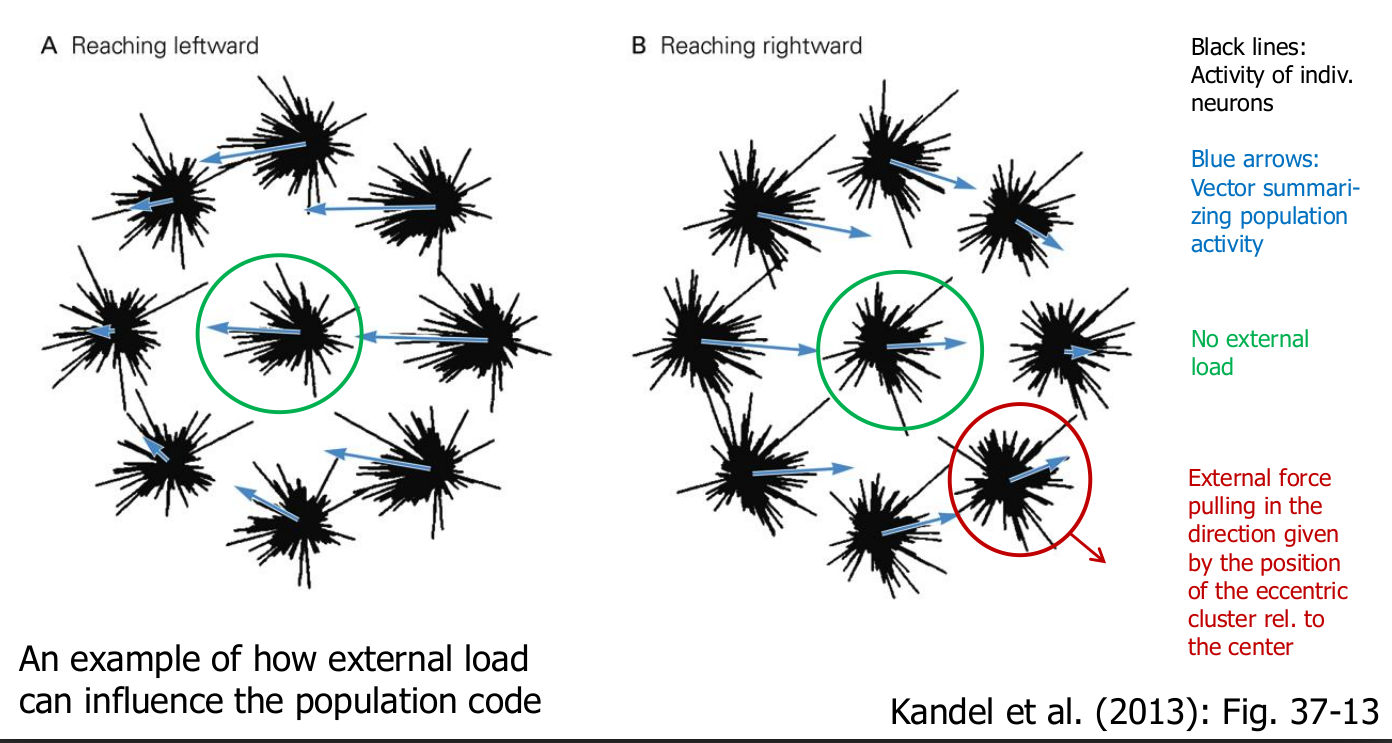
- Direction of cluster indicates the direction vector of force
- See how the population vector adapts to the force, compensating to result in intended outcome
back to central question of: What does activity in primary cortex reflect?
Optimal Control Theory
According to this theory,
When you activate your muscles you get a particualr resulting movement
- muscle activation -> Body action -> resulting movement
In motor control, you want to determine the muscle activation from a desired movement - desired movement -> box -> muscle activation -> body action -> resulting movement
In other words:
- Desired movement
- Inverse body model:
- Theorized that this needs to be learned.
- Somatosensory function
- Muscle activation
- Actual Body:
- Resulting movement
Takes a desired outcome x, then:
flowchart LR
    A([Desired Movement]) -->|f_inv| B[f_inv: Motor Commands]
    B -- Muscle Activation --> C[f: Body]
    C -- Resulting Movement --> D([Movement Output])
So with all that:
- M1 might not ‘represent’ movement parameters explicitly, but be a part of an optimal feedback controller that converts current goals and current sensory states into motor commands (“inverse internal model”).
Behaviorally Relevant Motor Cortex
A stimulation study found that they could induce behvaiorally relevant behavior through extended simulation (500ms)
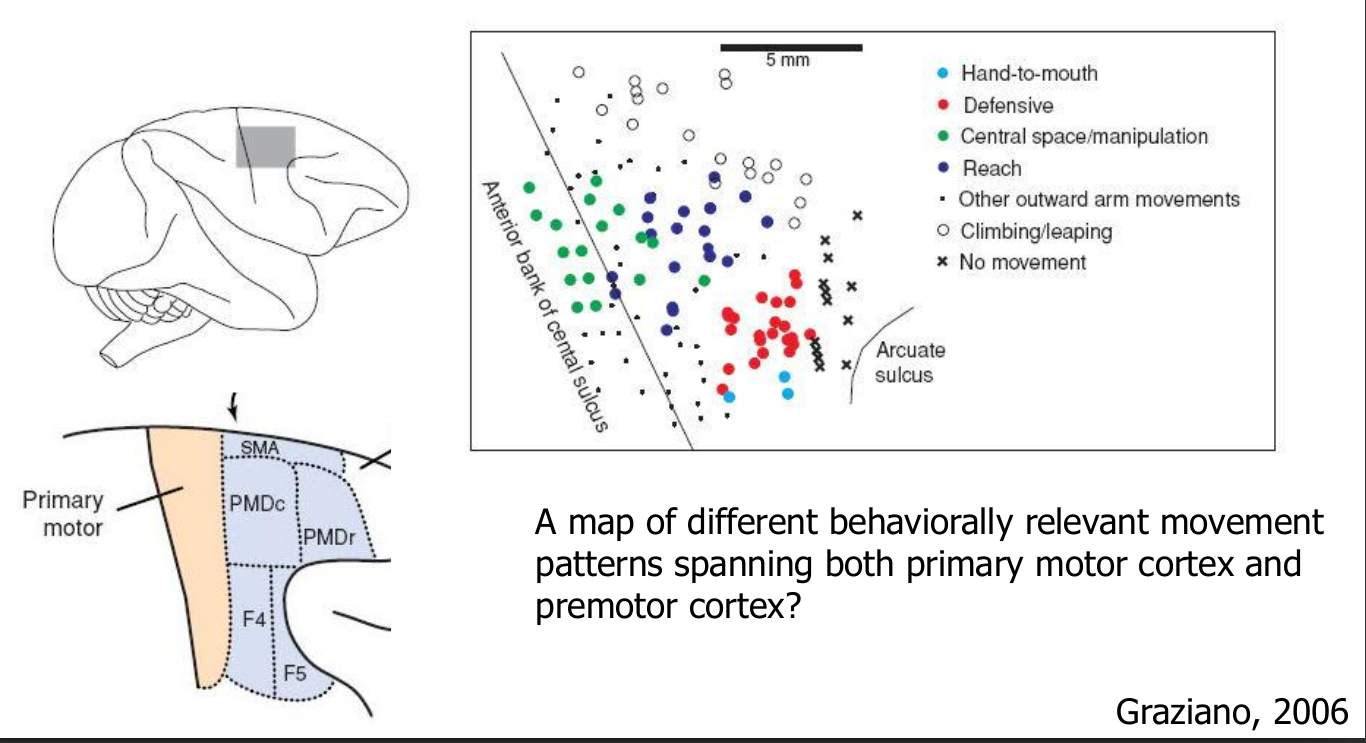
| M1 | PM | SMA | |
|---|---|---|---|
| Name | Motor Cortex | Premotor Cortex | Supplementary Motor cortex |
| Activation | Similar activations for same actions | Guiding movements through sensory information | Most active for prelearned sequences |
In motor cortex:
- Activation when planning action
- Activation when trigger stimulus
Dorsal and Ventral Stream
Vision What/where: dorsal is where, ventral is what
It also happens in motor cortex
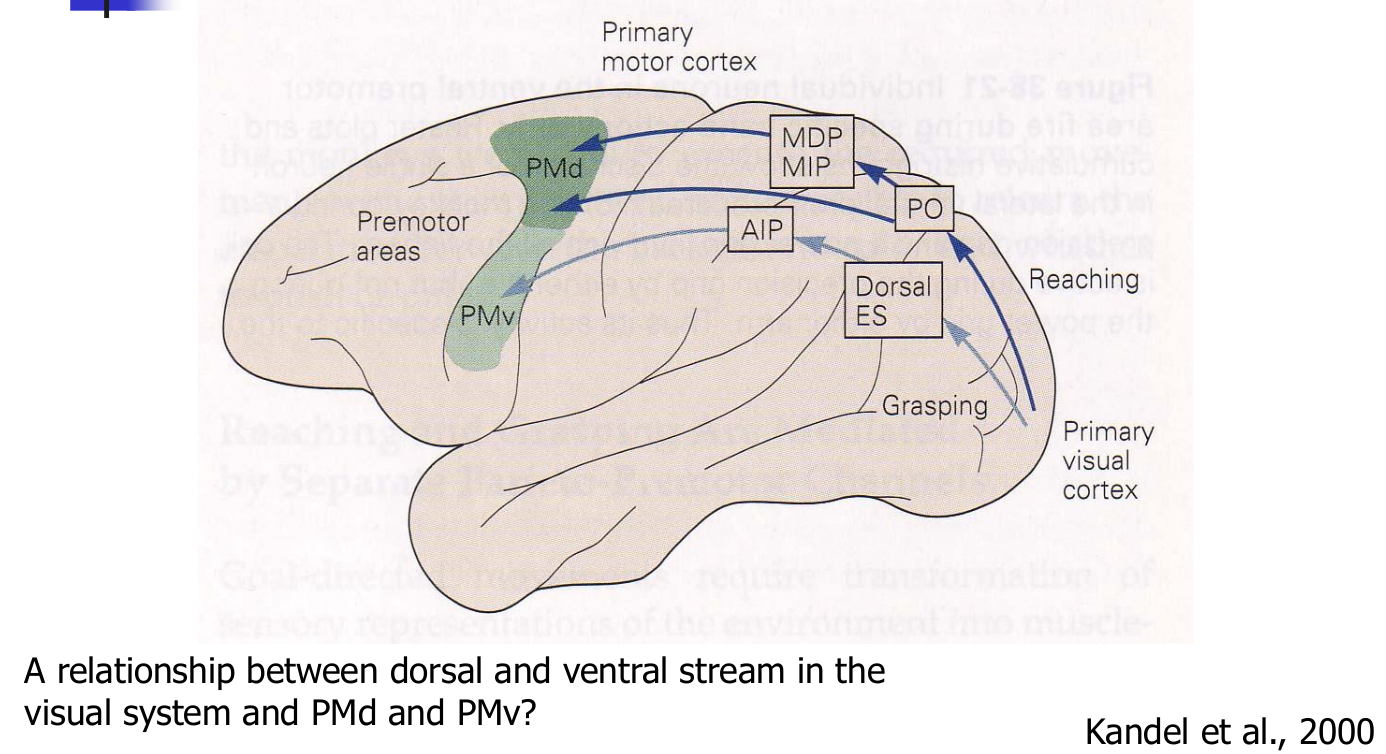
Premotor cortex neurons have multisensory reception
- Response to tactile or visual stimulation associated with its RFs
Mirror Neurons - Class of PMv neurons that activate when monkey:
- Plans an action
- Sees an action
Discussion
Problem Set: Motor Systems
1
- Is the final common pathway contingent on the type of eye movement?
Type of eye movement: saccades vs smooth pursuit vs.
No. Final common pathway is the machinery shared among all paths of movement
- Final pathway is muscles and motor neurons
A monkey has been trained to perform visually guided saccades. You show two targets on a computer screen, one 5 deg to the left of straight ahead and one 5 deg to the right of straight ahead. Whenever one of the target flashes, the monkey makes a saccade to the flashing target. Since the targets are flashed in alternation, the monkey performs an alternating sequence of leftward and rightward saccades.
- Saccades between left and right alternating
- 10 degree saccades
3a) You perform a single-unit recording from an omnipause neuron. What do you expect to
see?
- Omnipause neuron - Shared in the circuits regardless of saccade direction (left/right/up/down)
- Expect it to fire whenever the animal fixates but stop whenever it makes the saccade.
- Should be excited whether its a saccade to the left or right.
3b) You perform a single-unit recording from a horizontal excitatory burst neuron. What do
you expect to see?
- Neurons only activated during saccade
- Large spikes of activation on the initiation of saccades.
- Different activation depending on direction.
- Burst neurons only excite for their preferred direction. Either left OR right, not both
3c) You perform a single-unit recording from a neuron in the deep layers of the Superior Colliculus, which prefers leftward saccades with an amplitude of 10 deg. What do you expect to see? Next, you record from a neuron that prefers leftward saccades with an amplitude of 5 deg. What do you expect to see?
- Neuron preferring leftward 10 deg - Fires only on the saccade leftward 10 deg. No response when it makes saccade 10 deg right.
- Neuron preferreigng leftward 5 deg - Depends on the tuning curve of neuron. Neurons specifically in Superior Colliculus:
- Broad tuning curve, so we would still see some activation
3d) You now place a stimulation electrode in the Superior Colliculus, have the monkey fixate
straight ahead, and apply electrical microstimulation. The monkey makes a saccade that
ends at a location 8 deg to the left of straight ahead. You now have the monkey fixate
5 deg above straight ahead and repeat the stimulation. At what location do you expect
the eye to land?
- The activation corresponds to a movement vector, not a location
- We would expect the result to be 5 degrees up, 8 left
🧪 -> Refresh the Info
Did you generally find the overall content understandable or compelling or relevant or not, and why, or which aspects of the reading were most novel or challenging for you and which aspects were most familiar or straightforward?)
Did a specific aspect of the reading raise questions for you or relate to other ideas and findings you’ve encountered, or are there other related issues you wish had been covered?)
🔗 -> Links
Resources
- Put useful links here
Connections
- Link all related words