📗 -> 05/28/25: NPB163-L16
🎤 Vocab
❗ Unit and Larger Context
Starting from “Example 1: Eyeblink Conditioning”
✒️ -> Scratch Notes
Cerebellum theories:
- Involved in control
- Involved in motor control
- Involved in timing
Now, to address the third theory
Example 1: Eyeblink conditioning
If you blow puff of wind into rabbits eye, it blinks
- However, if you present a tone before the puff, the rabbit becomes classically conditioned and eventually the tone itself is enough to induce a blink
You can show the cerebellum is critical for:
- Learning: Mossy fiber carry info about the one, and climbing fibers carry information about the aversive stimulus
This example involves motor control (cerebellum triggers conditioned eyeblink), learning (tone predicts aversive stimulus), and timing (the eyeblink is timed appropriately to match the interval between the onset of the tone and the air puff; works up to approx. 1 s).
- producing the eyeblink, and critical for producing it at the proper time
Learning in the oculomotor system: Saccade Adaptation
- Saccades are open-loop movements (no visual feedback)
- Mechanical proerties of the eye movement system can change over time
- System needs to be able to adapt to these changes in order to maintain accuracy
- Eye muscle problems cause dysmetrias which have been shown to be gradually compensated for
- Can also be studied in the laboratory using intrasaccadic target steps
Adaptation
Happens over time in each eye, independently
Where?
- The Superior Colliculus is involved, but we see no change in the adaptated state -> No adaptation upstream from SC?
- Electrical stimulation in SC triggers saccades that are not adapted -> No adaptation downstream from SC?
So, no adaptation in SC pathway? How does that make sense
Proposal: - Cerebellum adaptation, a parallel stream. Neurons in the cerebellar vermis and fastigial nucleus burst during saccades; cerebellar lesions abolish saccade adaptation.
However: - Cerebellar lesions also produce quite large saccadic dysmetrias, which might make adaptation impossible
How?
? dunno, i couldn’t read the graphs
Basal Ganglia
Overview:
- ?
- Traditionally, people think the BG play a large role in motor control. Now, people think it’s doing more than that. Larger functional role. Not ONLY a motor control structure.
Overview:
A midbrain structure with 4 nuclei:
- Striatum
- Globus pallidus
- Substantia nigra
- Subthalamic nucleus
Striatum can be divided into: - Caudate nucleus
- Putamen
- Ventral striatum
Substantia nigra has its name from its dark color that is caused by neuromelanin, a dark pigment derived from oxydized and polymerized dopamine
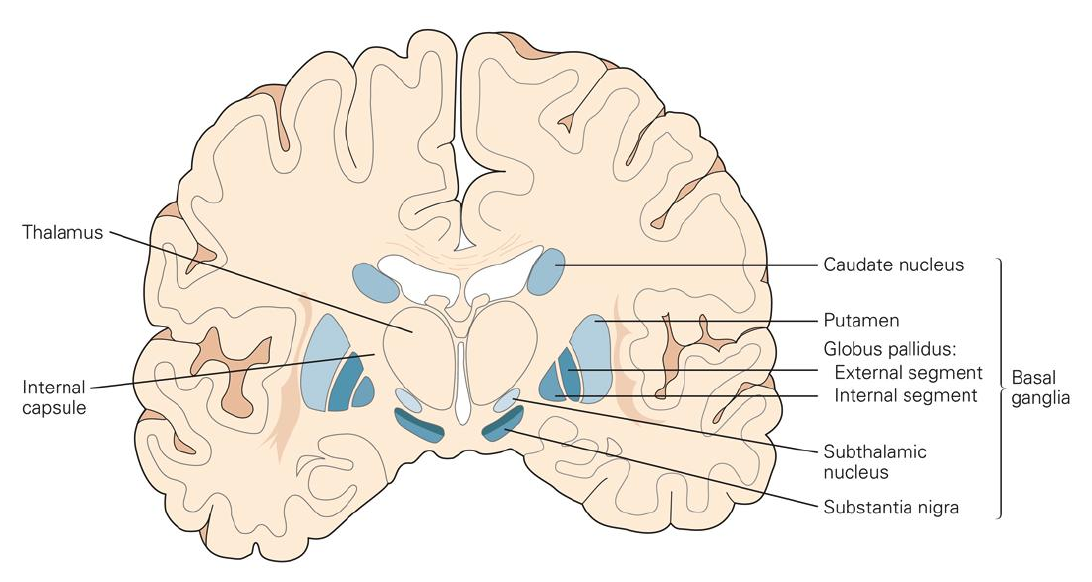
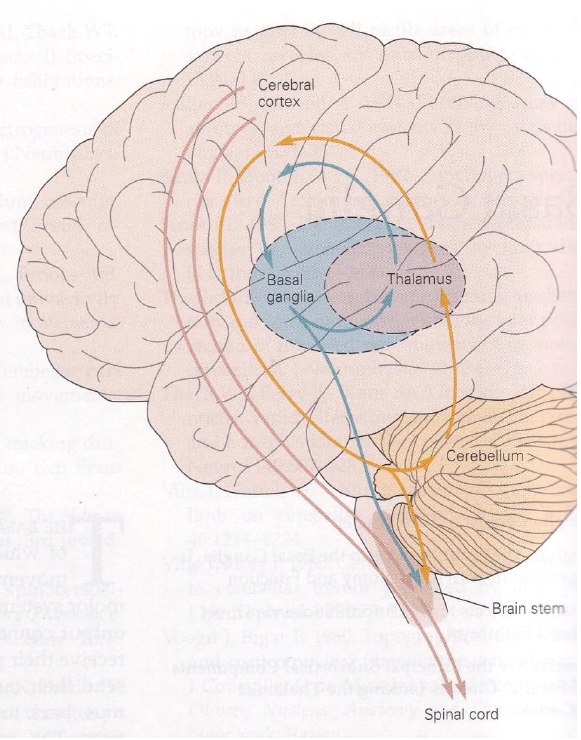
Striatum is the major recipient of inputs. Primary input from cortex
Striatum projects to the
BG does not have direct connections with the spinal cord and are therefore considered to be part of the “extrapyramidal” motor system
- Consequence of removal of spinal cord is paralysis
- Consequence of damage to extrapyramidal system is movement disabilities like Parkinson and Huntington
In contrast to lesions in the pyramidal tract, deficits in the basal ganglia do not lead to paralysis, but to involuntary movements or to immobility without paralysis. Typical examples of basal ganglia disorders are Parkinson disease (diminished movement) or Huntington disease (excessive movement).
As mentioned before, not only part of motor system, but also cognitive/behavioral deficits
Mechanism of Action
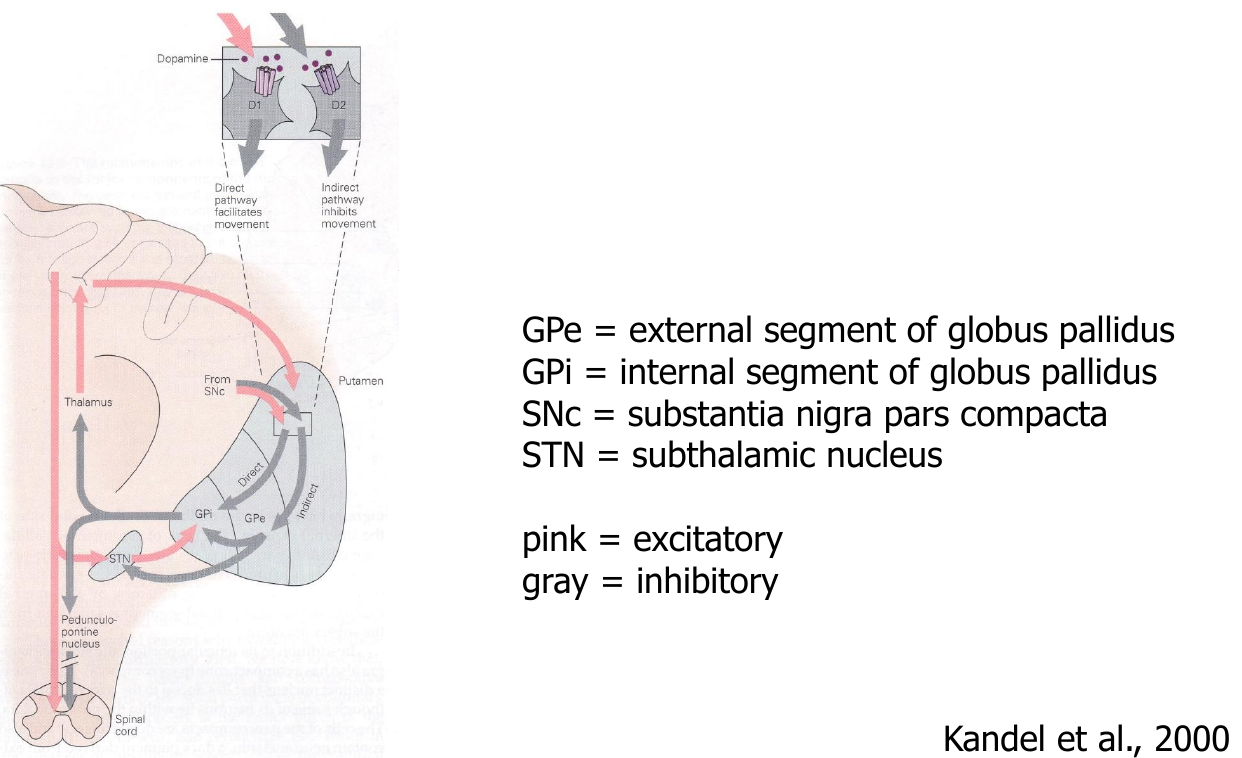
- To find if it would be net inhibiting/exciting, count the number of excitatory vs inhibitory pathways
- Positive amount of negative connetions, cancels out and is a net positive excitation when excited
- Odd number, creates a net inhibitory effect
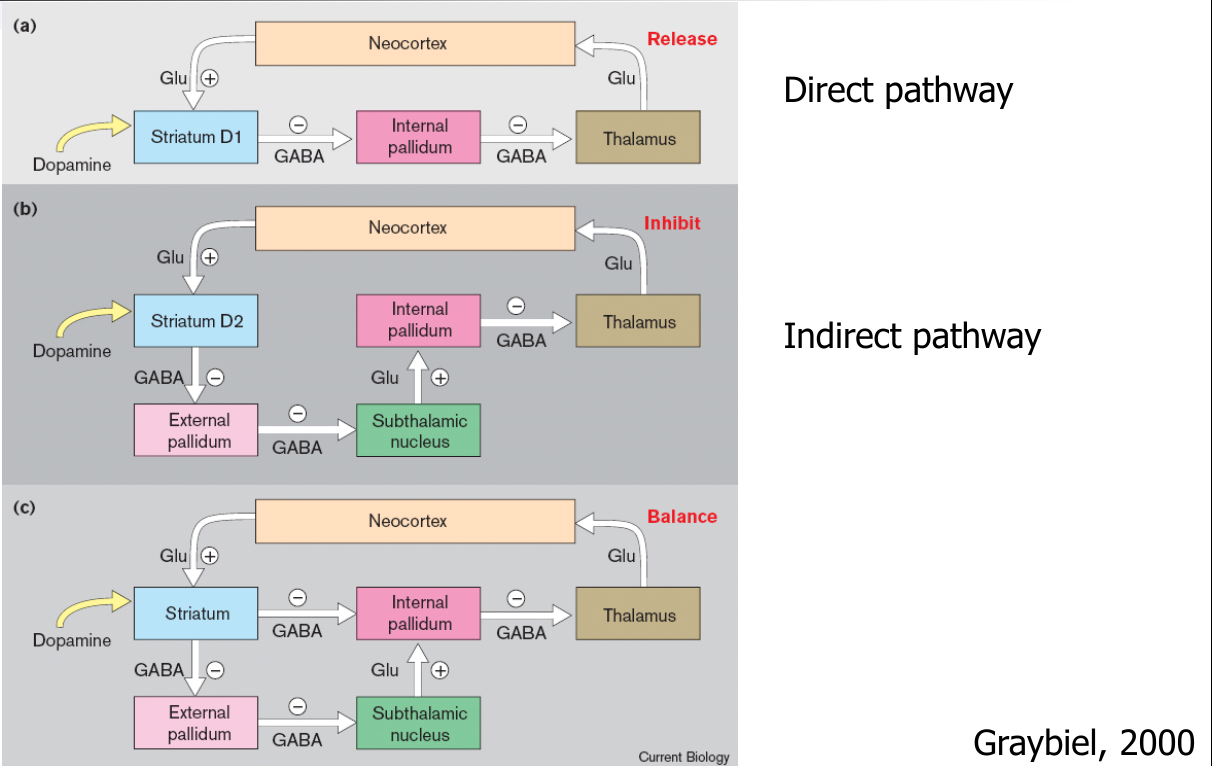
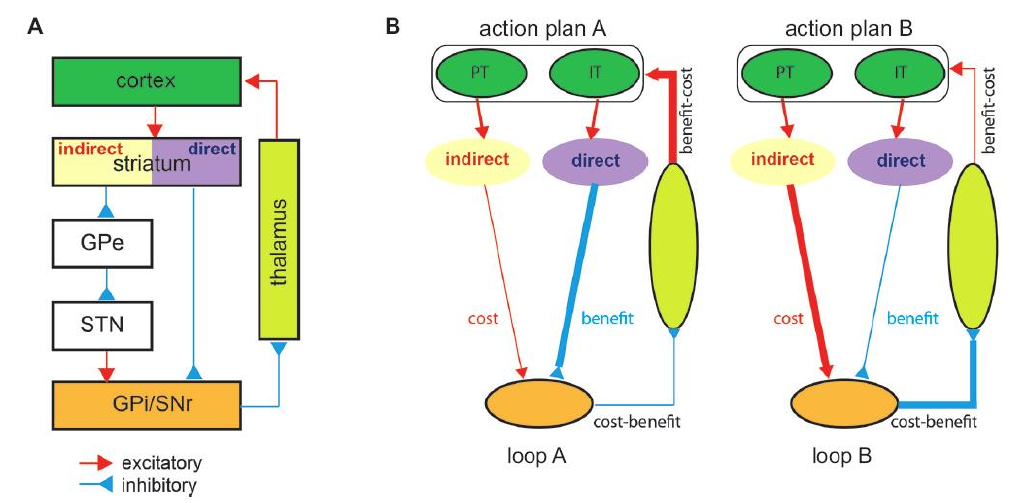
Direct - Even number of connections so excitatory
Indirect - Odd number, so inhibitory
Output neurons exhibit a tonic high-frequency discharge
Phasic activation of the direct pathway suppresses the activity of the output neurons. It allows the thalamus/cortex to be activated and facilitates movement
Phasic activation of the indirect pathway increases inhibition of the thalamus and therefore inhibits movement
…
BG
Recordings from GPi:
- Majority of cells firing before initiation of a movement -> Suppresion of unwanted movements
- Minority of cells decrease firing -> Allowing intended movement
Are the BG responsible for selecting an appropriate action? - perhaps
Is this mediated via lateral inhibitions - anatomy and simultenuous recordings from multiple neurons in the basal ganglia argue against this idea
Why are there two pathways? - not entirely clear, but see slide chart on cost-benefit model
Imbalance between the direct and indirect pathway seems to cause problems: - Overactivity in indirect pathway -> hypokinetic disorders (like Parkinsons disease)
- Overactivity in direct pathways -> hyperkinetic disorders (like Huntingtons)
BG Diseases
Huntington
…
Parkinson
…
Parkinsons Treatments
- Drug therapy (L-DOPA, dopamine precursor)
- Surgical intervention
- Target subthalamic nucleus, and lesion excitatory input to GPi
- Target internal segment of globus pallidus, and lesion inhibitory input to thalamus/cortex
- However - Aside from being invasive, these are irreversible
- Deep brain stimulation
- Potential targets: globus pallidus, STN (most promising), thalamus
- High-frequency (>100 Hz) electrical stimulation has an effect similar to lesioning: the neural output of the stimulated area is blocked
- Advantages:
- Reversible, stimulation parameters (intensity, pulse width, frequency), can be adjusted to optimize the effect
Back to BG
Traditionally viewed as a motor structure.
However, it is connected to virtually the entire cerebral cortex, the hippocampus, and the amygdala
BG are part of specific thalamocortical loops, the motor loop is only one of them
Moutning evidence that is not only involved in movement disrders, but also:
- Psychiatric disorders: Schizophrenia, depression, OCD
- Been proposed that these disorders might be analogues to the Huntington/Parkinson disease model but with different thalamocortical loops, up/down regulation of thoughts
For example: - Observations from brain mapping during DBS shows: sudden and severe depressive episodes by stimulation in the substantia nigra, followed by an euphoric rebound when the stimulation stopped
Unifying theory?
Wolfram Schult - Experiments have suggested a role of dopamine signals in reward prediction
Reward Prediction Error (RPE) plays an important role in theories of learning. Is the BG an important structure for learning? What does it learn?
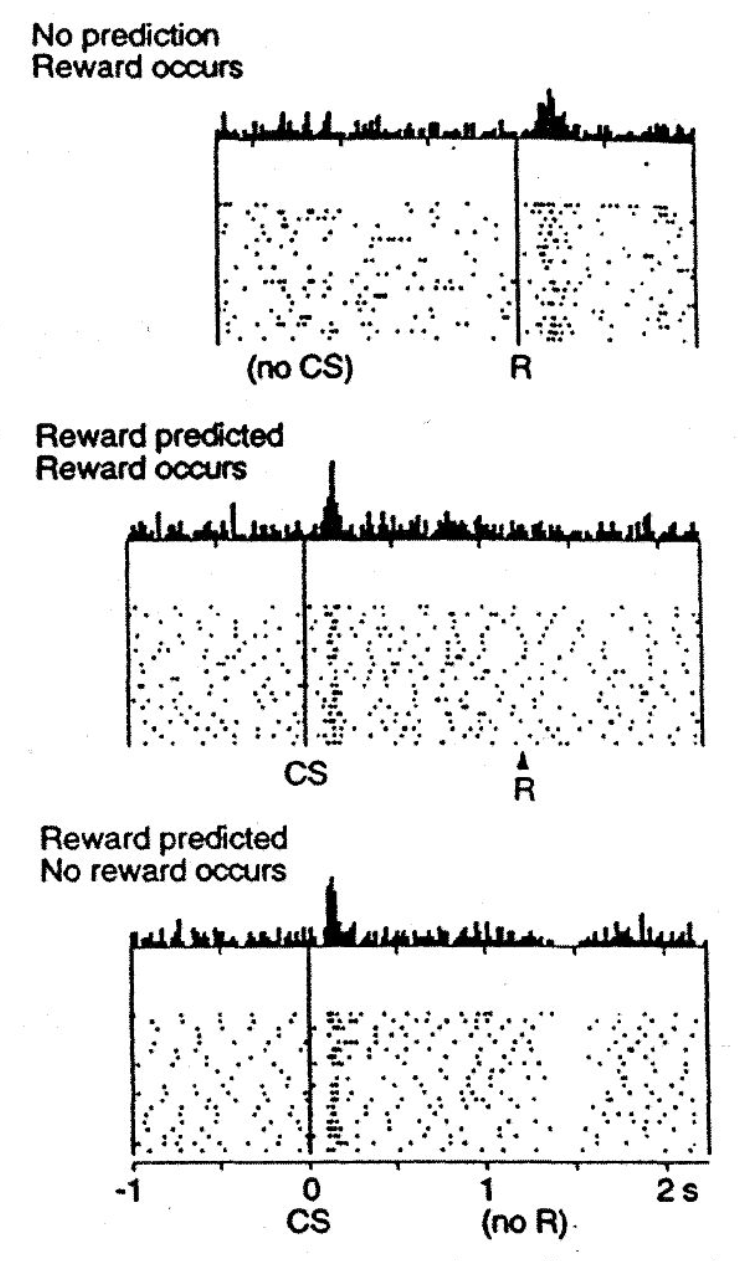
- The reward signaling moves to the CS
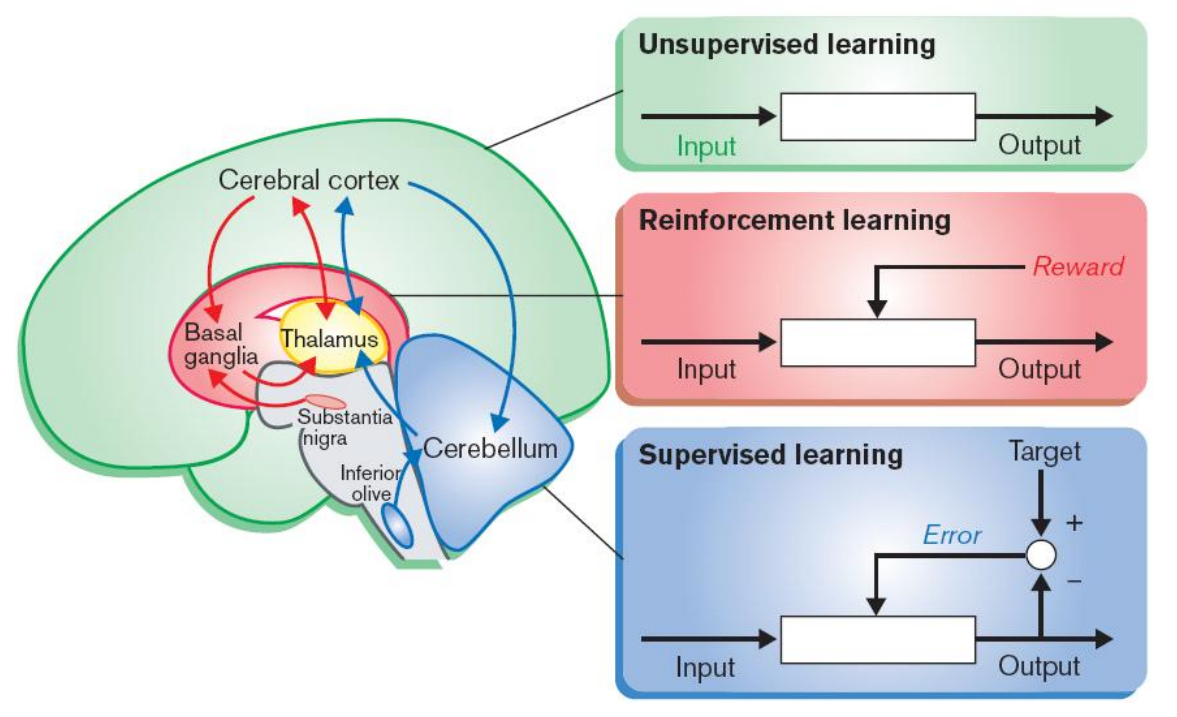
Suggestion
The basal ganglia might play an important role in reinforcement (reward-driven) learning
- Adapt behavior to rewards, do it if rewarded, stop it not rewarded
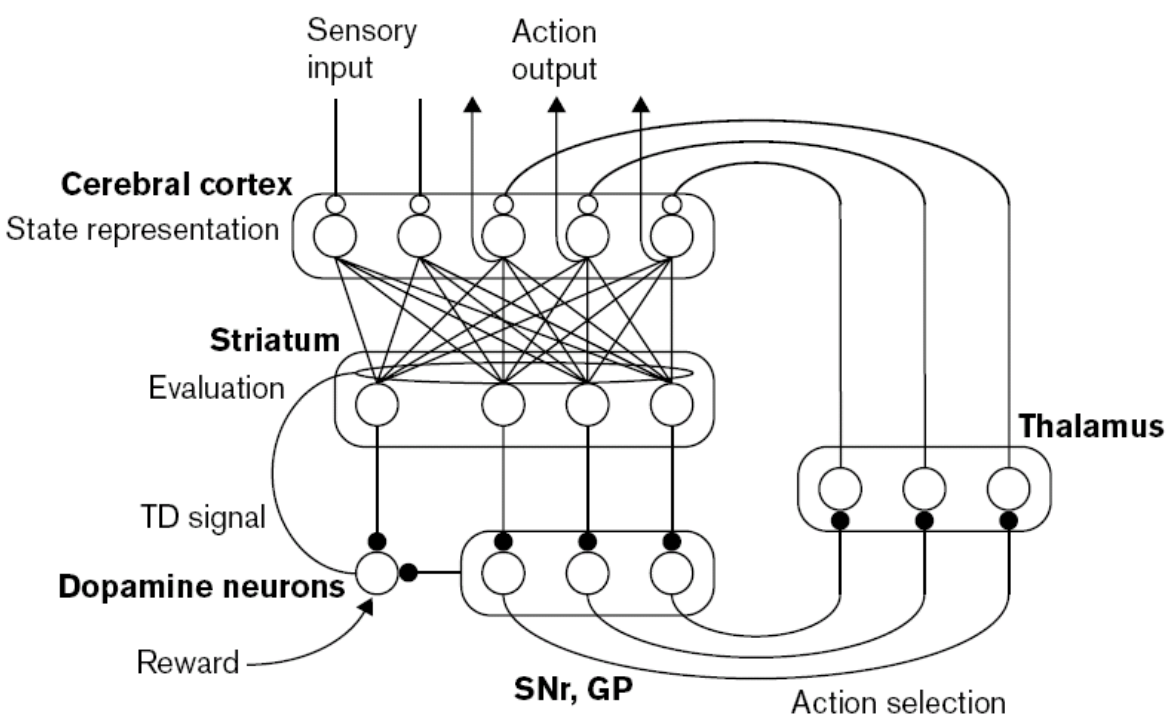
Are the BG an action (or thought) selective network modified by reward-driven learning
Graybiel: “In a forward model of the basal ganglia, the striatum and other basal ganglia nuclei would receive incoming signals about the current status of events (in action or mental space), as well as signals predicting future events. The cortico-basal ganglia loops running through the striatum and basal ganglia circuits would sort and combine such signals, and then influence cortical and subcortical networks responsible for the production of motor or cognitive activity. Under conditions of circuit dysfunction, at one extreme excessive and repetitive actions or thoughts could result, and at the other extreme poverty of movement or thought could be the result.”
Cost-Benefit Dependent Action Selection Model
According to the cost-benefit dependent action selection model, the direct pathway evaluates the potential benefits of potential actions (plasticity in the direct pathway is thought to be mainly driven by dopamine bursts), whereas the indirect pathway evaluates the potential costs associated with potential actions (plasticity in the indirect pathway is thought to be mainly driven by dopamine dips deriving either from omissions of expected rewards or from punishments). A signal reflecting the outcome of a cost-benefit comparison is sent back to cortex:
Discussion
Motor Systems
- Single unit recording etc.
a.
b. Monkey needs to generate more force to compensate
8 was skipped
Cerebeullum
-
Recording from a Purkinje cell in the vermis. Notice complex spikes
a. Complex Spike = Triggered by climbing fiber activity. Climbing fiber activity = Error signal. We see it because the saccade did not land on target, that’s why we see the adaptation
b. Decreased number of complex spikes as the animal adapts. Less error over time.
c. climbing fibers come from Inferior olive.
we would expect NO complex spikes. no error signal input. We would expect no saccade adaptation. -
Cerebellum as a feedforward controller.
a. Need to have sensors on each component (valves, inlet, rain sensors, temperature for evaporation, etc). Then, counteract changes by opening/closing controllers.
b. Mossy fibers would carry the sensory information to make the prediction.
c. Don’t do it predictively, just measure water level (one sensor, current fluid level). Then compare it to desired fluid level and compoensate -
Presenting tone alone sometimes triggers an eyeblink, but not always. Next day, tone triggers eyeblink almost everytime
a. Might have taken a while before memory consolidated.
b. Lesion the cerebellum! Test it after the training session and see what happens (however, could interfere with timing.). Could do some other form of inactivation, cooling, etc.
c. Climbing fibers originate in inferior olive, and carry error signal. In the eyeblink conditioning experiment, the error is the aversive stimulus (air puff). If we block inferior olive, the cerebellum would not know about the air puff. (in this paradigm, we can think about the climbing fibers as information about the air puff, not necessarily the error?)
Mossy fibers would tell it we’re presenting tone, but no information about air puff. We would expect the behavior to be extinguished, as it thinks there is no air puff and would unlearn the triggering of the eye blink.
🧪 -> Refresh the Info
Did you generally find the overall content understandable or compelling or relevant or not, and why, or which aspects of the reading were most novel or challenging for you and which aspects were most familiar or straightforward?)
Did a specific aspect of the reading raise questions for you or relate to other ideas and findings you’ve encountered, or are there other related issues you wish had been covered?)
🔗 -> Links
Resources
- Put useful links here
Connections
- Link all related words