📗 -> 06/02/25: NPB163-L17
🎤 Vocab
❗ Unit and Larger Context
Small summary
✒️ -> Scratch Notes
Cortical Association Areas:
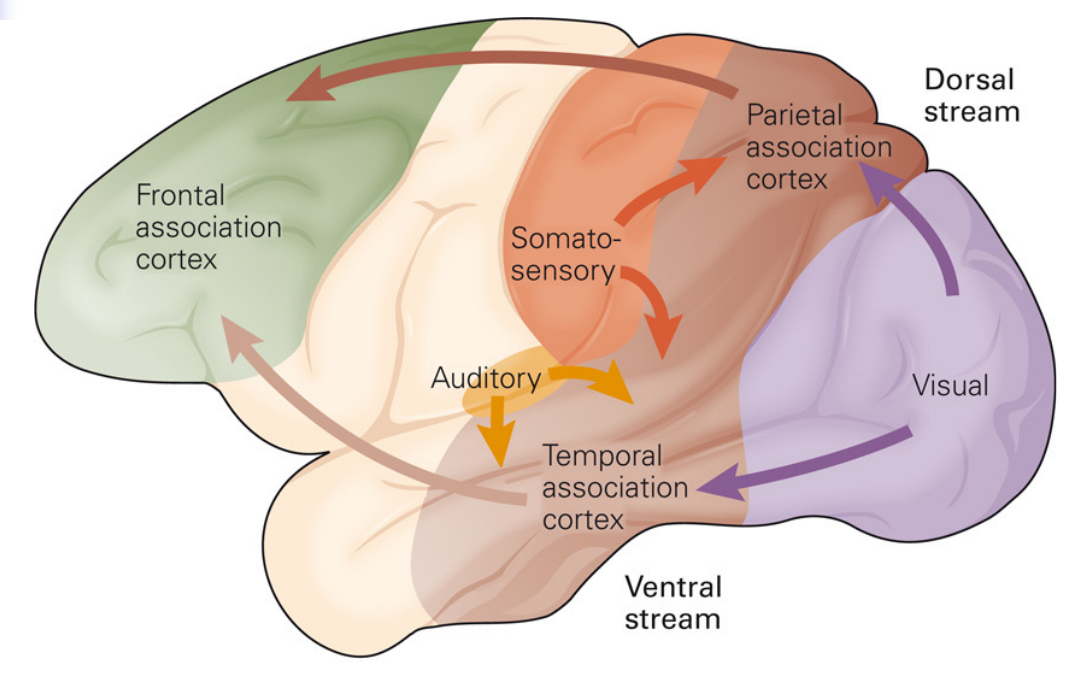
- Posterior Parietal Cortex
- Spatial Neglect
- Prefrontal Cortex (PFC)
- Executive function
- Phineas Gage
- Executive function
PFC
Human patients with PFC lesions show severe deficits in working memory tasks
- Tower of London
- Tower of Hanoi
Animal lesions - Delayed response tasks
- Memory guided saccade task (remember which cue to follow post delay period)
- Correct trials show sustained activity during delay period, while in error trials the activity stops firing
- Recording from DLPDC (dorsolateral prefrontal cortex)
- Similar activity can be found in parietal cortex (area LIP)
- Correct trials show sustained activity during delay period, while in error trials the activity stops firing
- Small lesions in area 46 interfere with working memory
Arbitrary Visuomotor Mappings
Monkey learns arbitrary mappings, and then has PFC lesioned bilaterally
- Still able to recall familiar stimulus-response mappings (more error prone but can perform then)
- Completely unable to learn new stimulus-response mappings
Decisions about Visual Motor
Monkey watches random dot stimulus with some embedded net motion in one of two possible directions
Has to figure out in which direction the dots are moving and reports decision with a saccade
How is the sensory information transformed into motor commands?
Quick Facts:
- Stronger the strength of motion: the higher percentage correct and the faster the mean reaction time
How to study this?
Sensory areas sensitive to motion:
- MT and MST
?? - PFC and …
Continued Decisions
Activity in MT is correlated with intensity and alignment of stimulus with preferred stimulus
- 6% motion in preferred or against preferred are roughly equal (base firing)
- 100% motion in preferred show highly elevated firing, against preferred shows inhibited firing
Info in Area LIP (parietal)
Takeaway: Motion strength is represented in LIP. Motion signal itself is not represented here. Somehow, it is driven by sensory stimulus.
Additionally, if you compare activity here to pure visual response in MT, there are differences?
- Potentially, the LIP activity can be viewed as an integrative model, which supports why activities look somewhat similar prior to response
- Activity DIFFERENT with respect to stimulus onset, but SIMILAR prior to response. Supports idea that they are coming to a decision prior to saccade, motivated by integration
- Early on in a trial (left side) the parietal activity was mainly determined by the properties of the sensory stimulus (slope reflects motion strength or coherence of the stimulus).
- Late in a trial (right side; shortly before the eye movement response) the parietal activity was mainly determined by the monkey’s choice (in particular true for neurons with chosen target in their RF).
- Looks like these neurons allow us to monitor the ongoing decision or sensorimotor transformation process.
Proposed Mechanism
Pool of MT neurons ->
- Proposed that between integrator (
) and threshold element LIP is innervating - LIP - Both an integrator and a threshold? debate
- Big idea, it is a distributed network
- Two neural integrators (one for each available choice) are racing against each other. The one reaching a critical threshold first wins the race (and determines the choice and terminates the decision process).
- Each integrator accumulates the net sensory evidence for the associated choice (difference between the activities of the two relevant pools of sensory neurons).
- Model can explain both the behavior and the neural activity in parietal cortex.
Similar neural activity patterns have been recorded from prefrontal cortex (area 46), the frontal eye fields, and from the superior colliculus
- Differential roles of these areas are not clear at this point
Is this viable?
It can be proven that this relatively simple approach allows the brain to approximate an optimal decision algorithm: sequential probability ratio test (SPRT)
- When a decision has to be made between two alternatives based on continuously inflowing sensory observations (that are statistically independent), SPRT is optimal in the sense that it guarantees the shortest possible mean decision time for any desired accuracy
Decisions about Somatosensoroy Stimulu
Monkeys have to remember a vibratory stimulus, and then make a judgement about a second vibration to rate if it was higher or lower in frequency than the first
Recordings:
S1, S2 (primary and secondary somatosensory cortex) and PFC, MPC (prefrontal cortex and premotor cortex. Written here as MPC instead of PMC?)
S1 and S2 show activation briefly before, and during stimulus presentation then back to baseline
- S1 has a positive signal correlation (higher frequency, higher activation)
- S2 has a negative signal correlation
PFC activity is higher breifly before and during and during stimulus presentation, as well as sustained activation during the delay period - We see differential activity depending on frequency of stimulus (higher stimulus, higher activity)
🧪 -> Refresh the Info
Did you generally find the overall content understandable or compelling or relevant or not, and why, or which aspects of the reading were most novel or challenging for you and which aspects were most familiar or straightforward?)
Did a specific aspect of the reading raise questions for you or relate to other ideas and findings you’ve encountered, or are there other related issues you wish had been covered?)
🔗 -> Links
Resources
- Put useful links here
Connections
- Link all related words