📗 -> 06/04/25: NPB163-L18
Visual Attention
Final Review Slides
🎤 Vocab
❗ Unit and Larger Context
Today is more of a bonus lecture, where she goes over her old research but doesn’t expect us to know it for final
✒️ -> Scratch Notes
Recommends going over all material and making some personal notes/study guides.
- Helps to organize what you do / do not know
- Increase familiarity as you go
Visual Attention
What is it?
- w
Process by which visual information is organized / processed respect to behavior
Two Types
Stimulus Driven Attention and Goal Driven Attention
Stimulus Driven Attention
Two obvious examples:
- Camouflage - Elude attention, blend in
- Fashion - Capture attention, stick out
Why do different things stick out? What is salience?
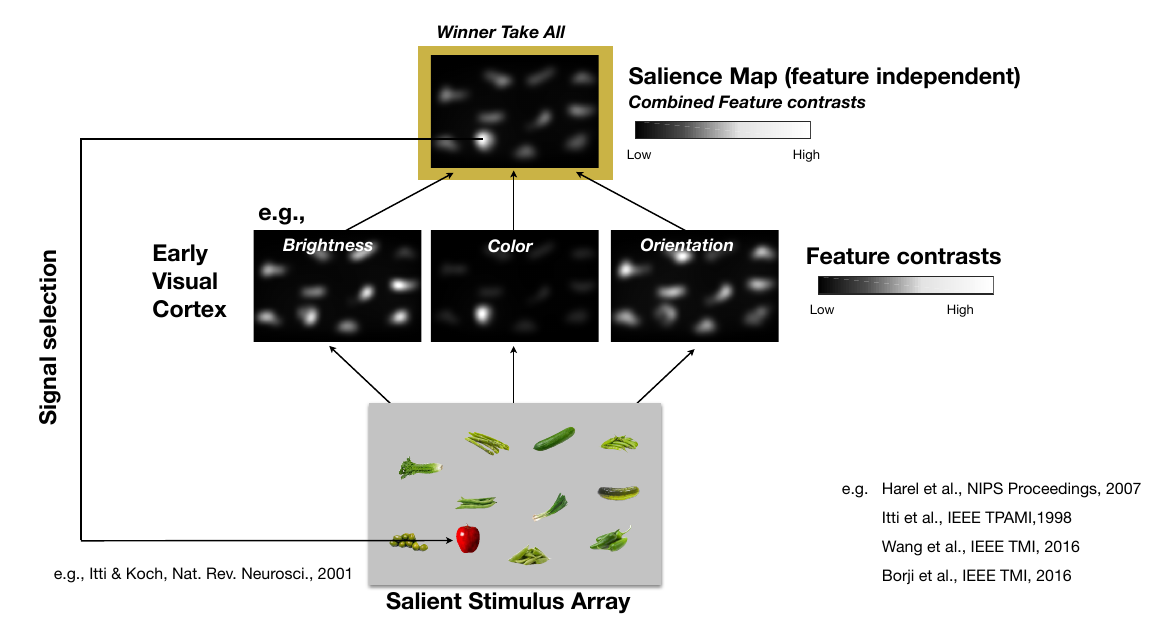
- This is in visual system
- Activations in parallel for different features / dimensions
- Apple has very high salience in the color dimension
- Different types of ‘salience’ compete in a winner take all salience map (feature independent)
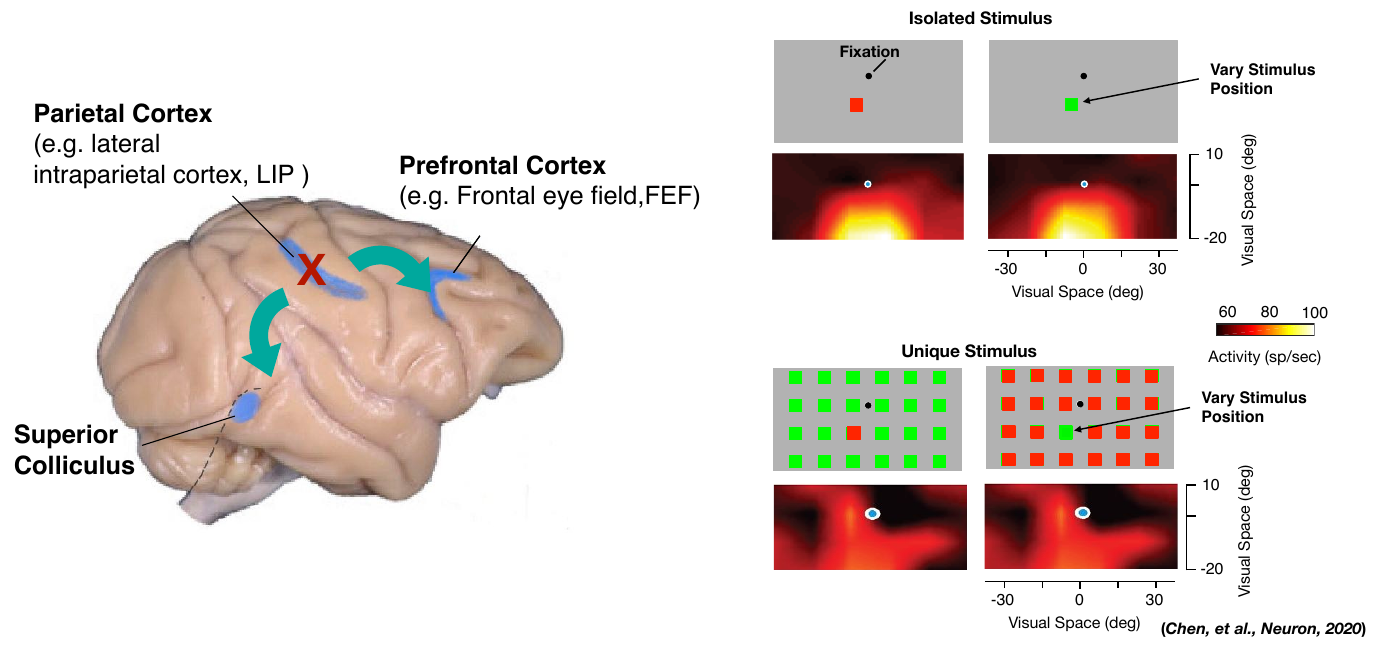
- Parietal cortex, Prefrontal cortex, Superior Colliculus all play a role in visual attention. Recordings show ‘salience’ activation in all
- Normally, we see highly similar activation fields to isolated and unique stimulus, but after perturbation, of LIP, we see the receptive field change
- This tells us there is a causal infleunce here
What is the sensory epithelium of the visual system? How does the retina contribute to this?
Retina photoreceptors are already tuned to an area. This contributes to formation of retinatopic map
Sensory epithelium in auditory cortex:
- ?
Organization of auditory system? - Tonotopic
PFC area (frontal eye field, FEF):
- ?
Influence of stimulus driven attention on scanning eye movements
??
Goal-Driven Attention: Spatial Attention
Posner cueing task:
- Classic paradigm for visual/spatial attention
- Give cues, and measure RT performance
- Neutral cues (none), invalid cue (cue to wrong side), valid cue (cue to same side)
- Endogenous cue - Arrow right above fixation point
- Exogenous cue - Farther from fixation point
Neural Correlates
- Robust attention-related ring rate modulations have been reported in higher-order visual cortical areas like V4, MT or MST. Attentional modulation in primary visual cortex (V1) is substantially weaker.
- Spatial attention: responses to the same stimulus inside the receptive eld (RF) depending on whether attention is allocated inside or outside the RF:
Some of the effect can be described as a ‘gain change’
- Responses to stimuli are increased, especially for preferred stimuli
- Observed in MST and V4
Goal-Driven - Thought to be Top-down, evidence from FEF being activated before similar activations in V4
Stimulus-Driven - Feed-forward
LFP - Voltage signal measured from extracellular space
- Tied to oscillations
Gamma-band: Tied to synchronized population activity and …
…
When you stimulate superior colliculus / FEF you usually induce a saccade
Subthreshold stimulation administered (no direct saccades):
If you stimulate FEF:
- If target is at MF (motor field?): sensitivity will increase
- Selective effect
- If you measure selectivity at other locations, you will not see this effect
FEF causally related yippee
Administer the same experiment with superior colliculus (SC), and see similar effects
Example of Goal Driven:
Do a quick scan for red triangles:
- Afterwards, asked about yellow circles. No clue, information not attended to.
Review
very sparse notes, we skimmed over a lot of it
Techniques
Recording
- Invasive
- Noninvasive
Manipulation of neuronal activity - Inactivation
- Activation
Neural Codes
Single neuron vs Population
- Takeaway of information theory:
- Entropy = Uncertainty of system
- Bound to 0, log2(states)
- 0 entropy: System determined
- log2(states):
- Bound to 0, log2(states)
- Mutual information:
- 0, entropy of system
- Reduction in system uncertainty (things co-varying for example)
etc. etc…
- Entropy = Uncertainty of system
Visual System
Sensory epithelium:
- Where is it in vision? RETINA!!
Development of map is due to the retinotopic organization of the retina. Adjacent positions in space associated with adjacent retinas
etc. etc…
Auditory System
Sensory epithelium:
- Where is it in audition? ORGAN OF CORTI!!
synchronized code: low frequency when neurons can follow, high frequency they cannot and get misaligned
Sensory Systems – Feedback, Predictive Coding, Anticipating sensory consequences of own actions
Super important
Anticipating actions
Not just feedforward, but feedback signal shaping perception
Oculomotor System
Purpose of eye movements
6 different types, and their purposes
Muscles
Nuclei
Superior Colliculus
- Know:
- An association area, subcortical
- Service sensorymotor integration
- Help to control eye movement
- Role in decisionmaking and attention
Saccade generation (SC, FEF)
Smooth pursuit
VOR
Skeletal Motor System
…
pay attention to cortical movement control section
etc. etc…
in addition to that, talk about basal ganglia and cerebellum control…
Cerebellum
Basal Ganglia
4 nuclei:
- STN, Striatum (caudate, putamen), Globus Pallidus (external, internal)
Striatum is the input
different theories…
🧪 -> Refresh the Info
Did you generally find the overall content understandable or compelling or relevant or not, and why, or which aspects of the reading were most novel or challenging for you and which aspects were most familiar or straightforward?)
Did a specific aspect of the reading raise questions for you or relate to other ideas and findings you’ve encountered, or are there other related issues you wish had been covered?)
🔗 -> Links
Resources
- Put useful links here
Connections
- Link all related words