📗 -> 04/14/25: NPB163-L5
1 - Neural Codes
2 - Sensory Systems 1
✒️ -> Scratch Notes
Slide Show 1
How to interpret a population response?
Depends on the population, and the question you want to answer:
Given its a population of Gaussian tuned neurons:
- If you want to perform a parameter estimation, a population vector decoder or a Bayesian (maximum likelihood) decoder would be a good choice:
a) Array of tuning curves
b) Population response
c) Population vector decoding (vector average of preferred directions weighted by each neuron’s activity level)
d) Maximum likelihood decoding (based on expected shape of responses)
A Bayesian (or maximum likehood) decoder can be implemented using a RNN (recurrent neural network) - Cleans noise and estimates parameter
When attempting to make fine judgements in tuning (whether a stimulus is a vertical line slightly tilted to the left or right), the most discriminative neurons are not other vertical tuned neurons. It is neurons tuned to the sides.
- The most informative neurons are tuned to parameter values that are to the side of the discrimination line. (The tuning curve needs to be steep at the discrimination line for a high sensitivity.)
Slideshow 2
Sensory Systems:
Animals have sensory systems to guide interaction with it’s environment
What does a sensory system have to do then?
- Interpret the environment.
- An inferred problem, not necessarily perfectly perceiving the world, but inferring underlying causes in the world
- Rustling in the bushes >> rustling of own feet
What problems do sensory systems have to deal with?
- Redundant information, need to only transmit only informational signals
- Ambiguity, signals might not be clear in and of themselves
Sensation is an active process
- Obvious for touch
- Also true for vision, eyes are constantly in motion (saccade approximately 3 times per second)
- Some newer theories of vision propose that we actually only see what our visual system currently enquires about: vision on demand and vision as hypothesis testing. The idea is that our brain creates an internal model of what is currently going on in the world. Incoming sensory information is used to test whether the model is accurate.
- If true, explains phenomena like change blindness, inattentional blindness
Structure of Sensory Systems
- They tend to exhibit maps that follow the organization of the sensory epithelium ( retinotopic maps in the visual system, tonotopic maps in the auditory system, somatotopic maps in the somatosensory system)
- They tend to show a hierarchical structure: As information gets passed on from one level to the next, receptive fields tend to get larger, neurons have more complex response properties, etc.
- Almost all sensory systems (olfaction being the exception) pass their information through a “relay station”, the thalamus, before it enters cortex
- Information exchange between two different levels in the hierarchy tends to be bidirectional
Photoreceptors:
4 different kinds:
- 1 type of rods (low light levels, slow but sensitive)
- 3 types of cones
- L cones (long-wave, “red”)
- M cones (medium-wave, “green”)
- S cones (short-wave, “blue”)
Review: Local processing and center-surround receptive fields
Modulate level of glutamate released with light levels.
- In dark, rhodopsin inactivates, Na+ channels open, cell depolarizes and glutamate released
- In light, rhodopsin activates, Na+ channels close, cell hyperpolarizes and glutamate release is reduced
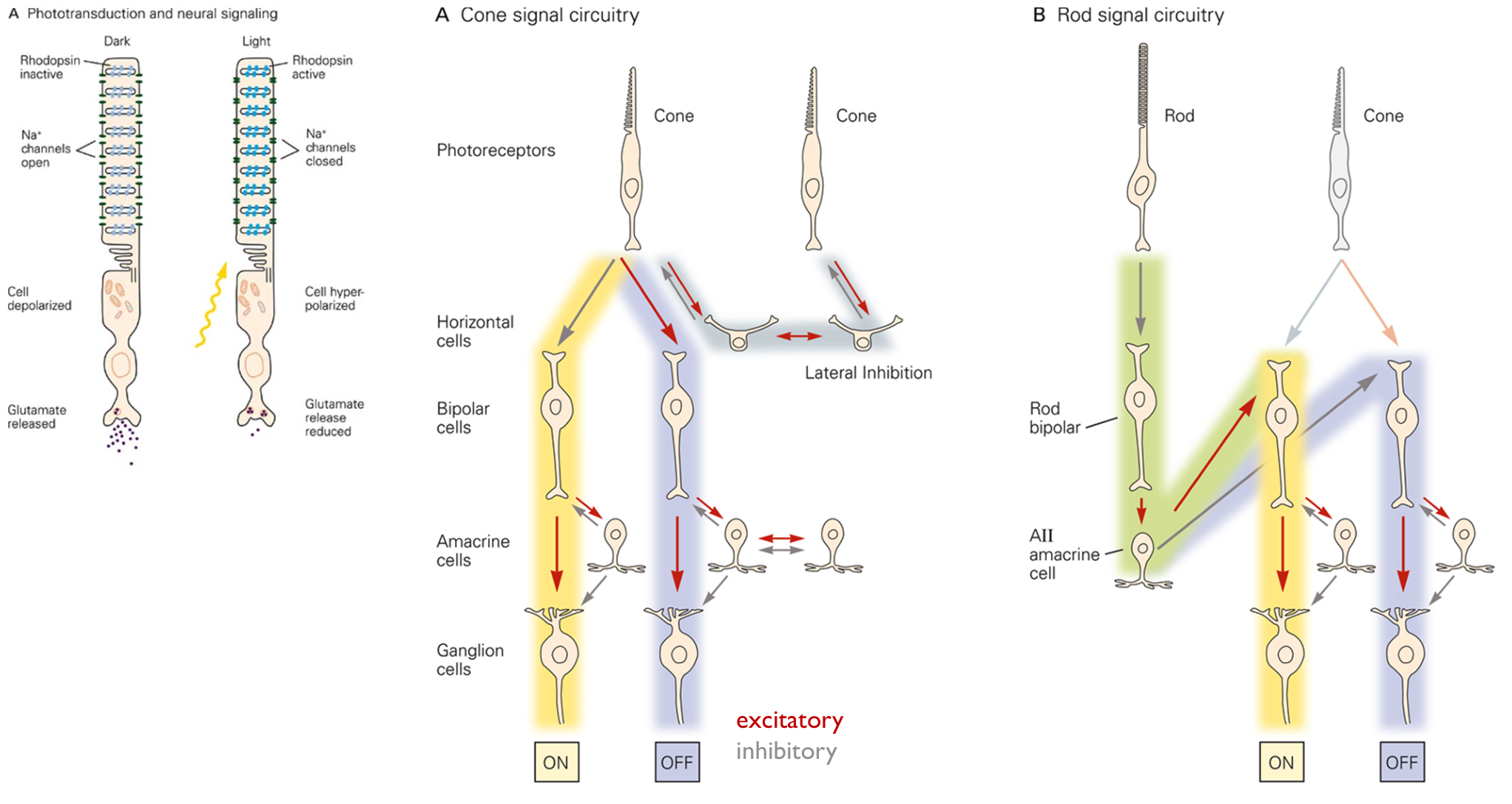
- Notice lateral inhibition
- Notice ON / OFF pathways
New Info: Sustained cells and transient cells
Sustained cells reflect the raw response to stimulus, sustain their activities
Transient cells emphasize changes over time, draw attention to changes
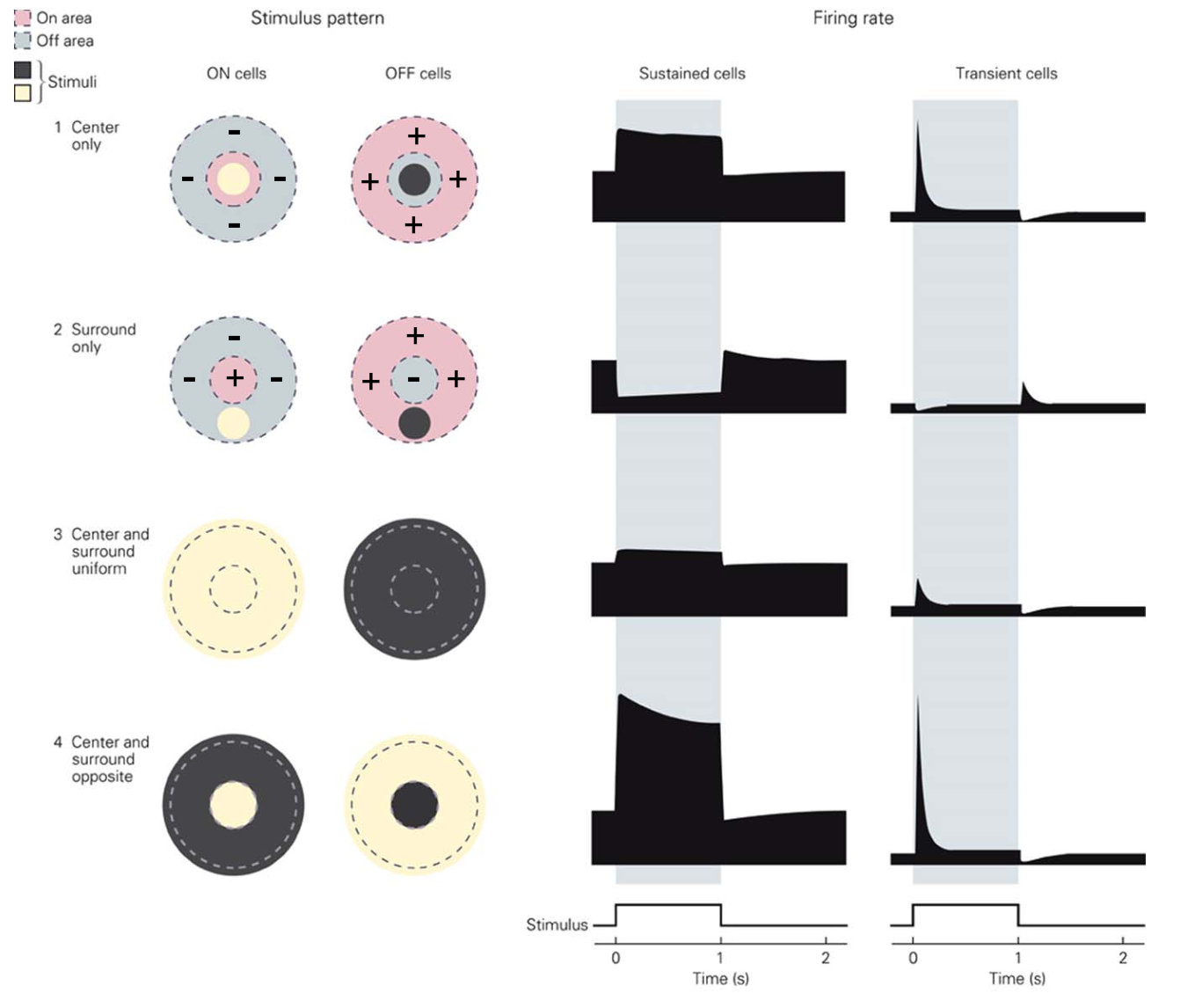
Center surround RF(receptive field) structure help remove redundancy!
- Things that are the same are not interesting, can optimize representation by being aware of where things change
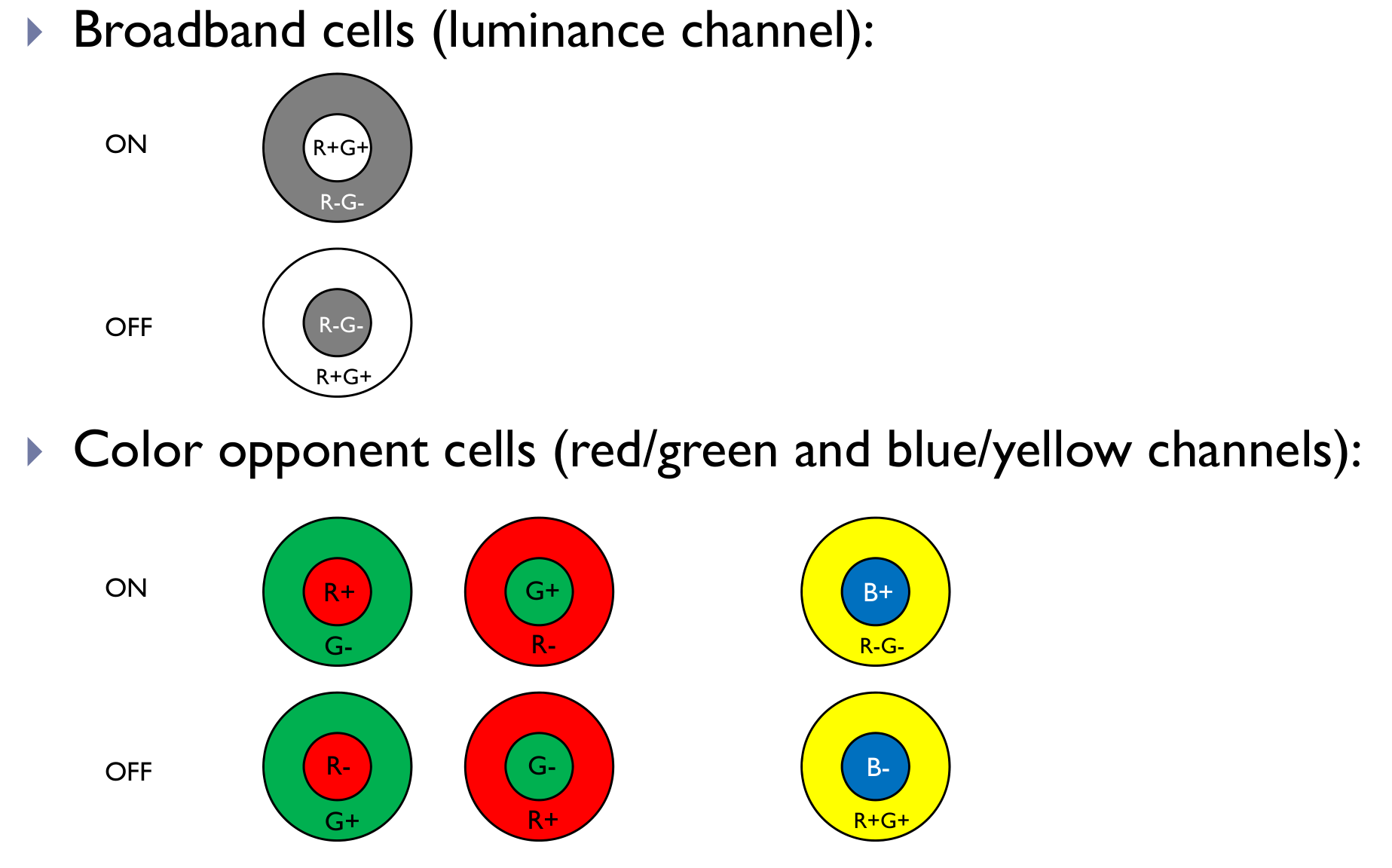
20 different types of retinal ganglion cells that form parallel channels for transmitting visual information to the brain
- Polarity (ON vs OFF center)
- Spatial resolution, fine vs coarse (fovea vs periphery for example)
- Fine -> Parvocellular pathway, color opponent, slower
- Coarse -> Magnocellular pathway, broadband, faster
- Temporal responsiveness (sustained vs. transient)
- Spectral properties (broadband vs. color opponent)
Information further from fovea has a larger receptive field
Information is compressed through this:
- Optic nerve information is estimated to be on order of
bits - Retinal image information is estimated to be on order of
bits
Discussion:
Entropy:
Mutual Information:
f)
It tells you that there is at least an entropy of 1 bit in the original system of the two neurons
It tells you that information about one neuron reduces the uncertainty of the system by 1 bit, which means a reduction of options by 2
🧪 -> Refresh the Info
Did you generally find the overall content understandable or compelling or relevant or not, and why, or which aspects of the reading were most novel or challenging for you and which aspects were most familiar or straightforward?)
Did a specific aspect of the reading raise questions for you or relate to other ideas and findings you’ve encountered, or are there other related issues you wish had been covered?)
🔗 -> Links
Resources
- Put useful links here
Connections
- Link all related words