📗 -> 04/27/25: NPB163-L6
🎤 Vocab
❗ Unit and Larger Context
Start from “Retina to Lateral Geniculate Nucleus (LGN) in the thalamus” (page 14)
Visual Pipeline
- Light - Light hits retina back of eye
- Photoreceptor pipeline - Photoreceptors on retina activate, and project to:
- Bipolar cells
Horizontal cells - Amacrine cells
- Retinal Ganglion cells - These have somas in the ganglion cell of the retina that synapse in the LGN at different areas. Note that they’re called “type” and not “cells”. The name P/M/K cell seems reserved for the neurons with somas in the LGN, very confusing.
- Parvocellular/Midget. P type
- Magnocellular/Parasol. M type.
- Koniocellular/Bistratified. K type
- Photosensitive ganglion type
- Other ganglion cells projecting to the superior colliculus for saccades. These do not project to LGN.
- Bipolar cells
- LGN - The ganglion cells have axons that project through the optic nerve, cross at the optic chiasm, and then through the optic tract, ultimately synapsing with their respective cells (P/M/K cells) in the Lateral Geniculate Nucleus (LGN) in the thalamus.
- Remember that the signals have already split at the optic tract according to hemifield (left/right field of view)
- The LGN maintains different projections separate in the 6 layers of the LGN.
- V1 - The LGN then projects to V1, or the striate cortex. Here is where the first binocular processing occurs, up to now signals were kept separate.
After this it kind of becomes a mess with projections:
- PICTURE OF MOMKEY not human
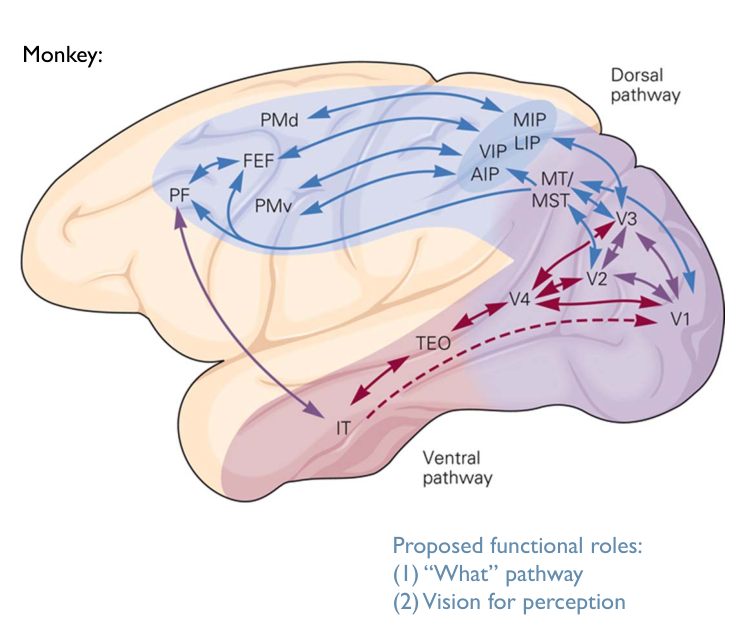
- Ventral stream (what):
- From occipital to temporal lobe
- V2 -> V4 -> TEO -> IT
- Dorsal Stream:
- From occipital to parietal lobe
✒️ -> Scratch Notes
Overall Vision Pipeline so far:
Light hits retina
- Retina (in back of eye) has photoreceptors, 4 types
- 1 rod, 3 cones
The photoreceptors in the retina will project to horizontal cells, bipolar cells, amacrine cells, and finally to ganglion cells in ON/OFF pathways.
- 1 rod, 3 cones
- ON cells and OFF cells with center surround RF structure
New
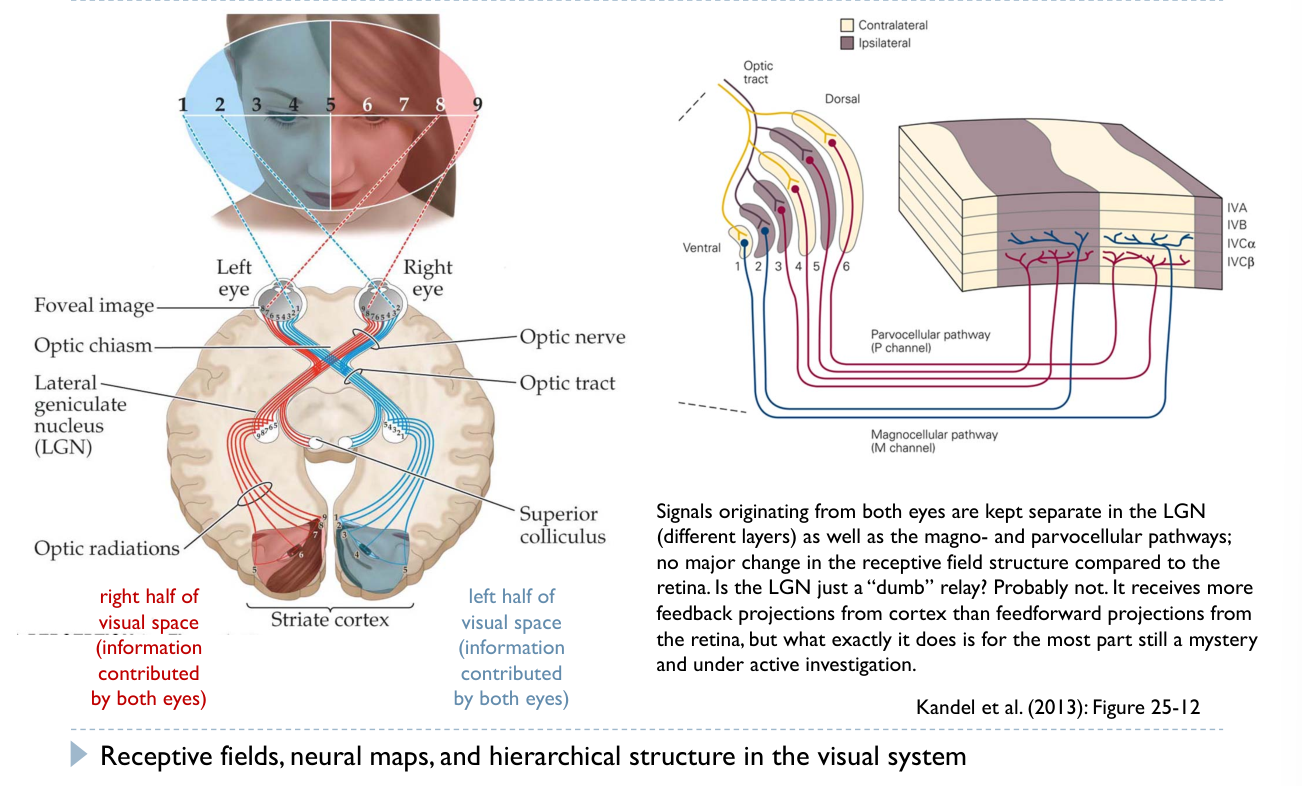
From there, they will travel down the optic nerve, cross at the optic chiasm, and then project through the optic tract to the lateral geniculate nucleus (LGN) in the thalamus as well as the superior colliculus.
- The LGN separates signals from both eyes in different layers of the LGN
- At this stage visual field is already undergoing early manipulation, with the fovea having a much larger representation in the LGN than more peripheral areas of the retina/visual field
The LGN then projects to the striate cortex, or V1, through optic radiations.
In V1, early visual processing will develop: - Simple cells - Have distinct ON and OFF regions
- Orientation selectivity, liking one direction of lines
- These line cells need both an alignment of spatial position/phase and spatial frequency (having the line size be aligned with its receptive field size, too small will hit not activate the on center and will activate the off surround)
- Orientation selectivity, liking one direction of lines
- Complex cells - No longer have distinct ON and OFF regions
- Spatial frequency important, but phase/spatial position no longer.
- Could arise from being compose of off phase simple cells, “covering each others blind cells” in a given receptive field
- Spatial frequency important, but phase/spatial position no longer.
- Disparity tuning - V1 is the first stage where binocular vision is computed.
- Binocular disparity used for calculating depth, as follows:
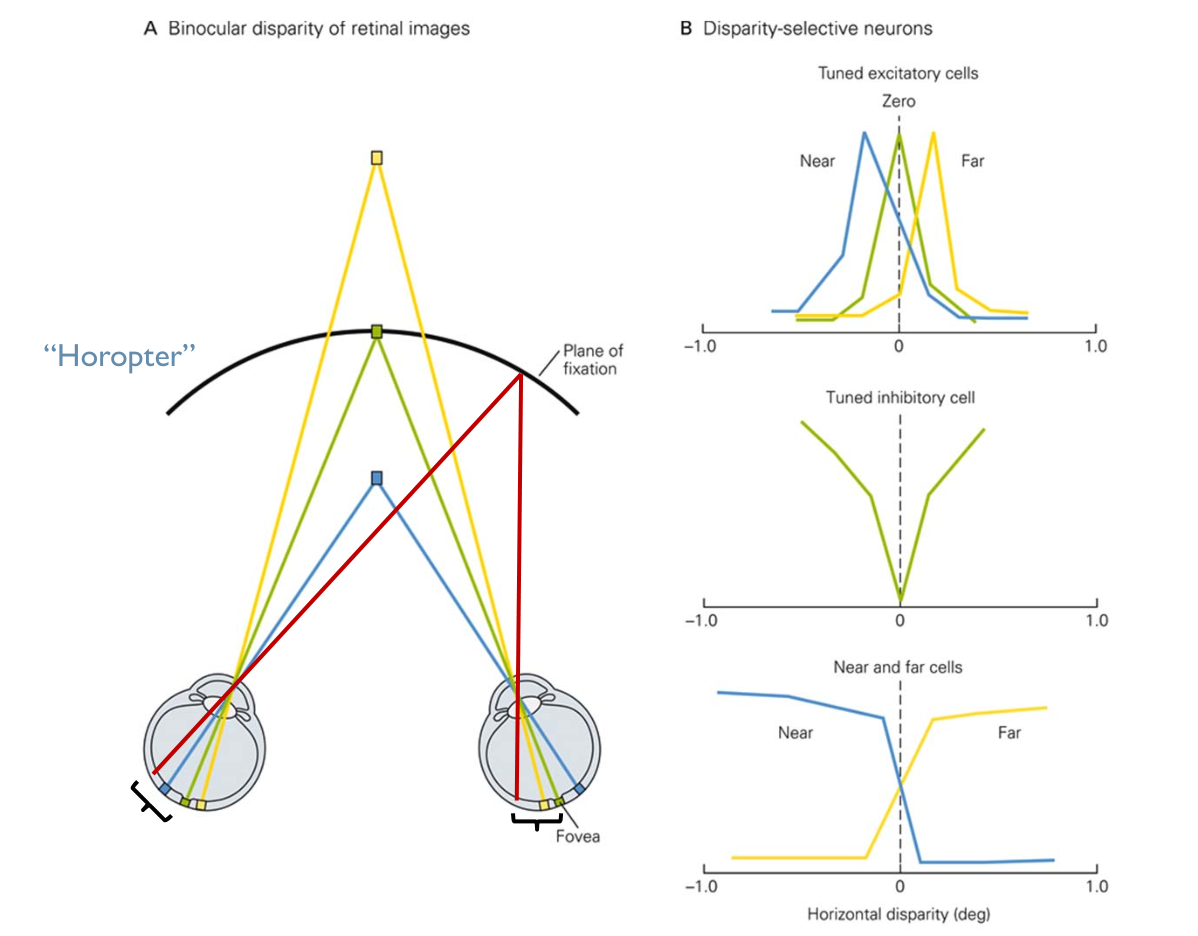
- Binocular disparity used for calculating depth, as follows:
- If a object falls on the plane of fixation, it will have the same corresponding position on the retina (red and green)
- If it lies beyond (far), it will have a positive horizontal disparity (be more shallow on retina than a corresponding object on plane of fixation)
- It it lies closer, it will have a negative horizontal disparity (be more wide)
🧪 -> Refresh the Info
Did you generally find the overall content understandable or compelling or relevant or not, and why, or which aspects of the reading were most novel or challenging for you and which aspects were most familiar or straightforward?)
Did a specific aspect of the reading raise questions for you or relate to other ideas and findings you’ve encountered, or are there other related issues you wish had been covered?)
🔗 -> Links
Resources
- Put useful links here
Connections
- Link all related words