📗 -> 04/29/25: NPB173-L8
🎤 Vocab
❗ Unit and Larger Context
Lecture 9 Overview
- Neurotransmitters and their life cycle
- Circuitry of the basal ganglia, including dopamine input
- The dopaminergic neuromodulatory system
- Neurodegeneration in Parkinson’s disease
- Overview of Parkinson’s disease
- Basal ganglia dysfunction in Parkinson’s disease
- Treatments for Parkinson’s disease
Lecture 9 learning objectives
- Basic concepts related to neurotransmitter clearance.
- Specifics of the dopamine life cycle.
- Specifics of basal ganglia circuits as discussed in class.
- Basic concepts related to ascending neuromodulatory systems.
- Signs and symptoms of Parkinson’s disease.
- Familial vs. sporadic diseases and relation to age of onset.
- Basic concepts related to neurotransmitter synthesis.
- Genetic factors affecting neurodegenerative disorders.
- Multiple initiating causes with a final common pathway of dysfunction.
- SNCA gene, alpha-synuclein protein, and Lewy bodies.
- Circuit mechanisms of Parkinson’s: rate model and pattern hypothesis.
- Braak staging and progression of degeneration in Parkinson’s.
- Possible treatments for Parkinson’s
✒️ -> Scratch Notes
Neurotransmitter mediated synaptic transmission
- At chemical synapses, nerve impulses arriving at the presynaptic axonal temrinal result in neurotransmitter release into the synaptic cleft between the neurons
- Neurotransmitters cross the synaptic cleft ad bind to receptors on the post synaptic neurons
- Receptors can be ion channels or metabotropic receptors that act through second messengers
Life cycle of a neurotransmitter
- Synthesis through chemical reactions, usually in the neurons that release them
- NTs are stored in vesicles at presnaptic terminals, ready for release
- After release and postsynaptic action, they are cleared from the synaptic cleft
- Finally, they are repacked for reuse or broken down through chemical reactions
Classification of neurotransmitters
- Can be classified based on: structure, mode of action, and location
- Glutamate and GABA are the two most common NTs for ionotropic signaling in the brain
- Man NTs instead play a neuromodulatory role acting via metabotropic signaling that has varying effects. This includes the biogenic amines.
- Neurons tend to have one primary NT that it releases. It can be affected by multiple different NTs, has multiple types of receptors
NT synthesis
- Synthesis usually starts from commonly occurring precursor molecules (e.g. amino acids)
- Synthesis regulated by enzymes expressed by neurons
- Some major NTs are part of the same synthesis cascade
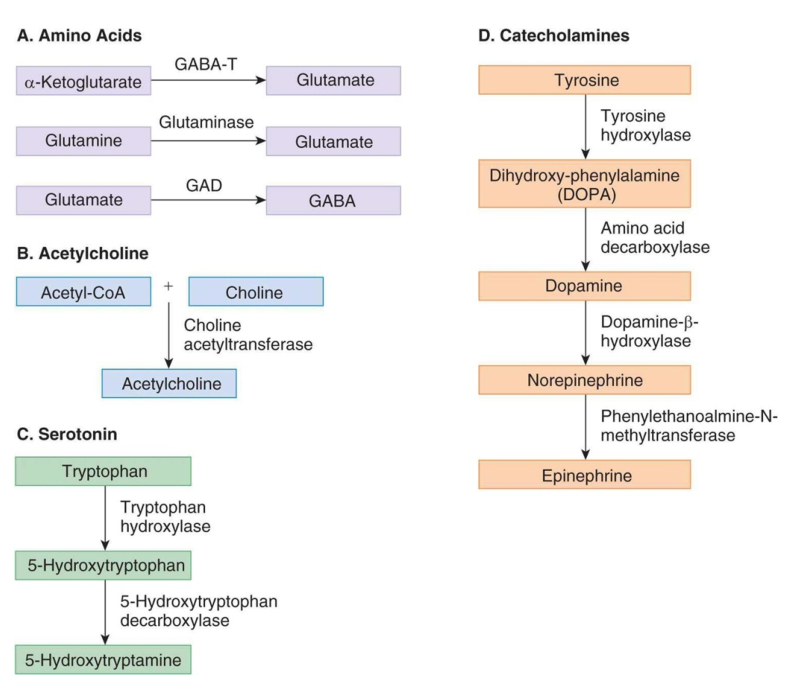
- Usually mediated by the molecule on the arrows, usually an abundant amount of the base molecule (for example, always enough glutamate, it’s synthesis into GABA is mediated by the amount of available GAD)
NT clearance
3 main ways of clearance from synaptic cleft:
- Diffusion - The slowest. Just drifts away
- Active transport - Requires energy. Mediated by NT transporters on neurons and/or glia
- Degradation - Occurs via enymes either in the cleft or intracellularly
Dopamine life cycle
Dopamine synthesized in two steps from amino acid tyrosine (super abundant) through the intermediary molecule DOPA. Both steps catalyzed by specific enzymes
Dopamine transporters mediate the reuptake of free dopamine in the synaptic cleft back into the presynaptic terminal
- Active transport, requires ATP
- One way transporter, synaptic cleft to presynapse
Dopamine can also be degraded by two enzymes: MAO and COMT (monoamine oxidase (MAO) and Catechol-O-methyl transferase (COMT))
If the degradation is inhibited, then dopamine’s effects will be larger, effectively in the cleft for longer
Ascending Neuromodulatory Systems
Dopamine mostly acts as a neuromodulator
Neuromodulators act via metabtropic receptors with effects that are slower and longer lasting than ionotropic effects
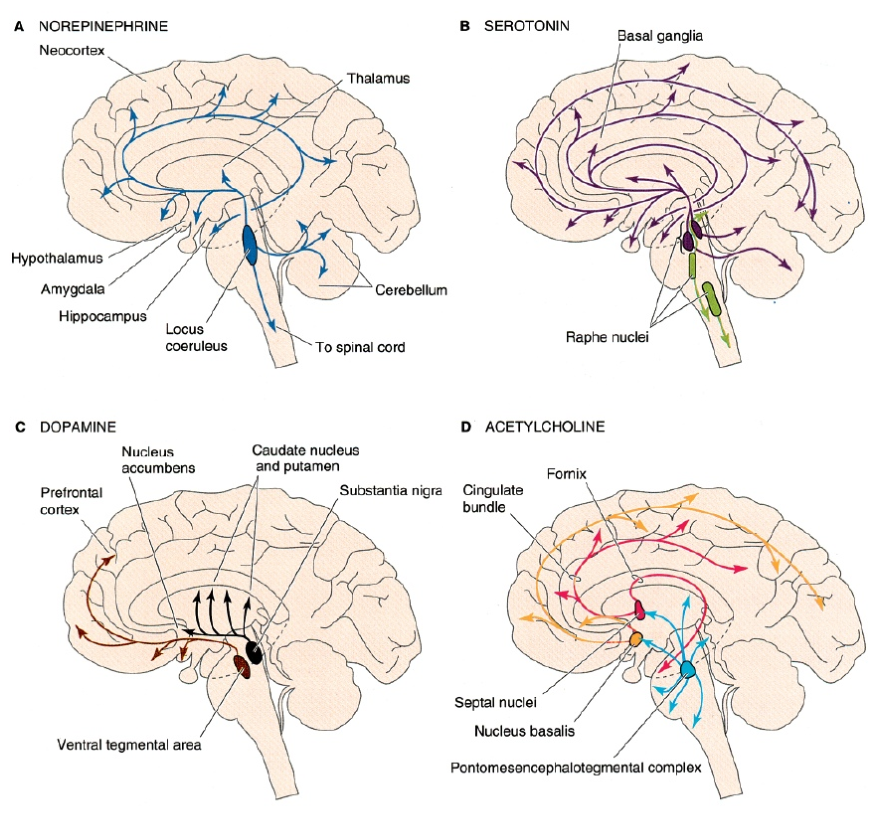
Multiple ascending neuromodulatory systems that use distinct neurotransmitters, including:
- Dopamine
- Norepinephrine
- Seratonin
- Acetylcholine
Called ascending because:
- They have projections that generally ascend cortical regions as well as subcortical regions
They tend to be diffuse and have different targets, as well as different sources
Basal Ganglia Circuitry
Two primary neural cirtcuits from the striatum: the direct pathway and the indirect pathway
- Direct pathawy facilitates movements
- Indirect pathway inhibits movements
Best understood by tracing excitatory and inhibitory connections to cortex
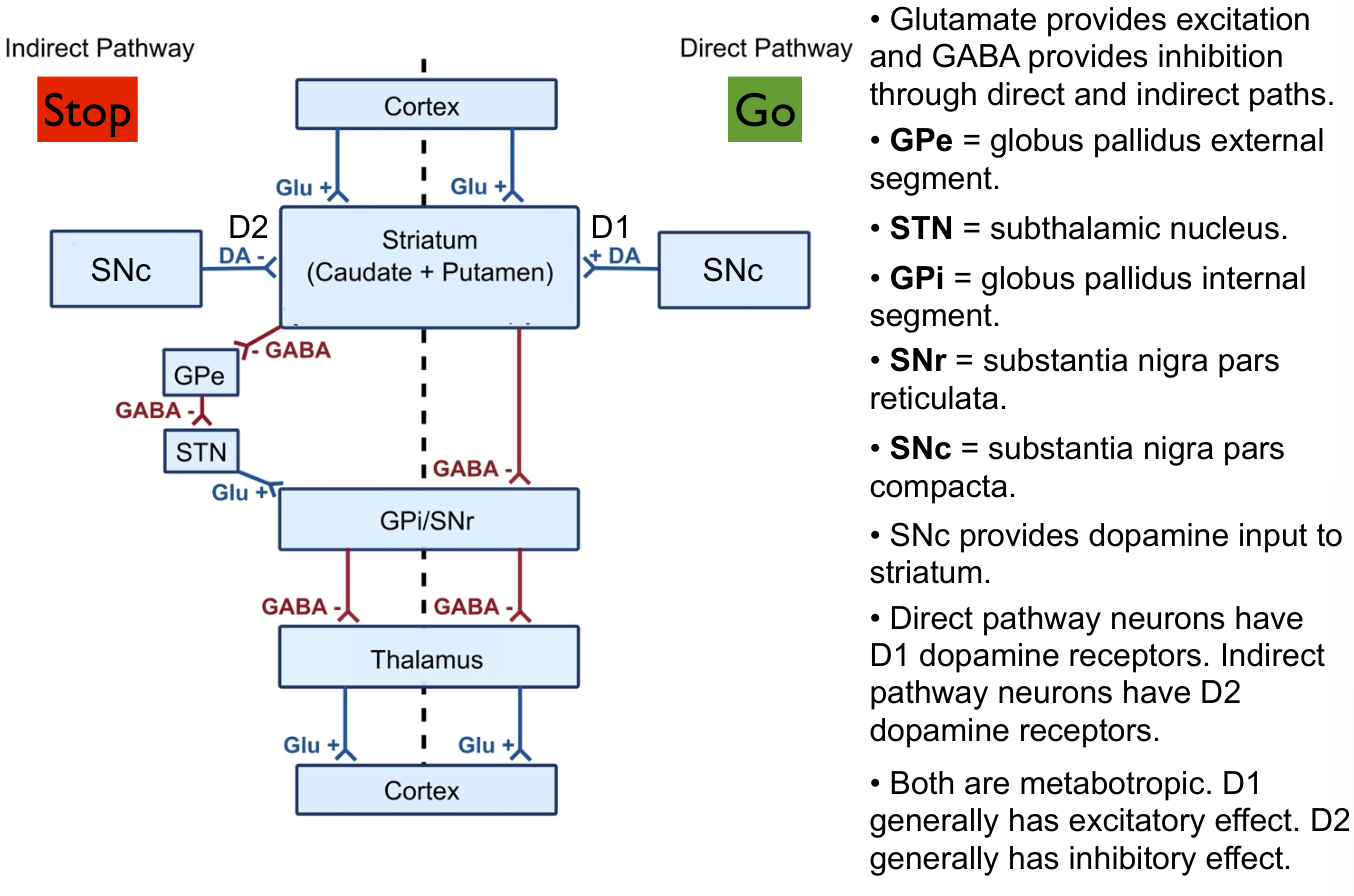
- Anything with thalamus, cortex, and nucleus in the name is excitatory
- Everything else is inhbitory
Parkinson’s
Parkinson’s on the basal ganglia
- Different neurons are most vulnerable compared to Huntington’s disease
- Parkinson’s leads to cell death that is most severe in dopamine neurons of the SNc
- Reduces dopamine neuromodulation of the striatum
Parkinson’s disease signs and symptoms
Associated with bradykinesia, slowness of movement
Associated with resting tremor (shaking during periods of inactivity) and muscle rigidity (resistance to imposed movement)
Associated with non-motor symptoms: sleep disorders, disturbances of autonomic nervous system function (control of internal organs), mood changes, and cognitive impairment
Prevalnce is age dependent with greater prevalnce at older ages
Progressive, with impact worsening over time
Impact
Prevalence of 100-300 per 100,000
Prevalence of 1% for age over 60, 3-4% for age over 80
Average life expectancy is 7-14 years after diagnosis
Accounts for over 100,000 deaths a year
Heritability
Two types of onset:
- Familial - Parkinson’s thought to be inherited
- More likely to have early onset
- Sporadic - Not believed to be inherited
Based on prevalence among close relatives
Some cases of familial PD have a known cause that is monogenic (based on a single gene)
- Recessive and dominant monogenic causes exist
- Penetrance - the likelihood that someone with a specific genetic variant will develop the disease
- Frequency of genetic mutation is anti-correlated with penetrance
Most cases are sporadic
Causes
Mangy genetic and environmental risk factors
Likely has multiple initiating causes that lead to common final pathway of dysfunction
Lewy Body Inclusions
Parkinson’s post-mortem brain histology shows specific pathology in neural tissue called Lewy bodies
Lewy bodies are a specific type of protein aggregate within cells that displace other cell components
- Composed of multiple proteins, with alpha-synuclein prevalent
- Encoded by the SNCA gene, point mutations to which can cause Parkinson’s with autosomal dominance and full penetrance.
- abundant in the brain, but its normal function is not well understood.
The role of alpha-synuclein in neurodegeneration
The alpha helix motifs in it can attach to the cell membrane, and eventually lead to Lewy body formations
Circuit Mechanisms of Parkinson’s
Rate model of Parkinson’s disease
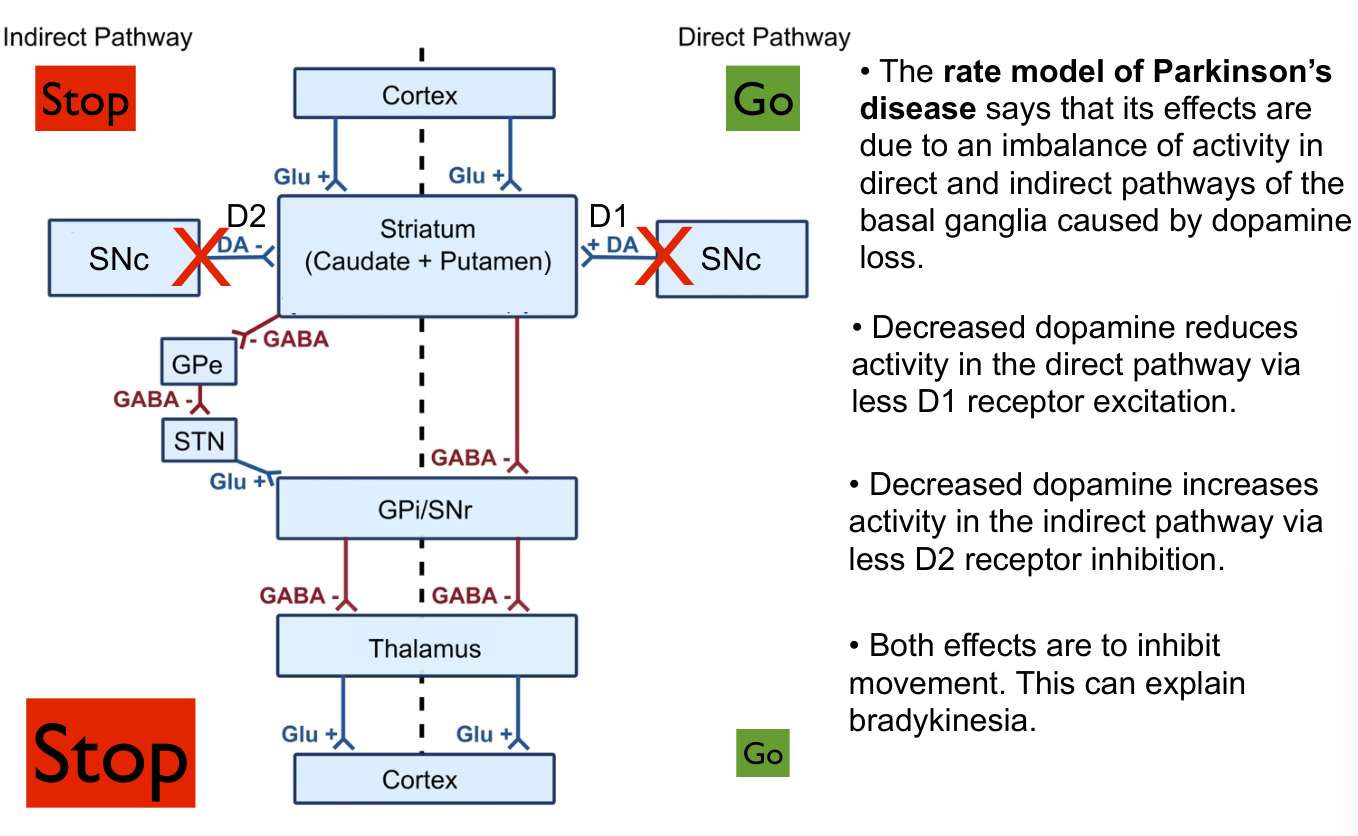
- Forcing the brain into a mode where its very difficult to initiate a movement
Pattern hypothesis of Parkinson’s disease
- Suggests that changes in response patterns due to dopamine loss play a role in its effect, beyond just changes in overall balance between direct and indirect pathways
Reduced dopamine alters patterns of responses in the basal ganglia
This leads to patterns of: more bursts of action potentials, increased oscillations, and increased synchronous action potentials between neurons

Progression of Parkinson’s Pathology
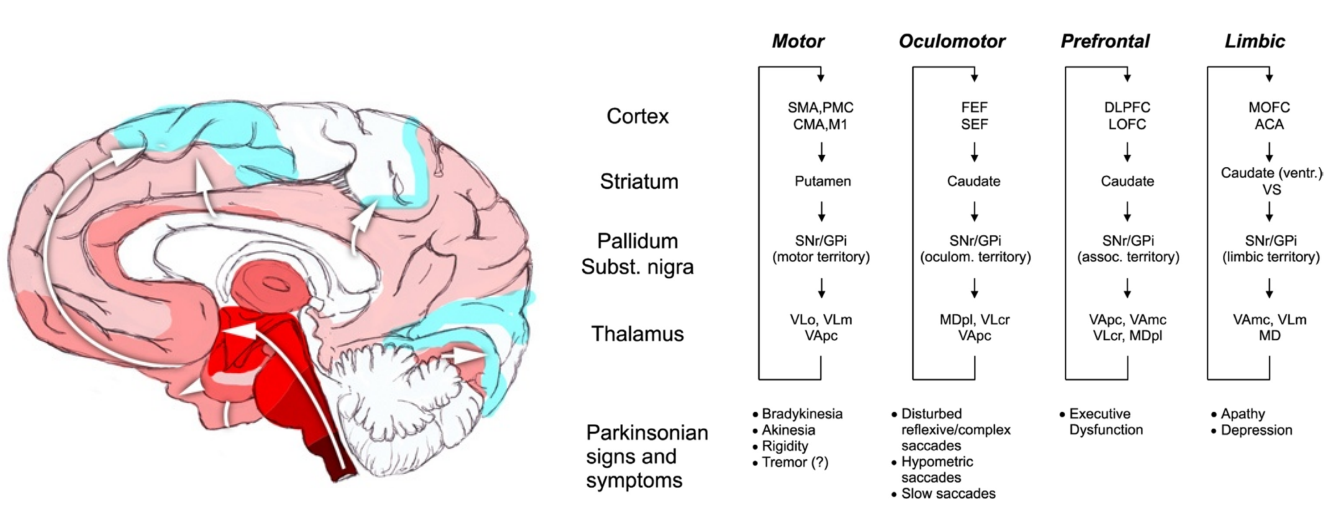
- Most severe damage is in the SNc, but happens elsewhere as well
- Degeneration usually begins elsewhere, progressing from more peripheral to more central areas. This progression is known as Braak staging
- Parkinson’s affects the motor loop most severely befoer progressing to other loops
Molecular Treatments
- Most effective treatment for Parkinson’s is medication with L-DOPA, the immediate precursor to dopamine in its synthesis pathway. L-DOPA crosses the BBB
- Dopamine release, receptor effects, clearance, and degradation are all potential targets of therapeutics, but none are as effective for Parkinson’s as L-DOPA.
Cellular Treatments
- The goal of mst cellular treatments is to slow, stop, or pervent disease progressin
- The best potential target is the molecular cascade that leads to toxicity, but it is not well understood and approaches have not yet proven successful
Circuit Treatments
Replacement - Ideally, SNc neurons that are lost could be replace artificially, but attempts with stem cells have not yet worked
Removal - Artificial lesioning of STN mitigates symptoms of Parkinson’s, but it is highly invasive and not reversible
DBS - The most effective surgical approach (employed after L-DOPA stops working) is regular artificial high frequency bouts of stimulation to STN. Mechanisms of action are controversial, but it may block or override abnormal activity from STN
🧪 -> Refresh the Info
Did you generally find the overall content understandable or compelling or relevant or not, and why, or which aspects of the reading were most novel or challenging for you and which aspects were most familiar or straightforward?)
Did a specific aspect of the reading raise questions for you or relate to other ideas and findings you’ve encountered, or are there other related issues you wish had been covered?)
🔗 -> Links
Resources
- List all resources