📗 -> EEG Witness Testimony Assessment
We now have a Notion Page for readings, put there as well.
Pages
EEG-Oscillations-Reflect-Cognitive-and-Memory-Performance
Review-Retention-Recall-Processes
Analysis-of-Eyewitness-Testimony-Using-Electroencephalogram-Signals
Future Reading
Human memory retention and recall processes. A review of EEG and fMRI studies
EEG biomarkers of free recall - ScienceDirect
Episodic and semantic memory: an analysis in the EEG theta and alpha band - ScienceDirect
Electroencephalography (EEG) and Event-Related Potentials (ERP’s) with Human Participants - PMC
Encoding- and retrieval-related brain activity underlying false recognition - ScienceDirect
🎤 Vocab
💡-> Ideas
Questions:
This paper has a much higher sampling rate (2048 Hz). Even after it is downsampled to 512 Hz, it is still higher than the sampling rate of the CytonBoard (only 250 Hz). This is something to keep in mind when applying filtering techniques (know that your data will look different and thus must be filtered/treated differently).
- How would this affect our experiment?
Current Pipeline
Transclude of Witness-Reading-2024-12-06-01.54.13.excalidraw
Options
- Make it softer, something like DRM paradigm
- Issues: subjects have to read, the ERP might be offset by how fast they read
- Limited generalization to the end goal, which is witness testimony assesment
- Maybe add a condition to simulate over rehearsal (ie a subject convincing themselves of something because they repeat it enough, over-rehearsal leading to false memories)
Transclude of Witness-Reading-2024-11-17-18.48.38.excalidraw
- Test for false memory induction, by having short unrelated witness videos used in succession
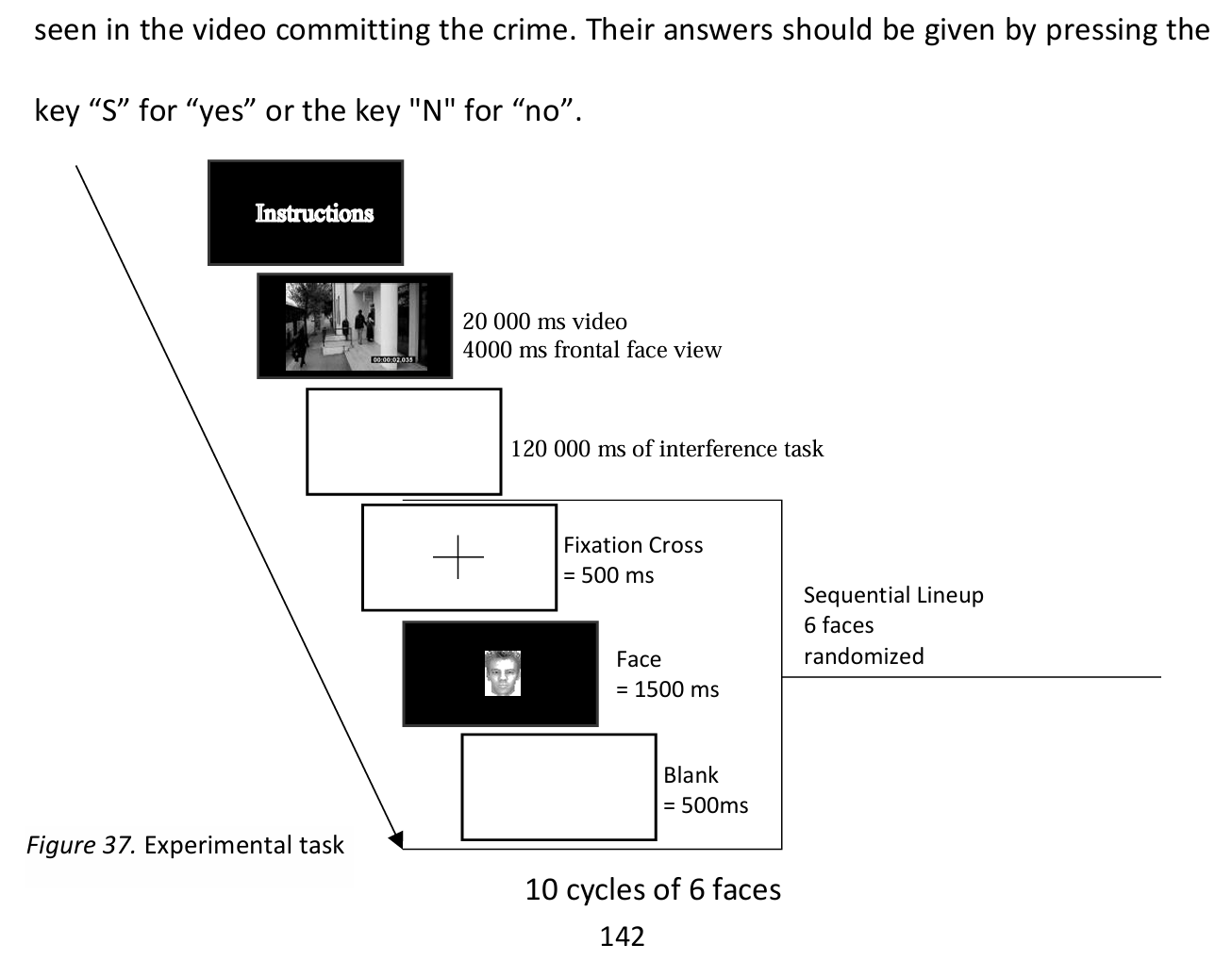
Transclude of Witness-Reading-2025-04-15-11.17.00.excalidraw
✒️ -> Reading Notes
Analysis of eyewitness testimony using electroencephalogram signals
Design
Used P. Bem-Haja’s dataset of 20 second crime videos, and asked participants question
Analysis
Selected theta, alpha, and beta bands.
- Theta waves - associated with mental operations: attention, learning, memory recalls
- Beta waves - active, busy, anxious thinking
- Alpha waves -
Finally, studies like 6 have been made concerning the asymmetry of the alpha waves in questions of emotion and motivation.
Gamma Oscillations Distinguish True From False Memories
Encoding
Increased gamma power (28–100 Hz) in the hippocampus, prefrontal cortex, and left temporal lobe predicted whether an item would later be successfully recalled.
Retrieval
A similar increase in gamma power during the 500 ms preceding correct recall was observed in the same regions. False recalls exhibited a weaker or absent gamma-power response in these regions.
Effect of EEG evidence on juror decision
Takeaway:
- Not directly useful for the project, but an interesting ethical consideration
- The evidence of EEG lie detection swung a decision by 20%, 40% → 20%
- Is it ethical to use/present evidence with a degree of uncertainty in trial
🔗 -> Links
Resources
-
Neural Markers of Decision Confidence
- Not related to this particularly, an experiment with a task that asks participants to rate their performance. ERP data shows there is a difference in the averaged waveform.
-
Neural Correlates of Perceived Confidence in a partial report paradigm
-
Neural Correlates of True and False Memory in Mild Cognitive Impairment
-
Analysis of eyewitness testimony using electroencephalogram signals
-
A little off topic, but an interesting ethical consideration
- Neurolaw: A brief introduction
- Effect of EEG evidence on juror decision
- The evidence of EEG lie detection swung a decision by 20%