Dataview
LIST
FROM #Collection
WHERE file.name = this.Entry-For
White-Box Transformers via Sparse Rate Reduction
🎤 Vocab
❗ Information
Title:
White-Box Transformers via Sparse Rate Reduction
Abstract:
In this talk, we contend that a natural objective of representation learning is to compress and transform the distribution of the data, say sets of tokens, towards a low-dimensional Gaussian mixture supported on incoherent subspaces. The goodness of such a representation can be evaluated by a principled measure, called sparse rate reduction, that simultaneously maximizes the intrinsic information gain and extrinsic sparsity of the learned representation. From this perspective, popular deep network architectures, including transformers, can be viewed as realizing iterative schemes to optimize this measure. Particularly, we derive a transformer block from alternating optimization on parts of this objective: the multi-head self-attention operator compresses the representation by implementing an approximate gradient descent step on the coding rate of the features, and the subsequent multi-layer perceptron sparsifies the features. This leads to a family of white-box transformer-like deep network architectures, which we call CRATE, which are mathematically fully interpretable. Experiments show that these networks, despite their simplicity, indeed learn to compress and sparsify representations of large-scale real-world image and text datasets, and achieve performance close to highly engineered transformer-based models, including ViT and GPT2.
Bio:
Sam Buchanan is a Research Assistant Professor at the Toyota Technological Institute at Chicago (TTIC). He obtained his Ph.D. in Electrical Engineering from Columbia University in 2022. His research develops the mathematical foundations of representation learning for high-dimensional data, and applies these principles to design scalable, transparent, and efficient deep architectures for problems in machine learning and computer vision. He received the 2017 NDSEG Fellowship, and the 2022 Eli Jury Award from Columbia University.
✒️ -> Scratch Notes
White-Box Transformers via Sparse Rate Reduction
Part One: Theoretical Principles for Learning Representations
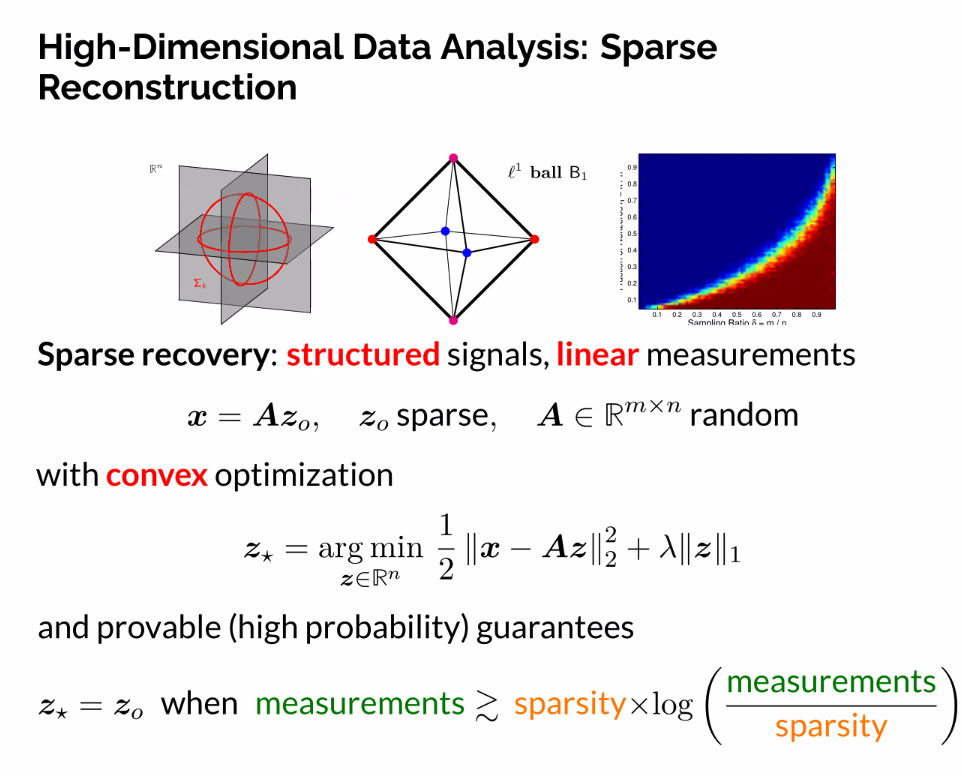
- High dimensional representations with low dimensional encoding
- LASSO
- Trade off ‘fiel’ representation to get a sparse representation
- Before DL this representation was SOTA
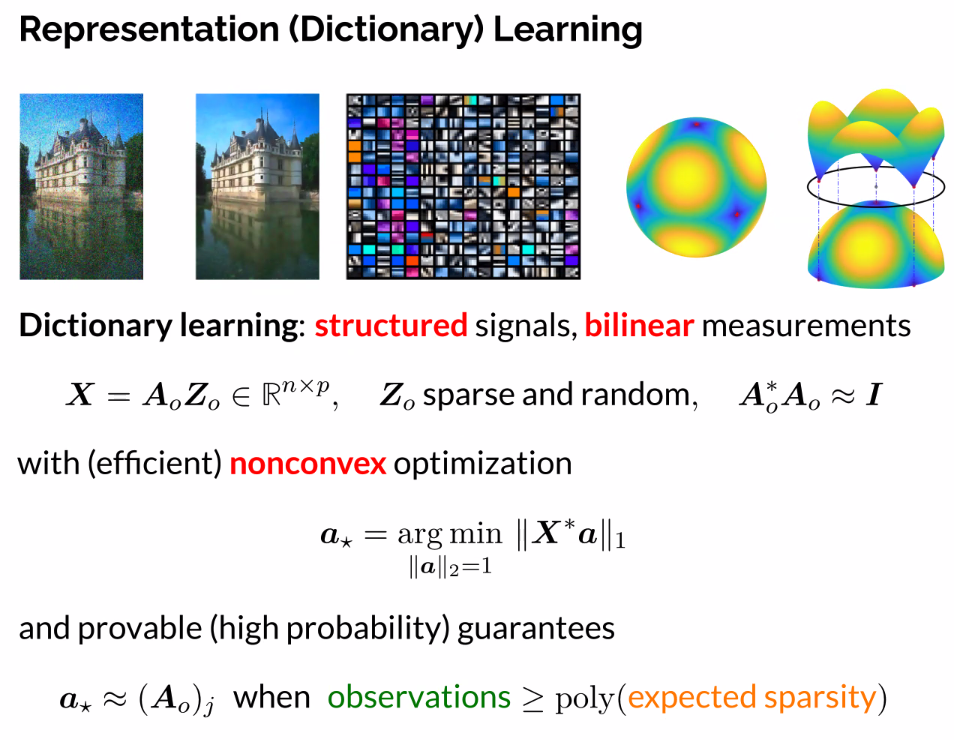
Now, modern deep representation learning:
- Perceiving the physical world -> nonlinear signals
- Real world requirement of dealing/working
- Nonlinearity demands deeper representations
Transformers: A universal Backbone
Helping in:
- NLP
- BERT, GPT
-
Vision
- Robots
Pitfalls of Black-box models
Transfomers are emperically-designed (or black-box models)
Q1: “How to understand such ‘emergent’ phenomena?”
- Learning emerges in training, why? Black box stops us from knowing
Q2: How to mitigate such risks and ensure safety?
- If we don’t know what internal computations are, we might get undesirable (even unsafe) outputs
- Understanding internals is a must
Representations: What and how to learn?
Identify low-dimensional structures in sensed data of the world and transform to a compact and structured representation
- The pursuit of low dimensional structures, using them for down stream tasks
Outline:
- Analytical Models
- General Distributions
- Denoising-Diffusion
- Compression and Information Gain
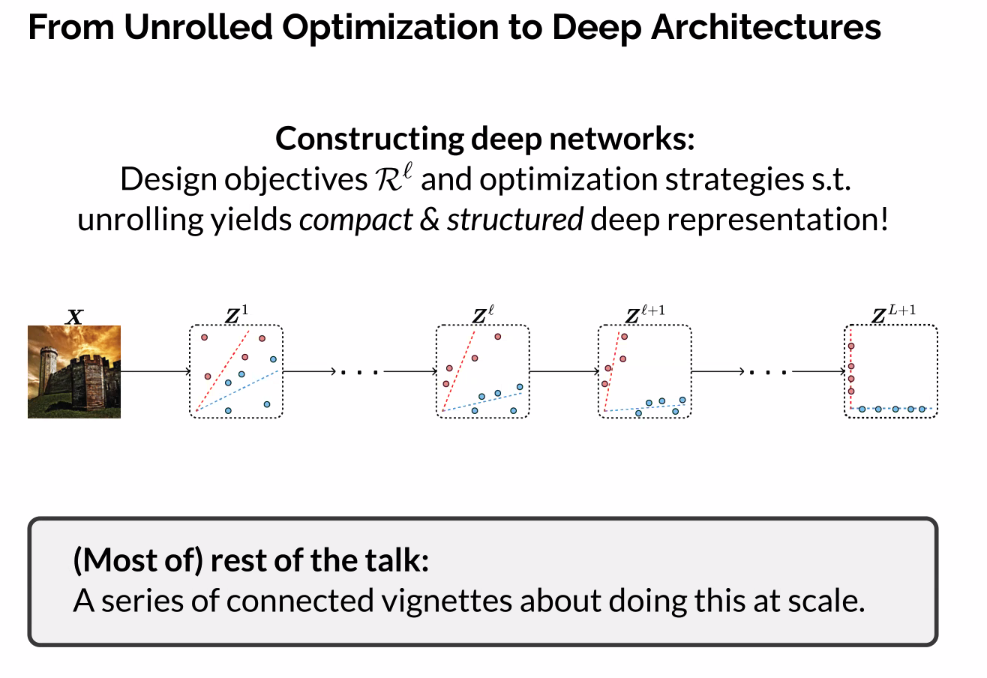
- Network Architectures via Unrolling
- Create objective functions of representation, and optimize them
- Gradient descent on an objective function of representation
- Resemble layers of a Deep NN?
A low dimensional subspace:
What is a linear structure?
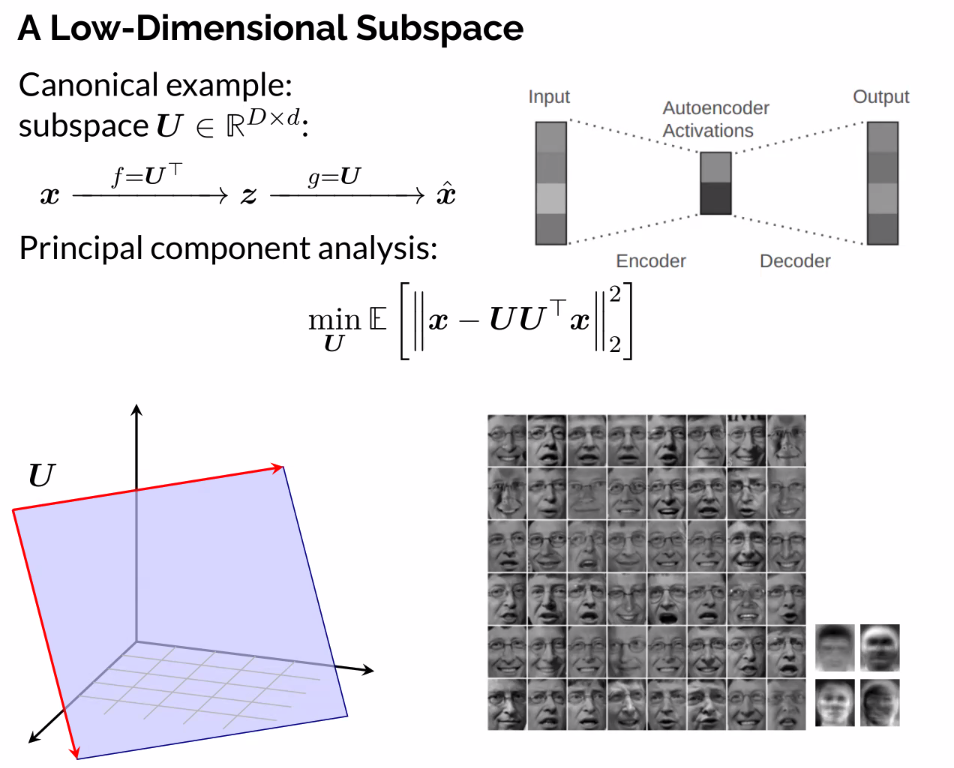
- X: Columns of data matrix
- Learn the subspace that the data lies on by solving the optimization problem
- Linear structure of the data, and once learned, go from encoding to decoding
- Encoder is a projection
- Deco
- All the primitavies of a more general learning scheme
Sparsity and Sparse Coding
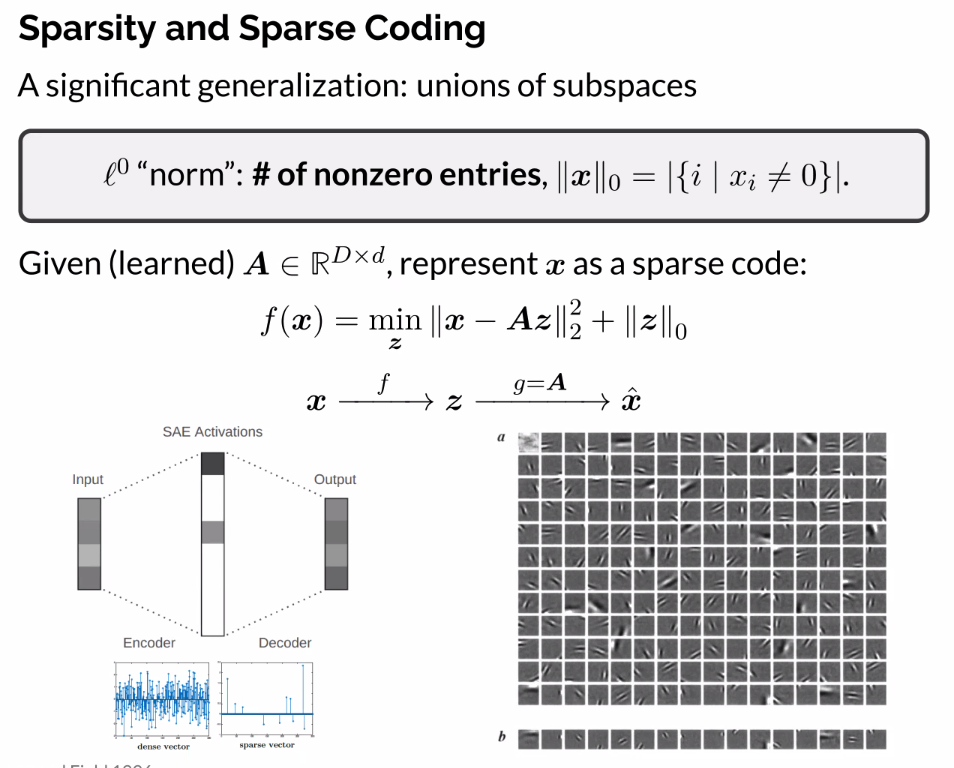
- Encoder solving sparse coding problem
- If we know apriory x, we can just solve
The way to solve:
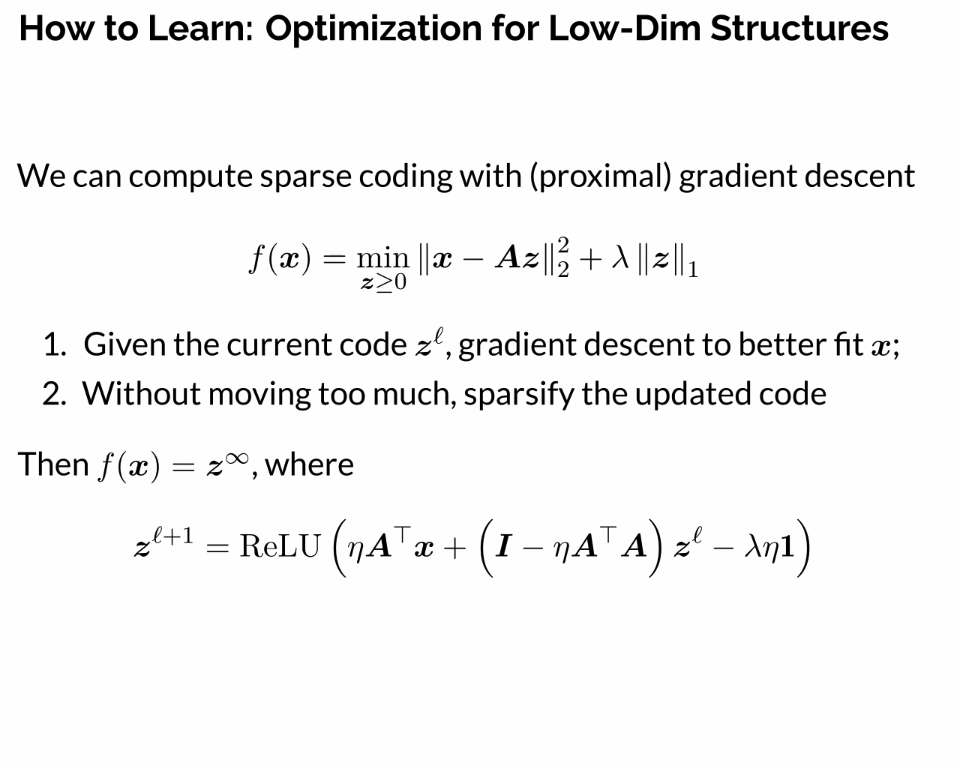
How to learn: Optimization for low-dim structures
One step beyond gradient descent:
Sparse coding with (proximal) gradient descent
- Given current code
, gradient descent to better fit x - Without moving too much, sparsify the updated code
Thenwhere
From analytical models to transfomers: Compression
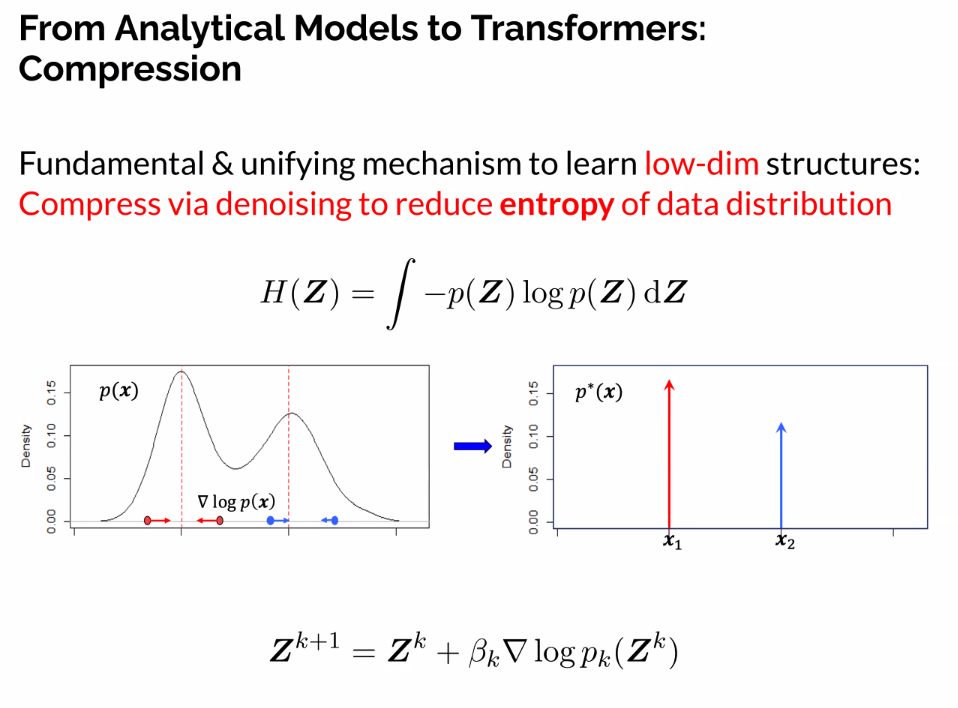
- Intuitively: Try to reduce the entropy of the data
- Low entropy correlates lower dimensional representation of the data
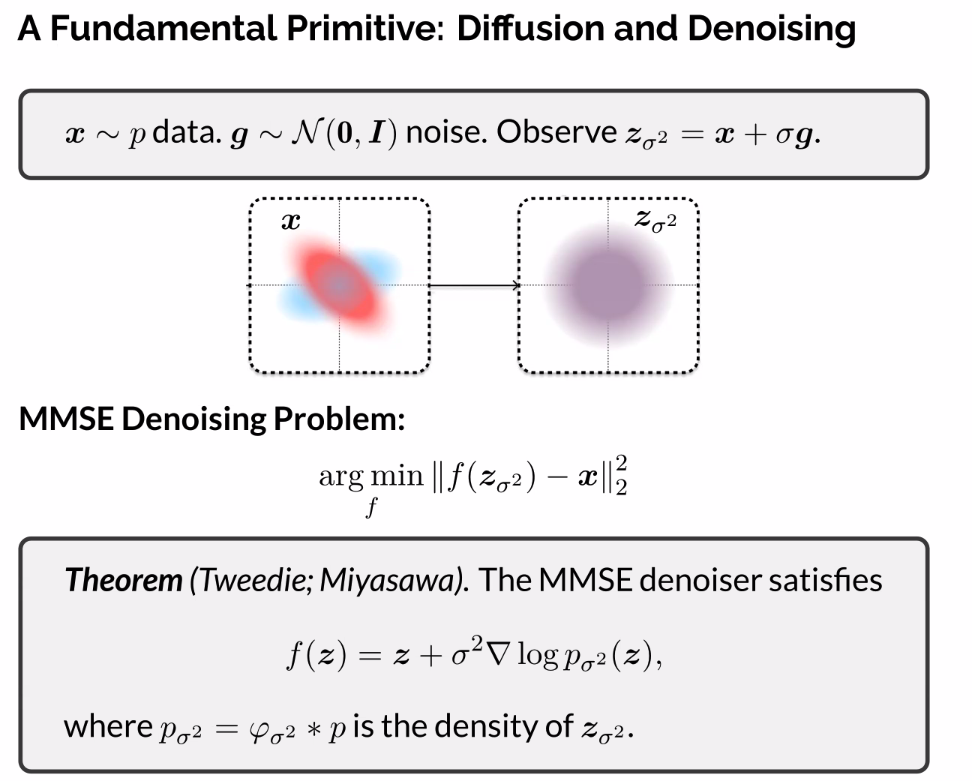
Fundamental Primitive: Diffusion and Denoising
-
Piecewise linear?
-
Independent noising observation
-
Pass a noisy representation through a mapping, and seek to reduce the noise
-
Median Mean Squared Error (MMSE) Denoising problem
-
Tweedie: Closed form for a MMSE denoiser
-
Not on slide, but should be expectation
-
Simple to write, but complex in form
-
Takes noisy input z, perturbs it in a score function
- Need to do learning to recover score function
-
Weighted by all the possible places the data ‘could’ have come from?
-
Denoising Against Low-Dimensional Structures
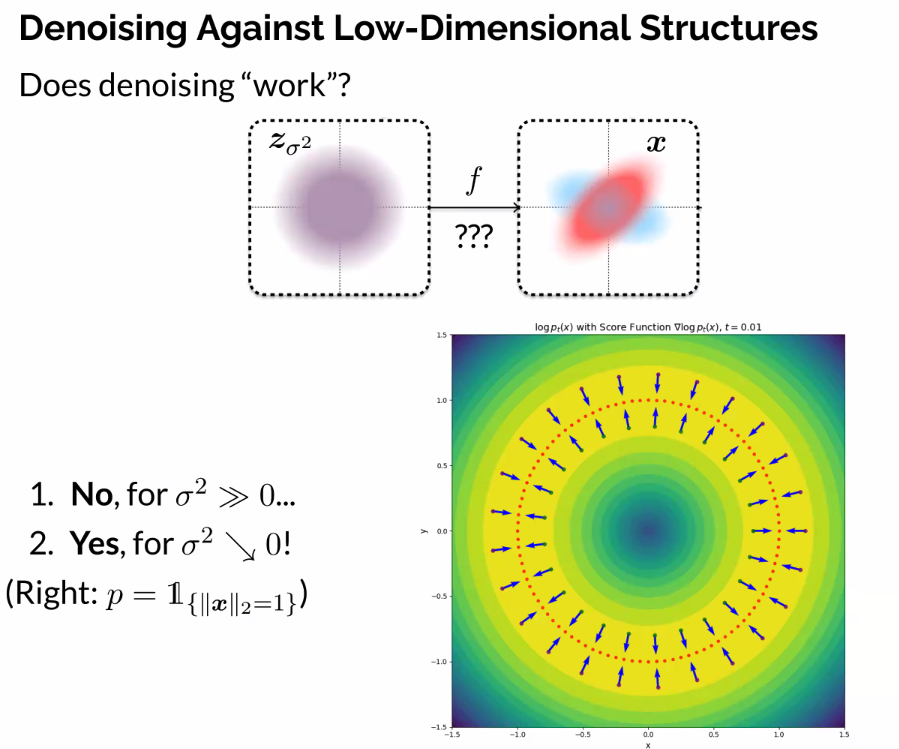
- Intuitively, too much noise destroys distribution
- If you add an imperceptible amount of noise, you can remove it
- Think of a data distribution on a circle, then add a small amount of noise.
- The blue arrows are the score function (gradient log p), and pointing us towards the score of the data
- Point back towards underlying data manifold, will recover signal
- However, add too much we can’t tell which side of the circle we came from.
- A toy example to build intuition
- “Critical radius”
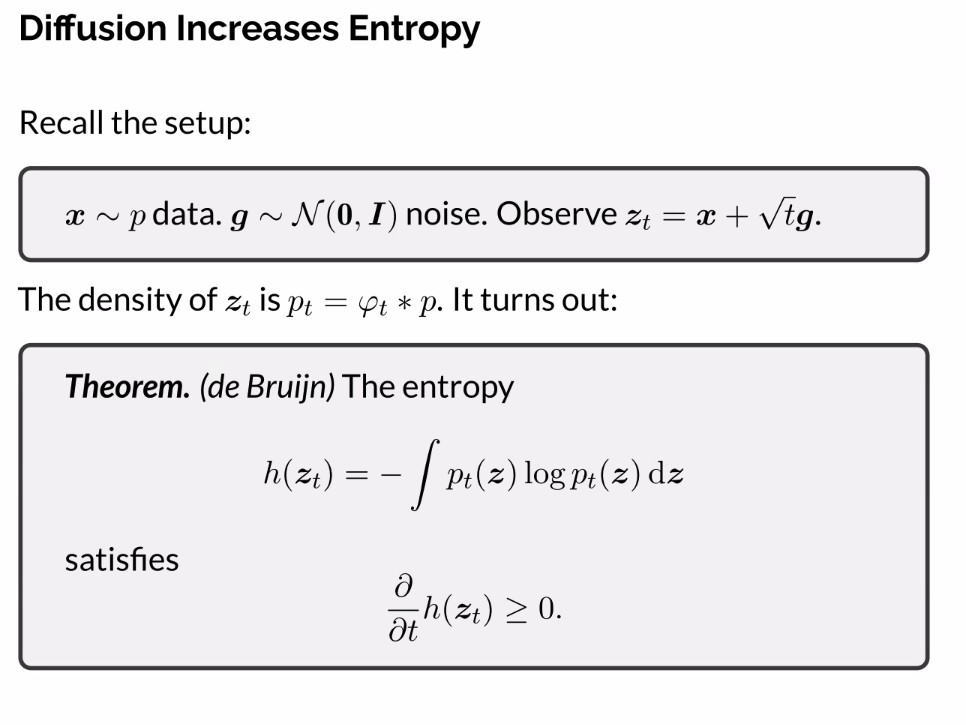
- The entropy increases as we add noise
- Removing noise, actually decreases entropy
- In a perfect sense, doing an ideal denoising function
-
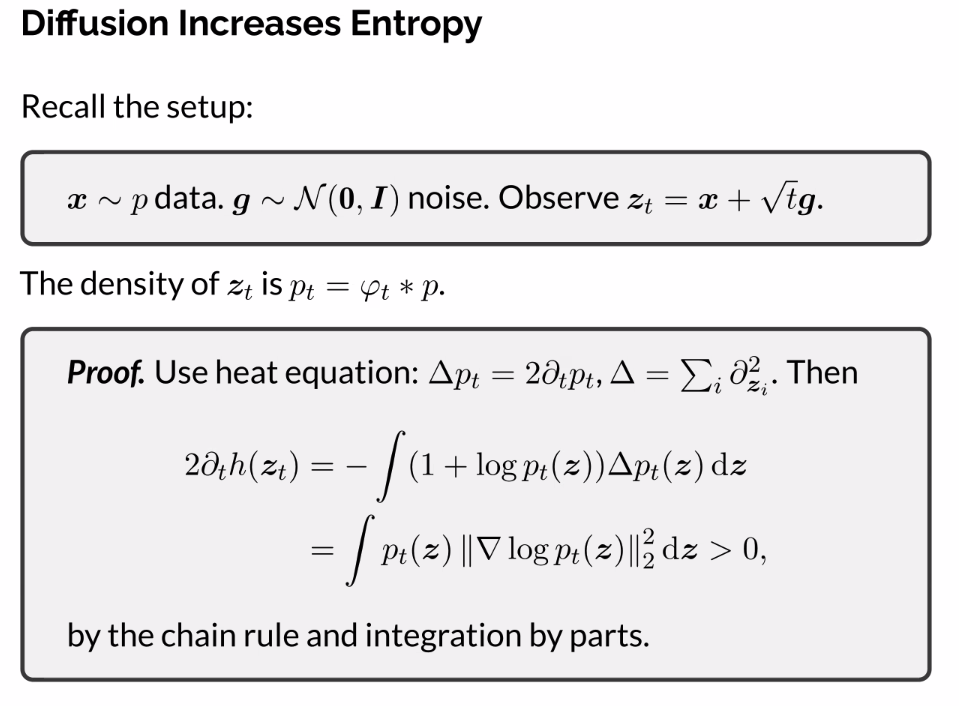
Key to a number of things
-
Take derivative of entropy
-
REplace derivate of time with space derivate (laplace operator)
-
Falls out that its a positive quality
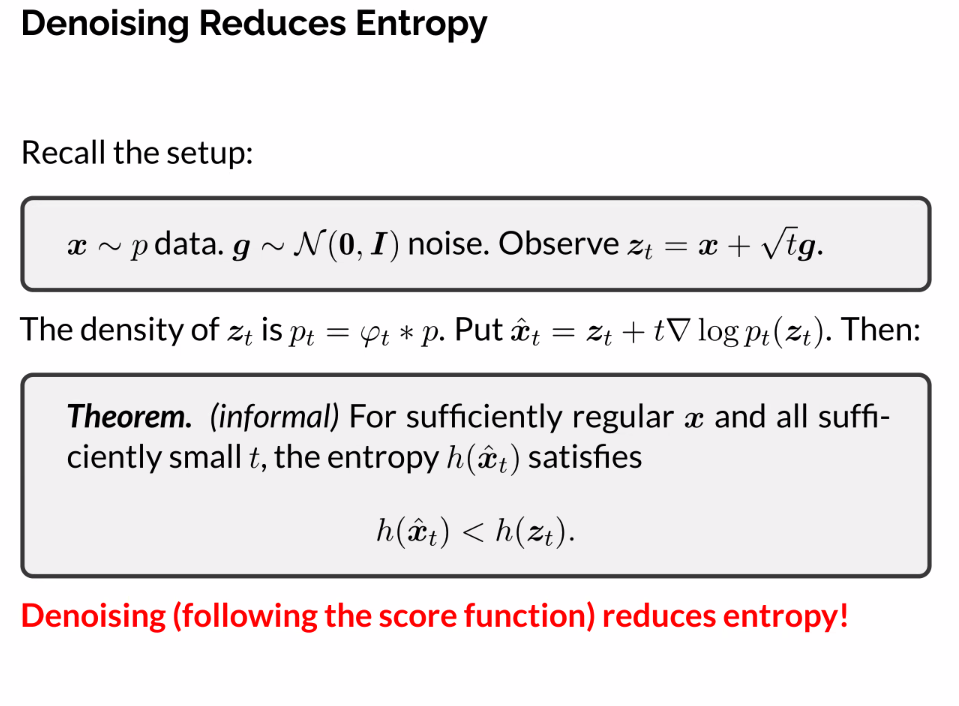
- Seeking to reduce empiral coding rate
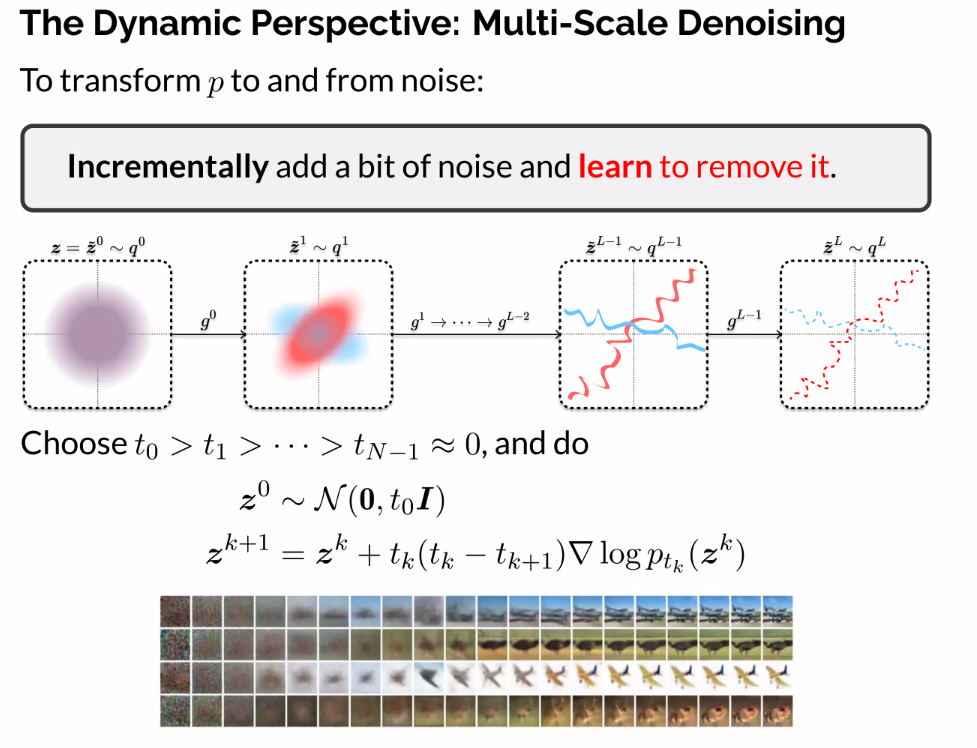
Dynamic Perspective: Multi-Scale Denoising
-
Add a little noise so that we learn to remove
-
Keep increasing it, until our model completely understands the underlying data
-
Noisy manifold?
-
Depending on how sophisticated the manifold is (corners/cusps), a smooth manifold intuition still implies, just like the circle.
- John’s group investigates this, the strucutre/completeness of the manifold after noising?
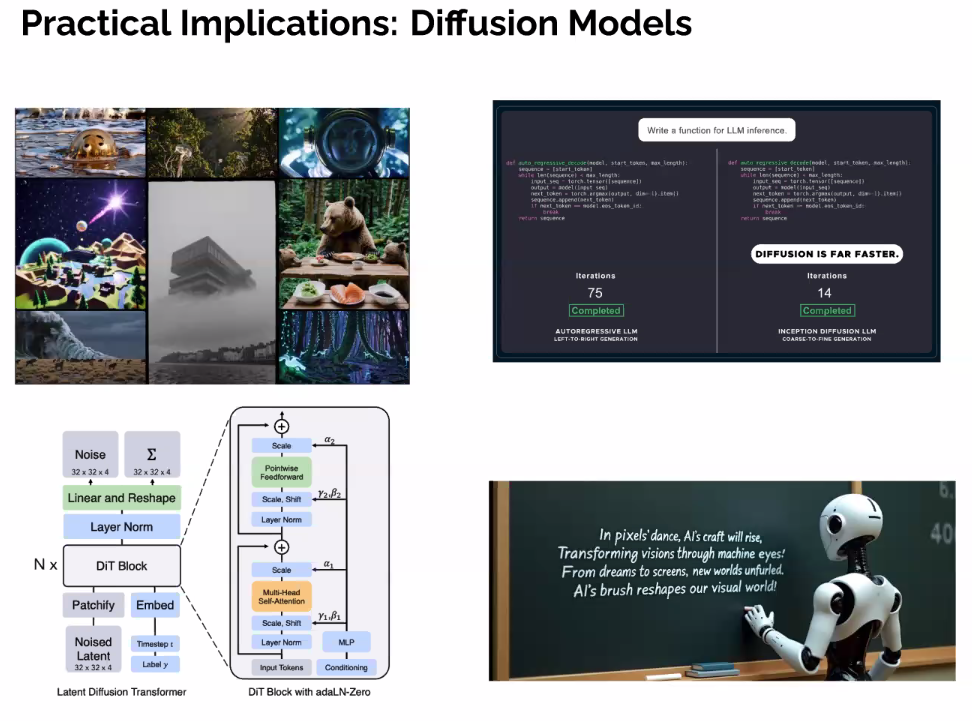
- A lot of these models are closed so hard to see, but many confirmed diffusion models
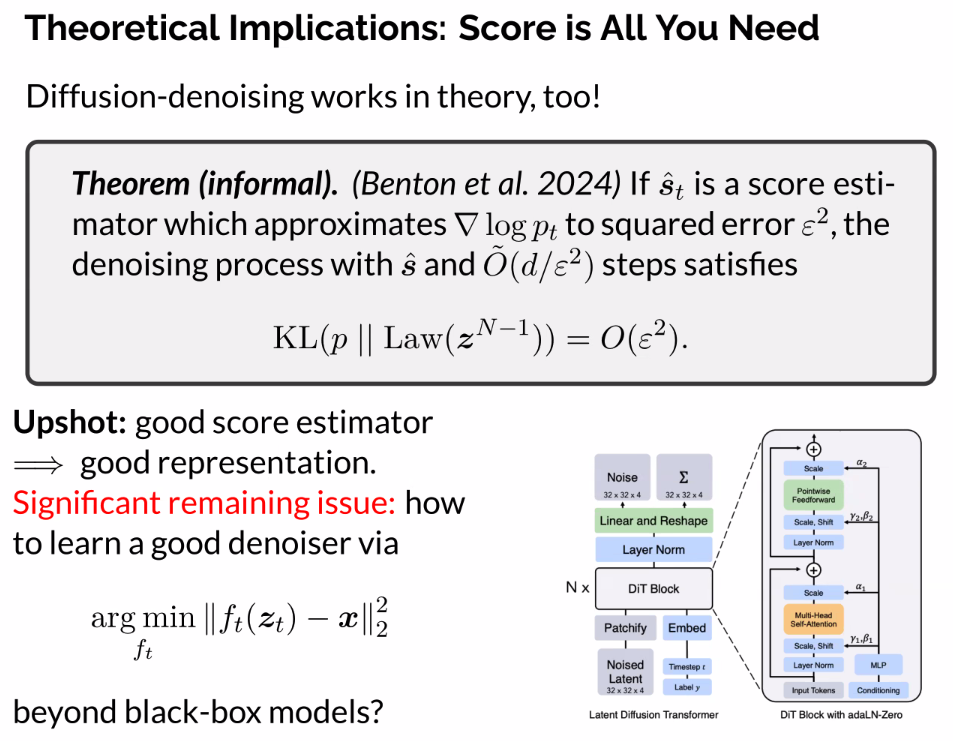
- How should you parameterize score functions, represent them in function?
- Everything we’ve talked about hinges on a good objective score function
Information Theory
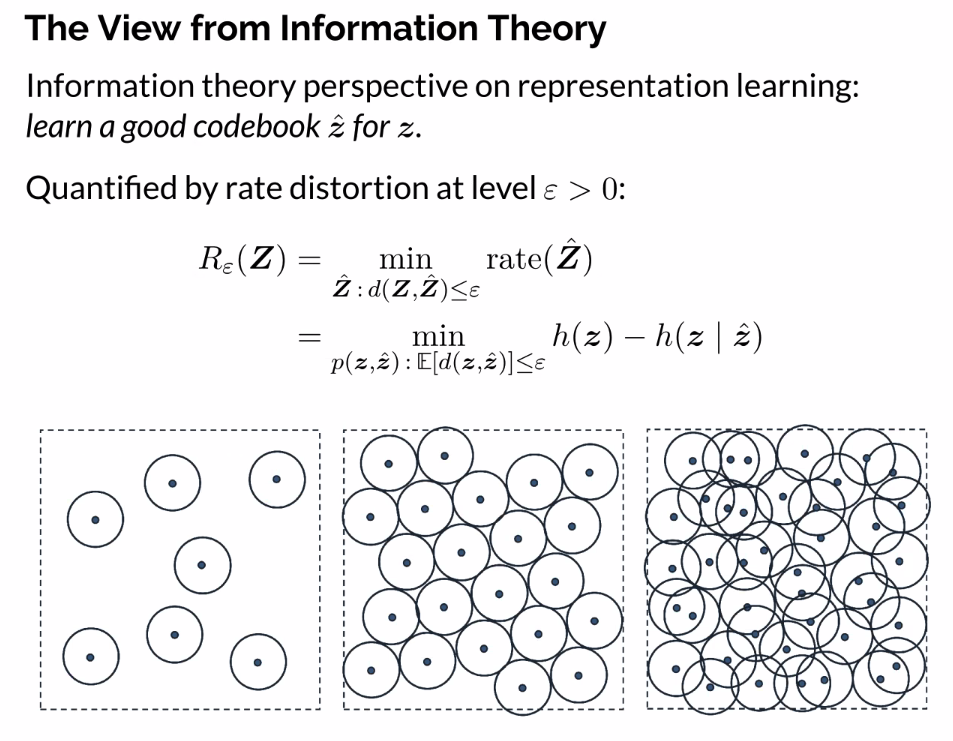
- Number of bits needed to represent data, subject to some distortion level
- Find a codebook that can represent using short number of bits subject to some small distrotion
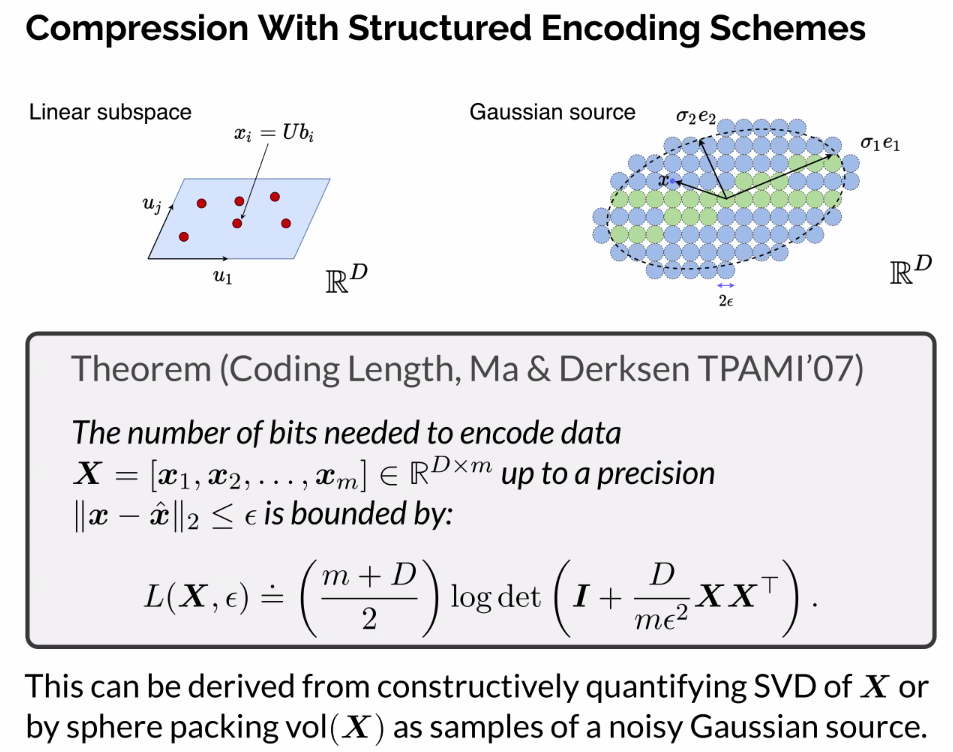
- How to compute with a very simple codebook?
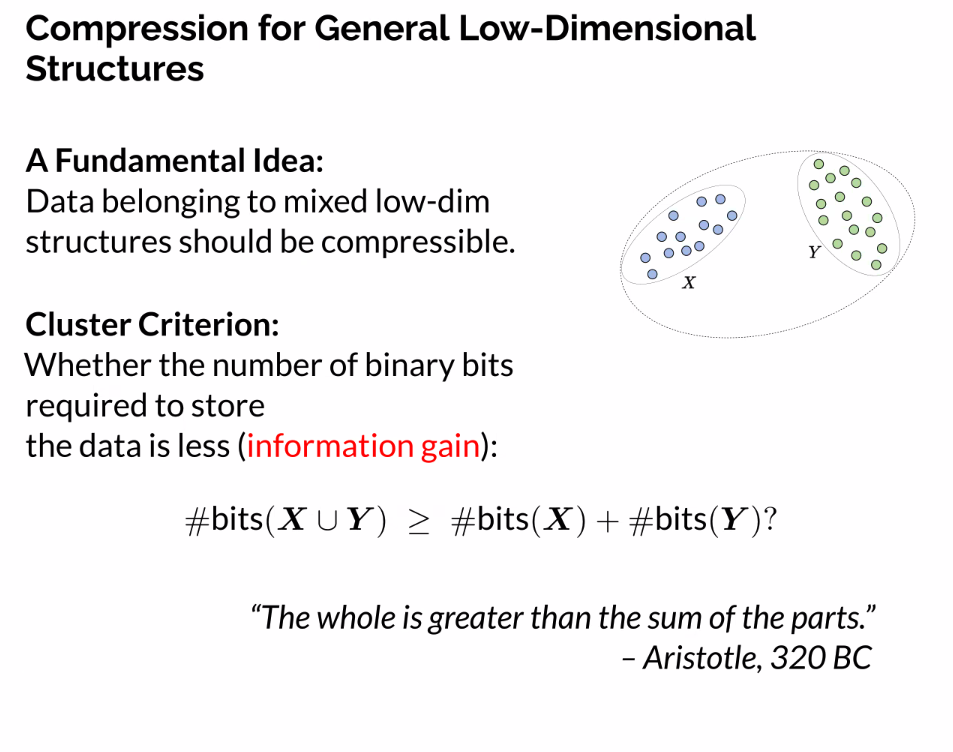
- If you have data coming from linear structures, it should cost less to structure the data
- If you code the data independently, it should cost you less than coding the data all together
- If you were to code the X and Y above all together, you would need to do an ellipsible
- If you were to code all together, you could get away with far fewer bits
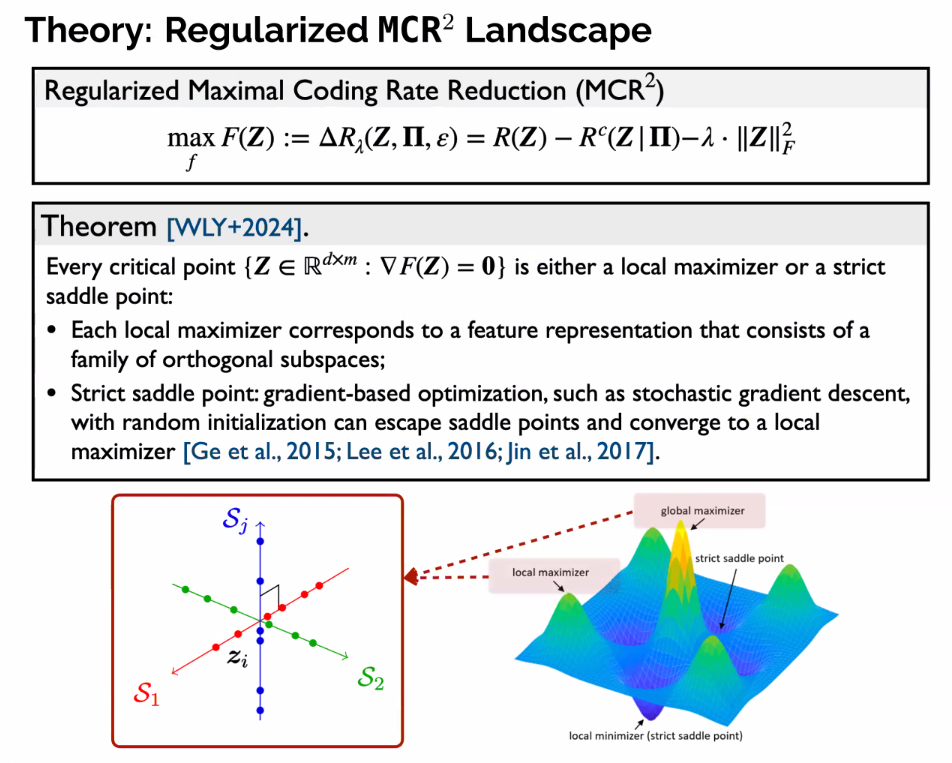
- Seek models for the data such that there’s a big information gain
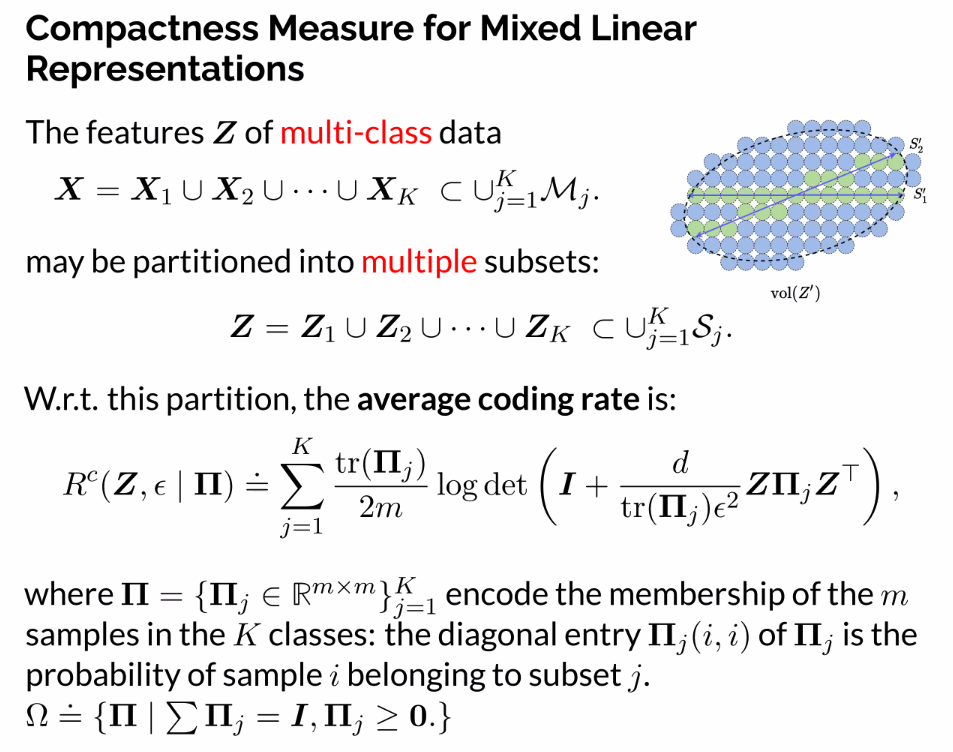
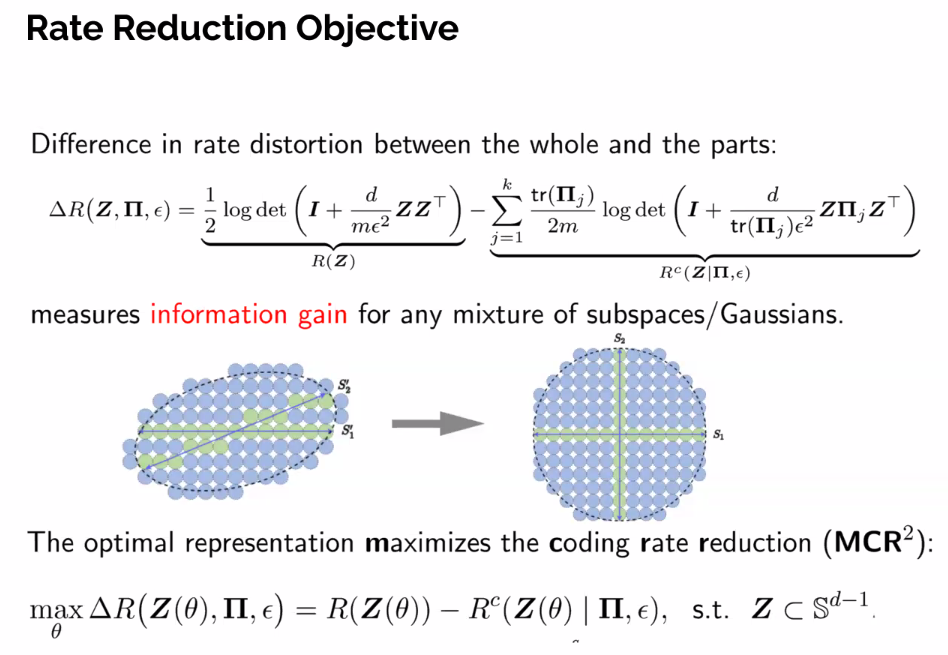
If data comes from mixture of gaussians, you can directly optimize
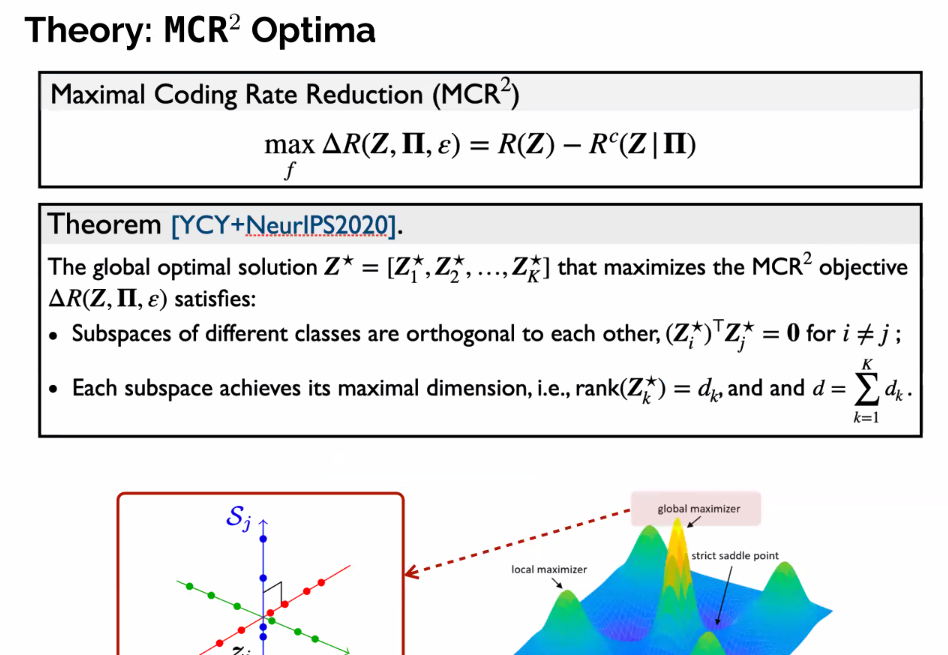
- Perfectly optimizing delta r represents to good representations of the data
Deep Networks from Optimizing Rate Reduction
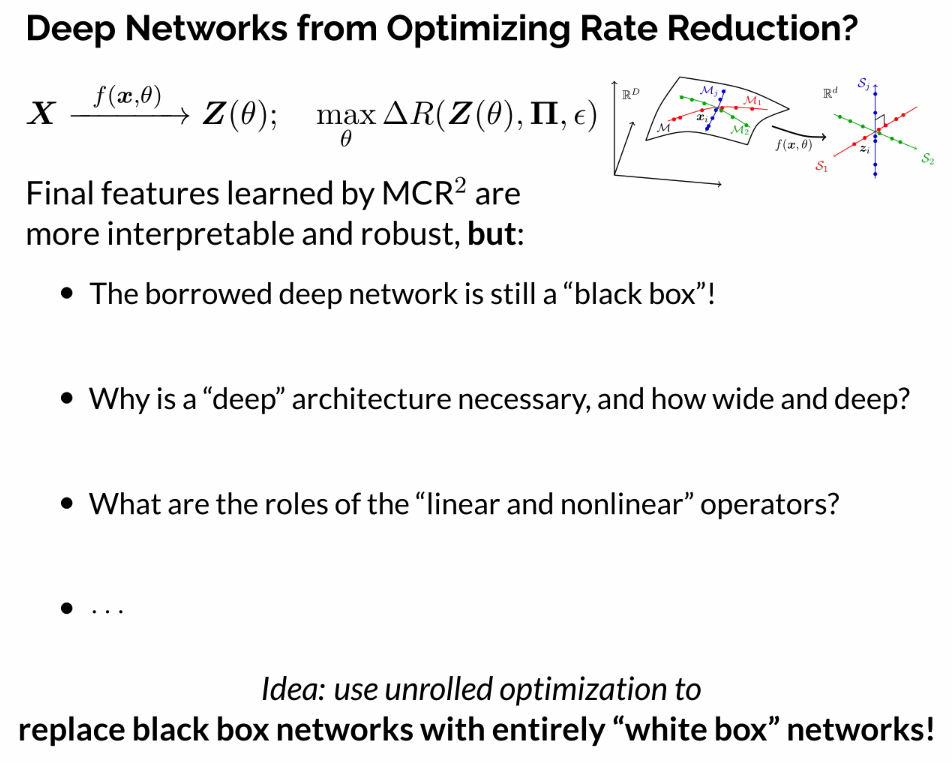
- Learn representations themselves by slowly optimizing function
- Each layer is trying to improve representation/information gain
Unrolled Optimization: From Objectives to Deep Networks
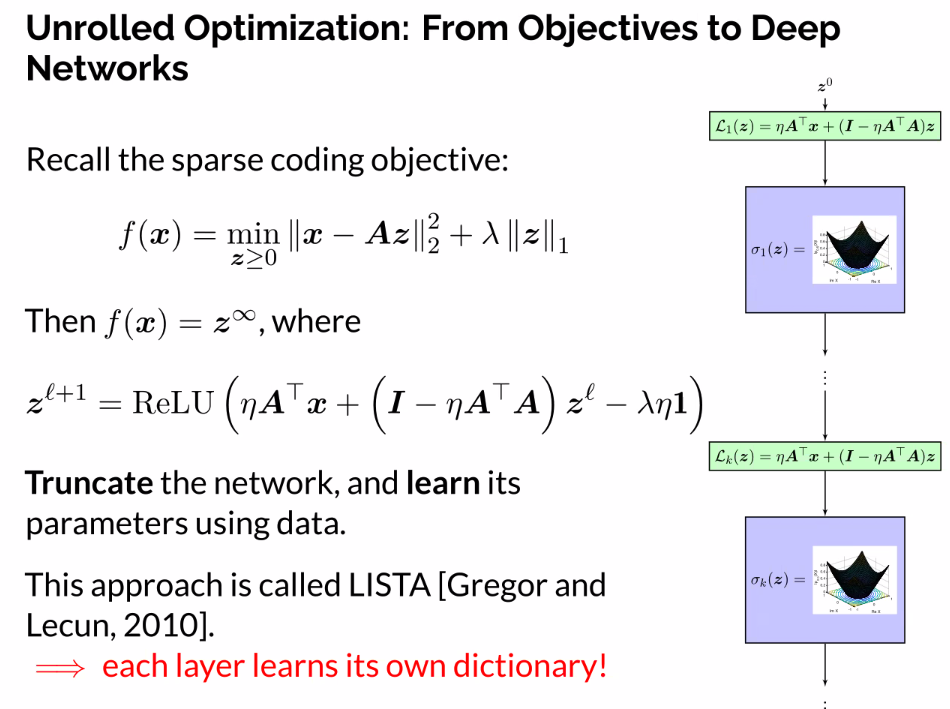
- Element wise non linearity
- Approach called LISTA, each layer learns its own dictionary
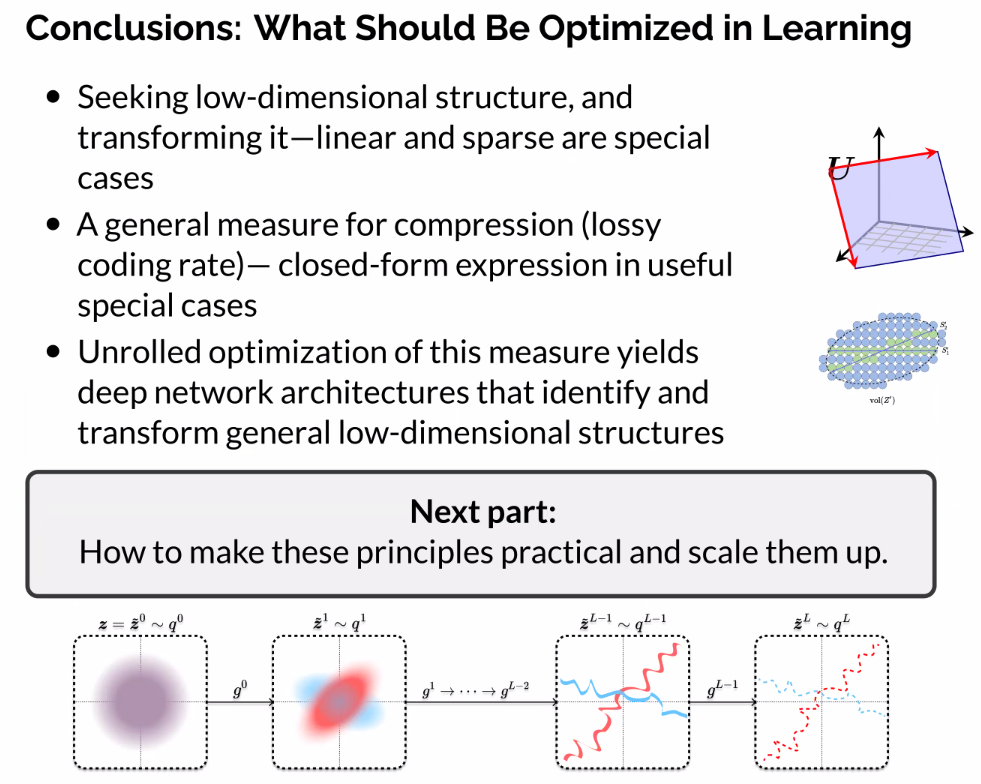
Part Two: Deep Representations via Unrolled Optimizations
Themes:
So far:
- Contextualisze representation learning wrt the pursuit of low-dimensional distributions
- Elucidate an objective for learning deep representations
Now: - Operationalize this
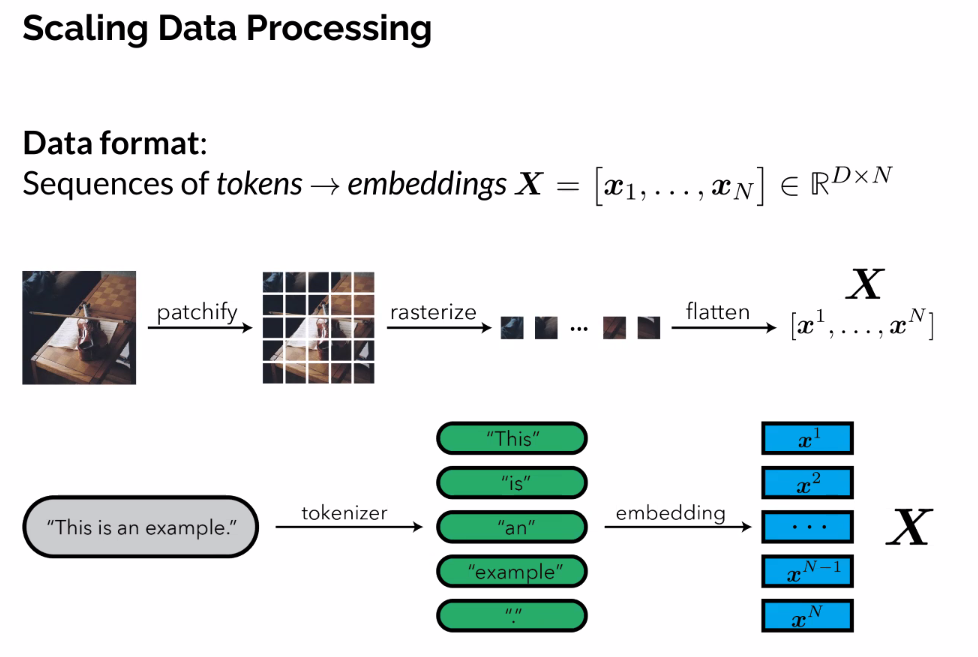
Previously:
- Rows correspond to data samples/observations
Now: - Each row represents a token, like in a transformer
- The method of reserizing and flattening images into vectors gets a lot of mileage?
High Level of Vision Transformer
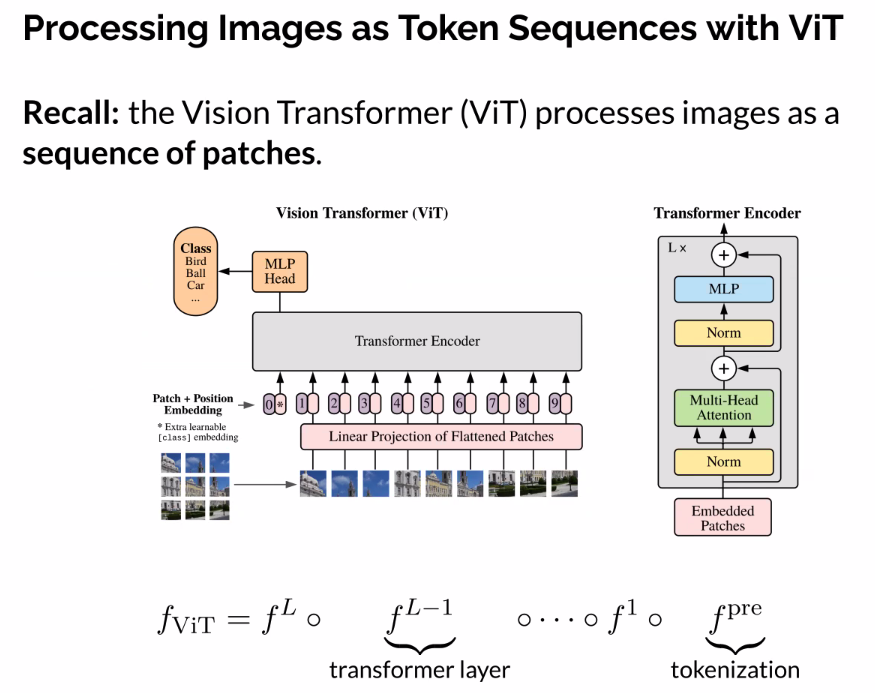
- Each layer has a certain strucutre, adaptive to sequence processing



Multiheaded self attention:
- Each lay
- Calculates corelations between calculated predicted token (seq_len x seq_len)
- Normalizes by 1 dimension
- Uses normalized scores (projected similrities) to combine with other similarites
- “Calculate similarities of the data, and use it to regenerate some of the data”
- Multi headed self attention does this in parralel, and uses it in parallel

- Usually increases dimension
Stack a bunch of these transformer encoder blocks:
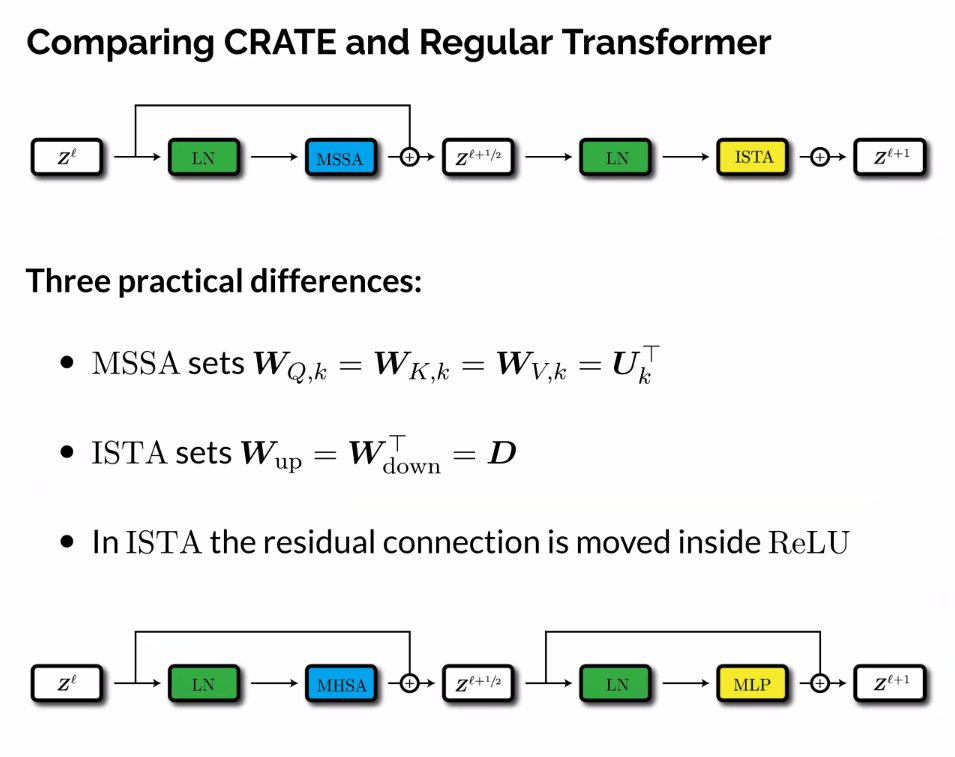
- Norm -> Multi head attention -> skip activation and norm -> MLP -> skip and output
Combine them for a transformer
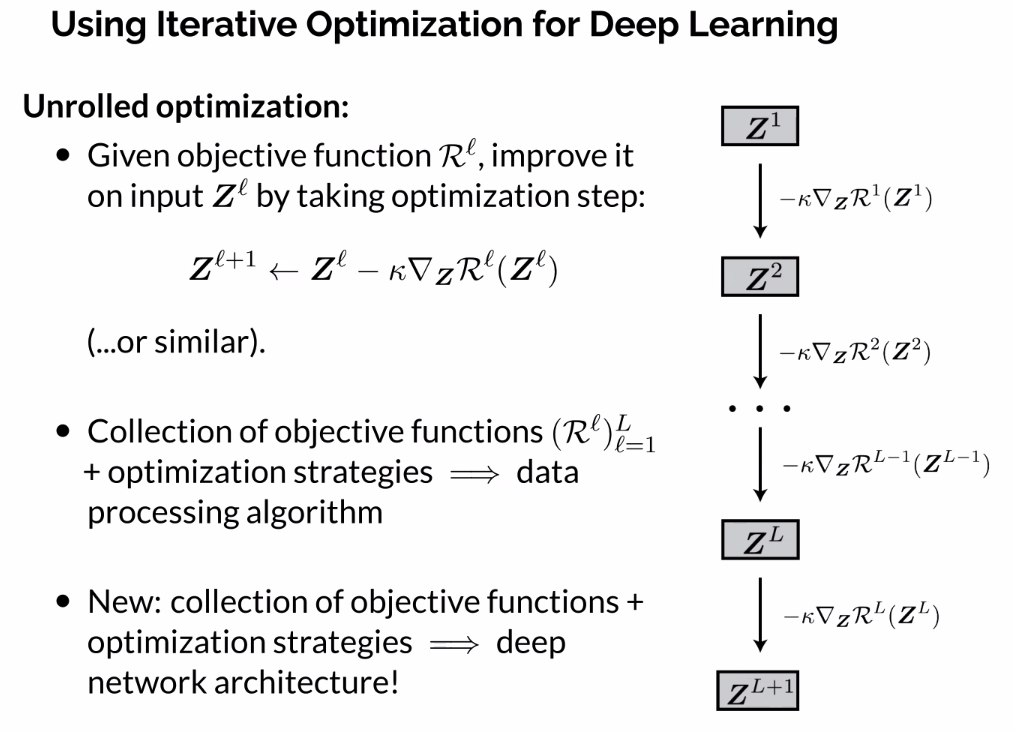
- Objective functions that measure representation quality:
- How to choose?
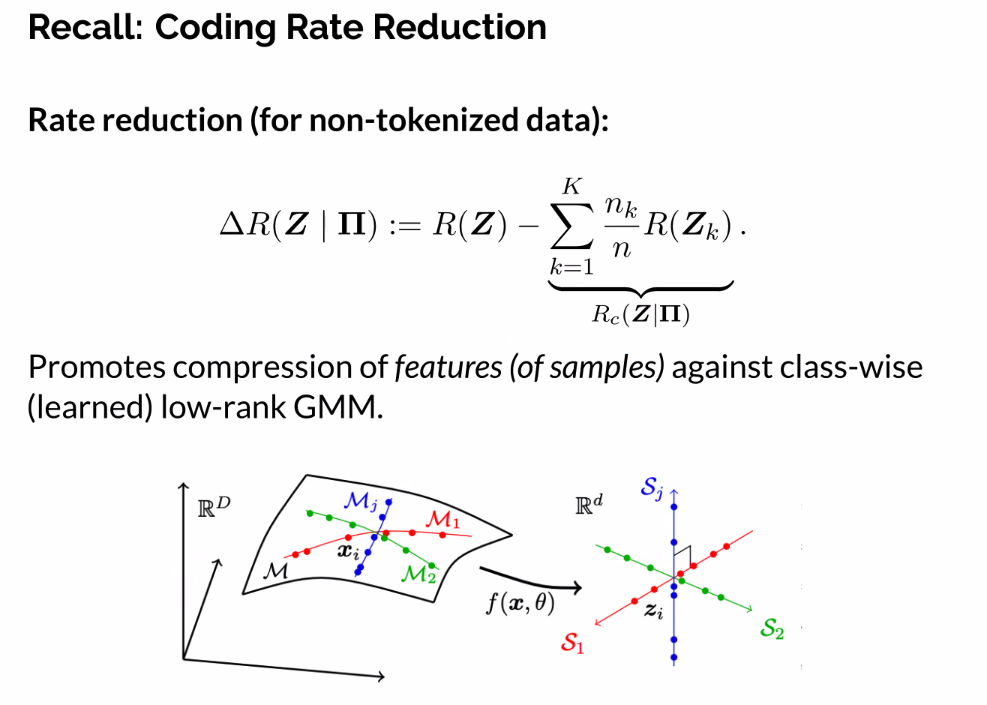
- Define information gain objective
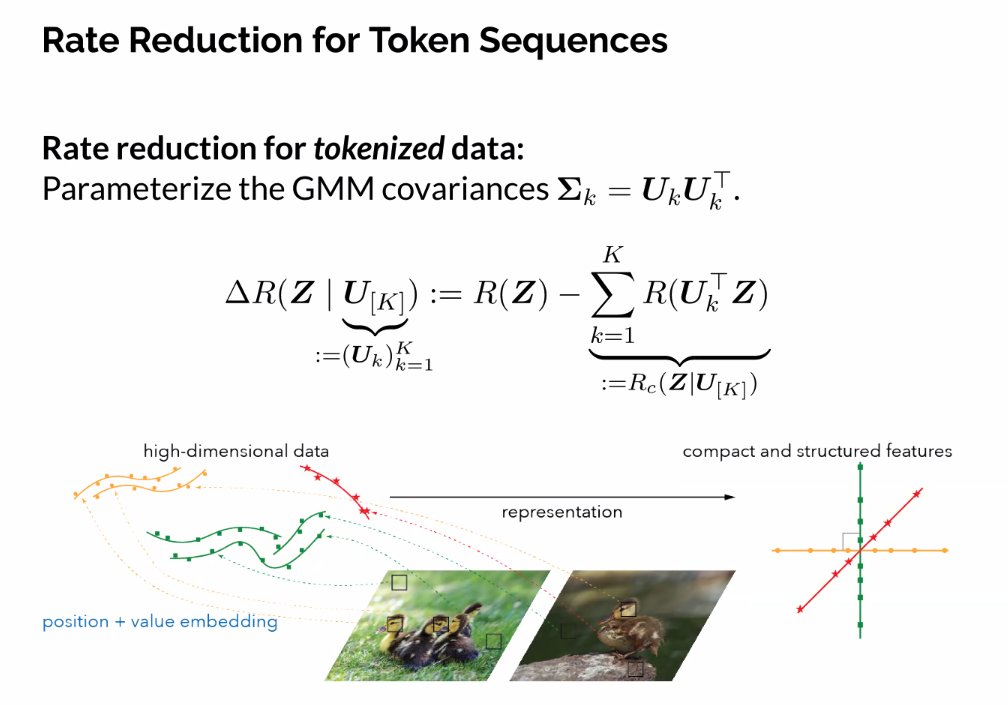
- Instead of using hard PI matrix, use soft assignments, learnable by network
- Require that they be orthogonal
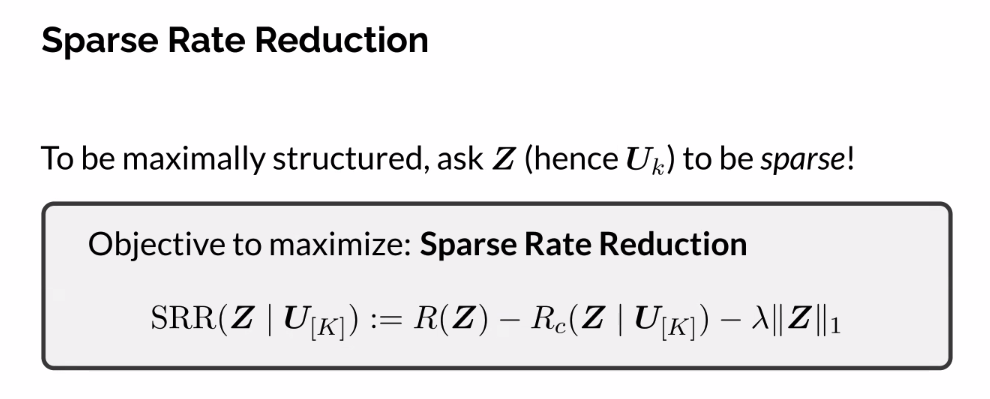
- The one that’s best with regards to L1 norm is the one that’s sparsest
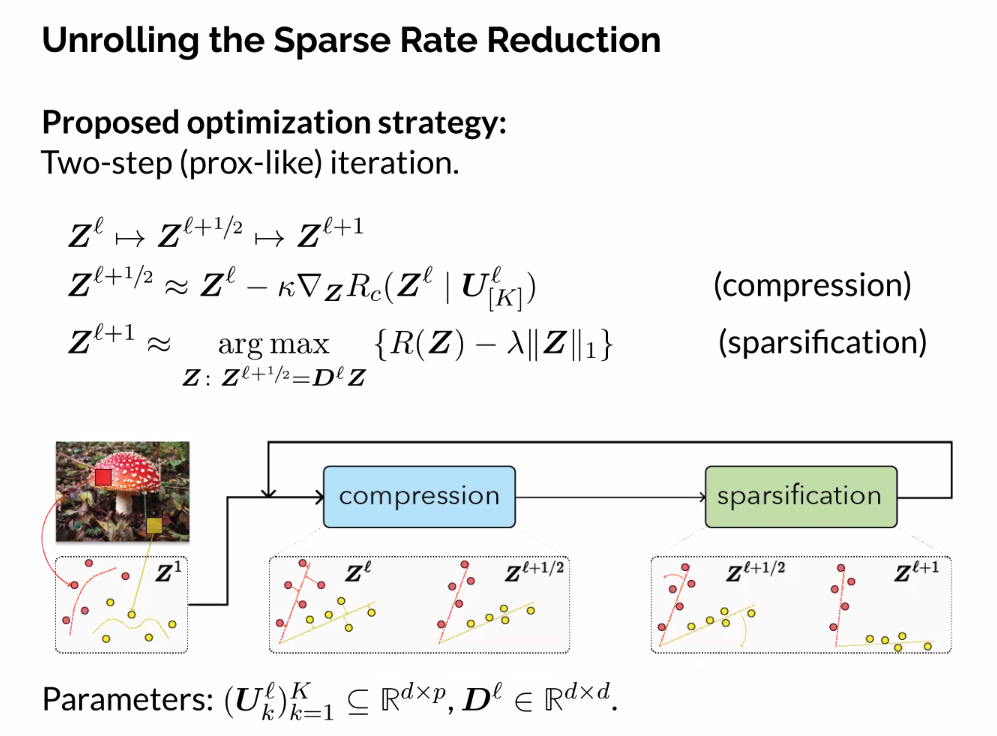
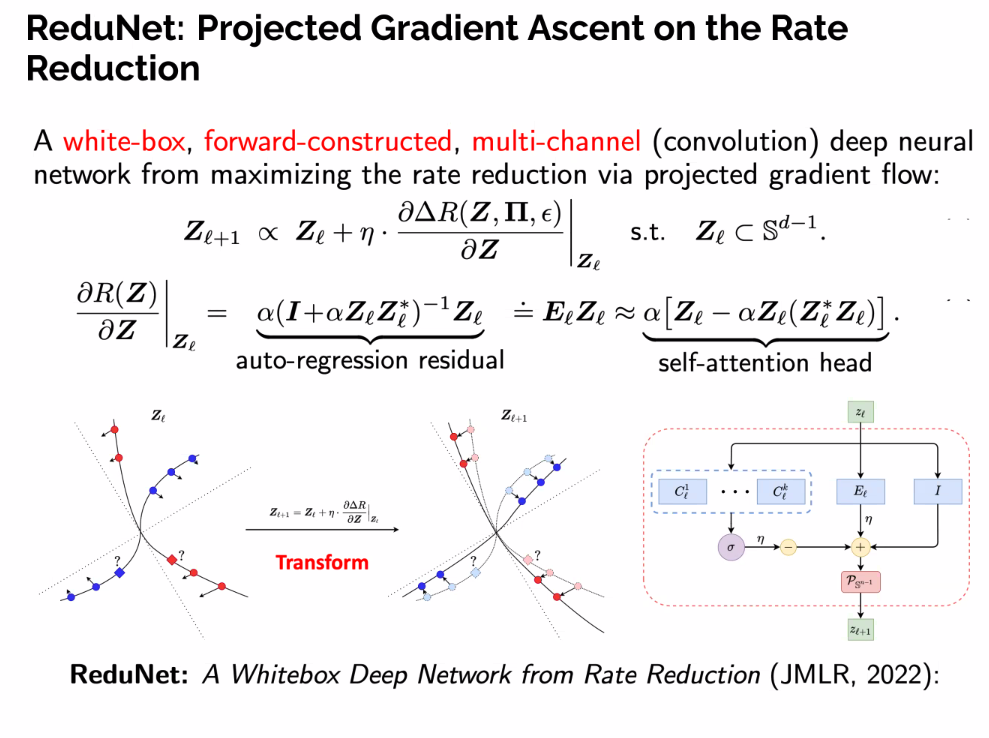
- Simple two step optimization of the objective function
- Compression
- Sparsification
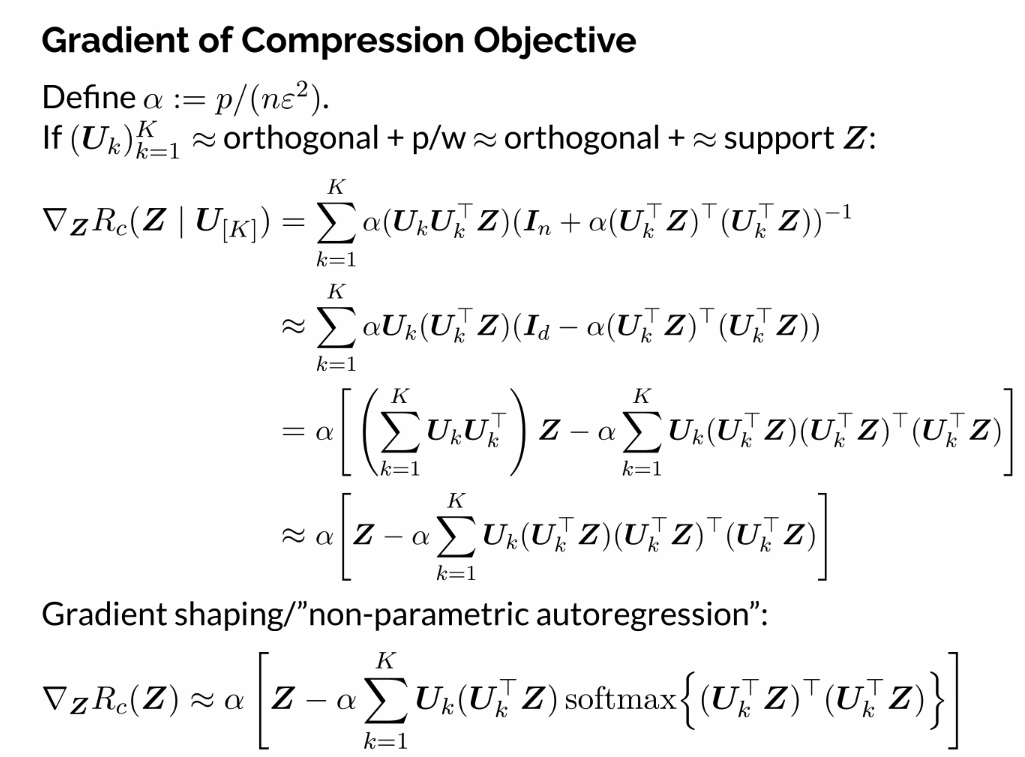
- Matrix inverse is hard, approximate instead
- How we go from first line to second
- In the ideal case that allows us a second approximation jump, we get to our final final
- Add some normalization to the correlation term to improve stability
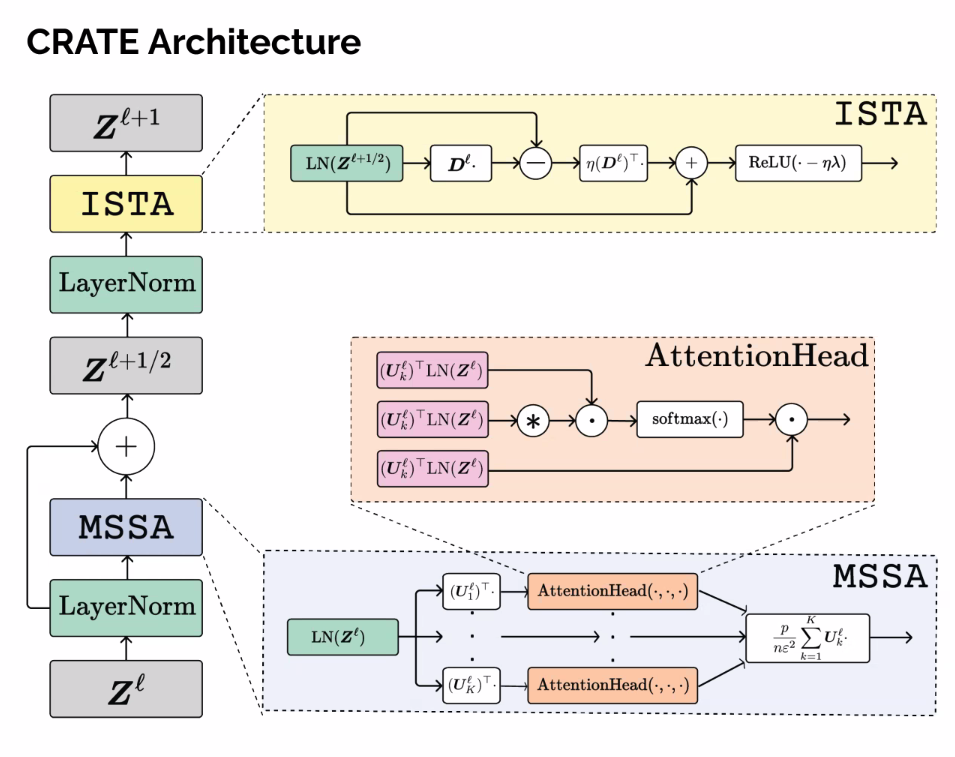
- Looks much more like the one-headed self attention block
- Normalized porjection between tokens of the set
- Used to …
- Key difference is that we get projections, before we had query and key value.
- Each projection is given by the subspace the head is representing
- The operation comes from GD on the compression term and optimizations made for tractability
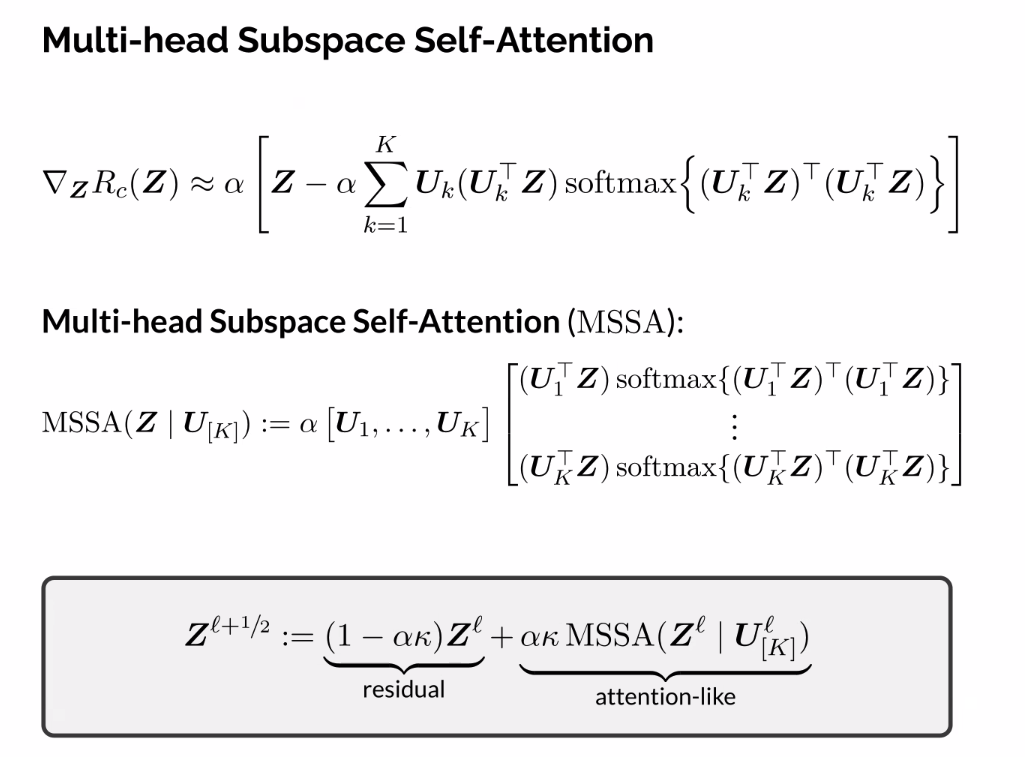
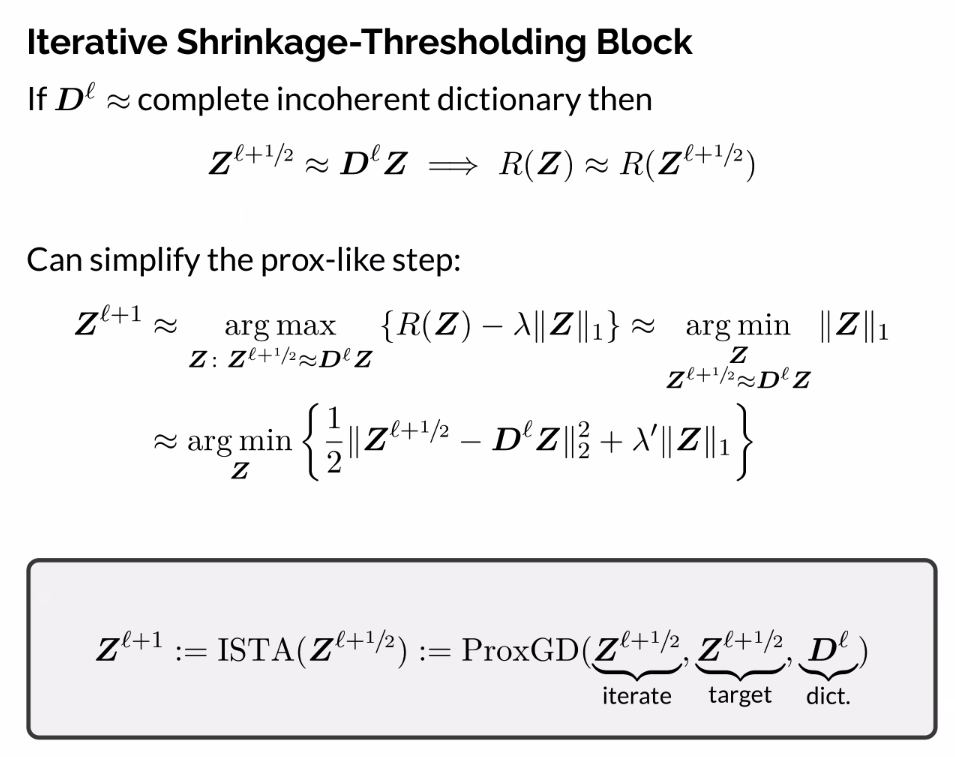
- Sort of to GD on the term
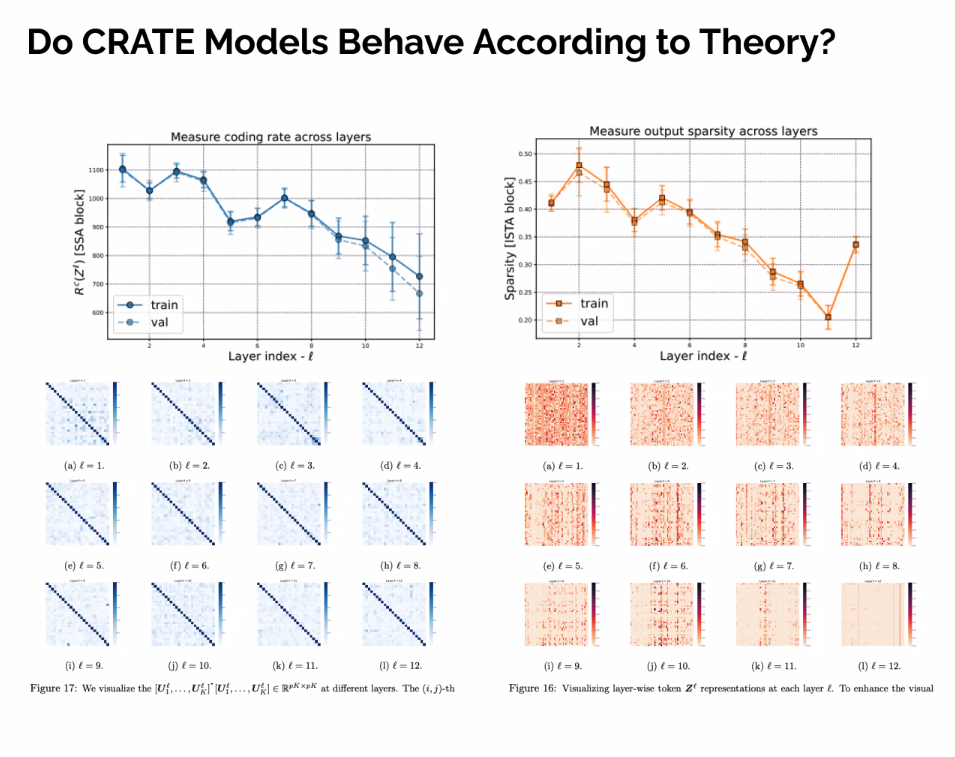
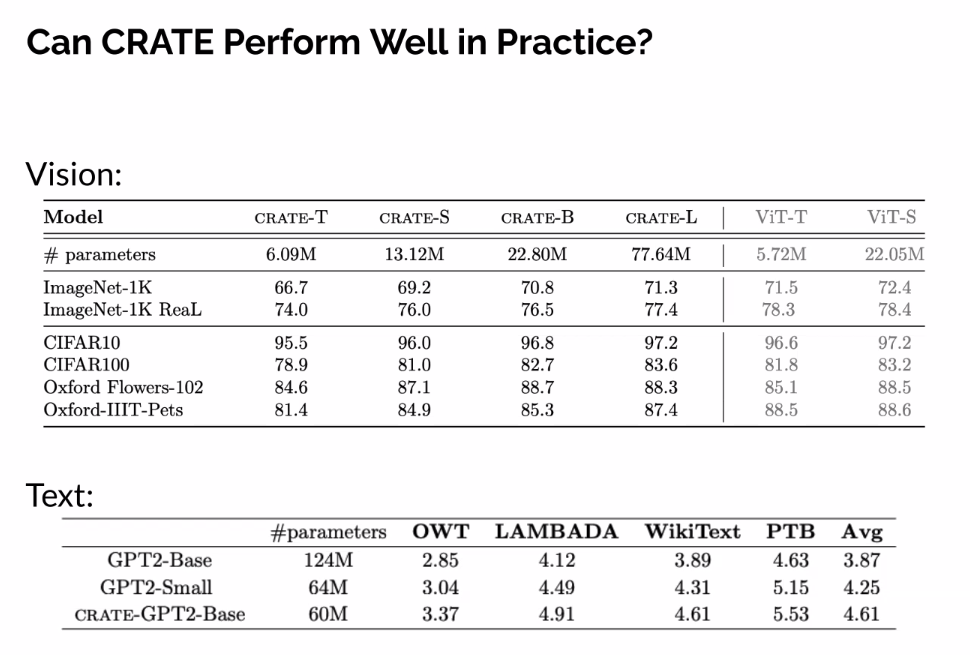
- Not incredible, but show viability
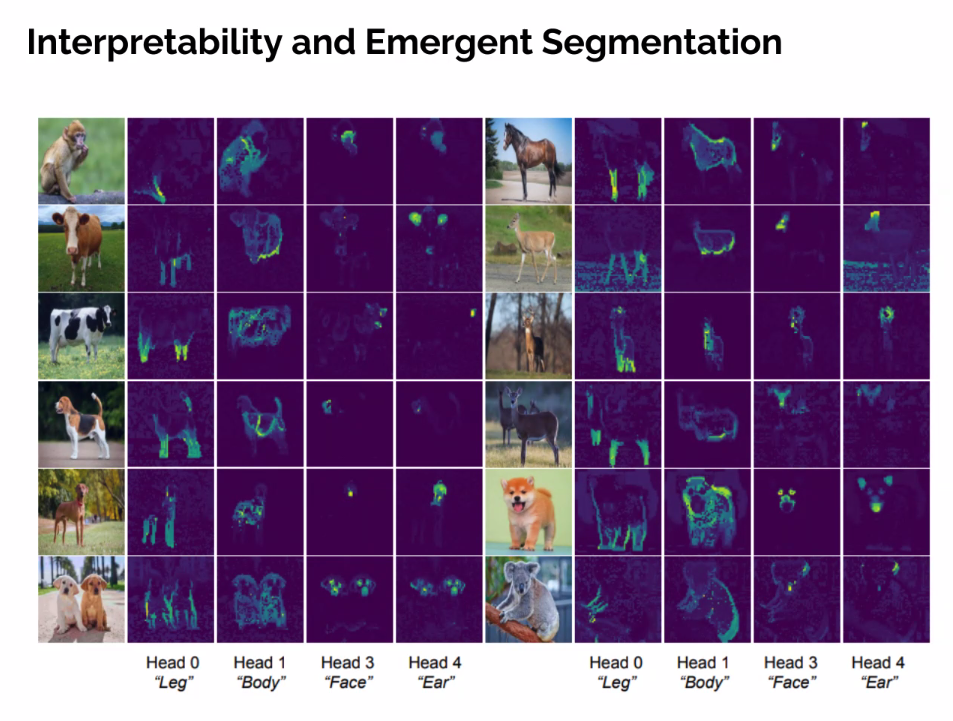
- Normal VIT - A large amount of large magnitude outlier token, that make segmentation not accurate to the parts.
- Not doing a good job at this
- Confirmed during ablation that is due to the MSSA layers
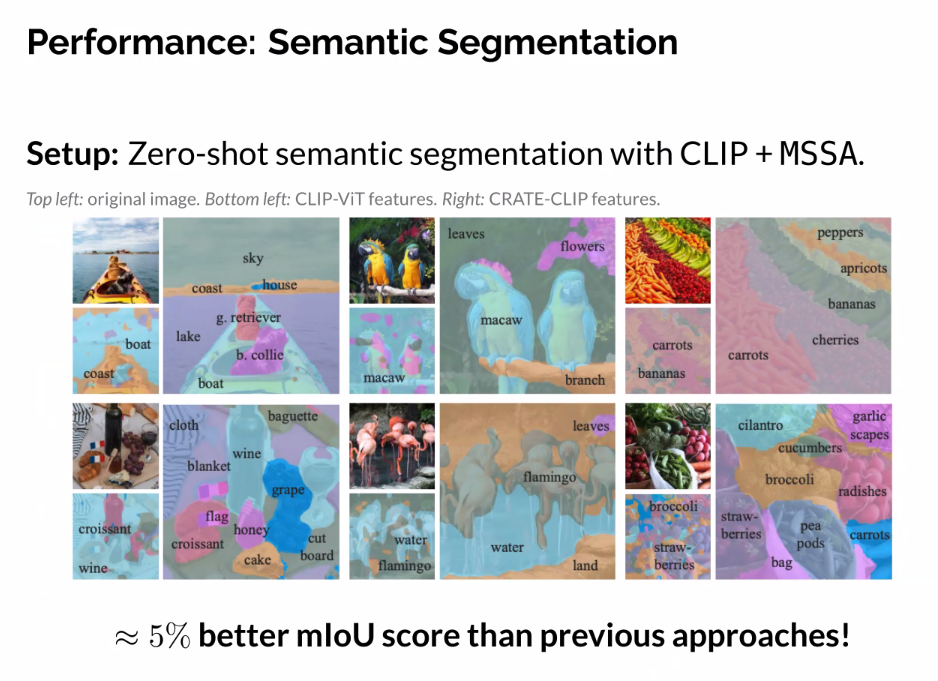
- better emergent sementation, semantic segmentation
Future work?
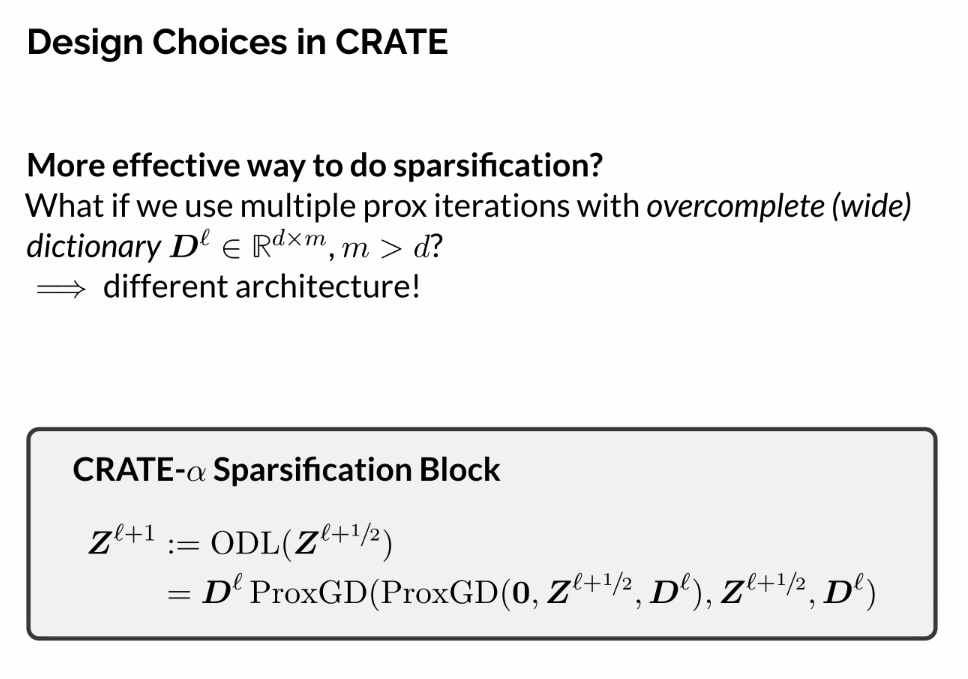
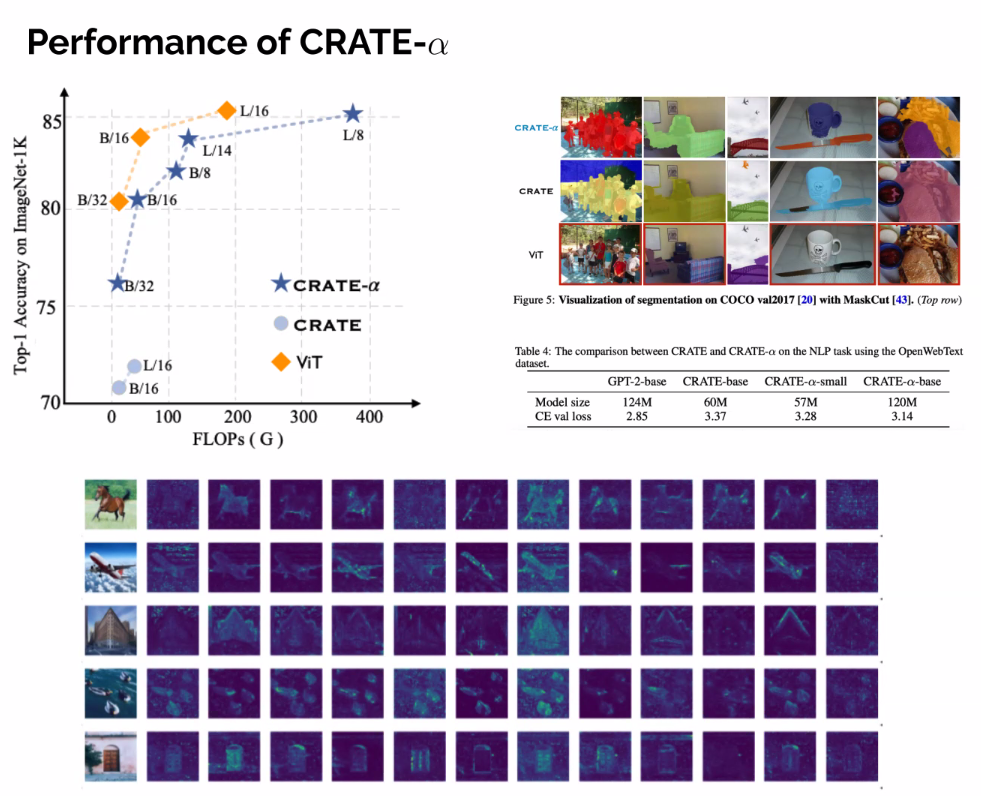
- Performance can continued to be scaled through future engineering
Principles for Deep Learning Methodology
- On top of suggesting new architecture, rate
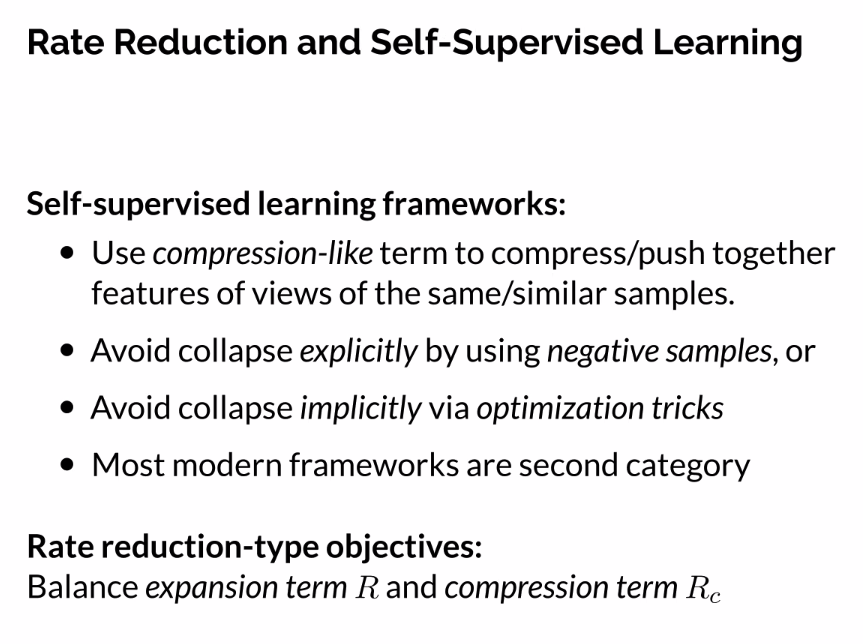
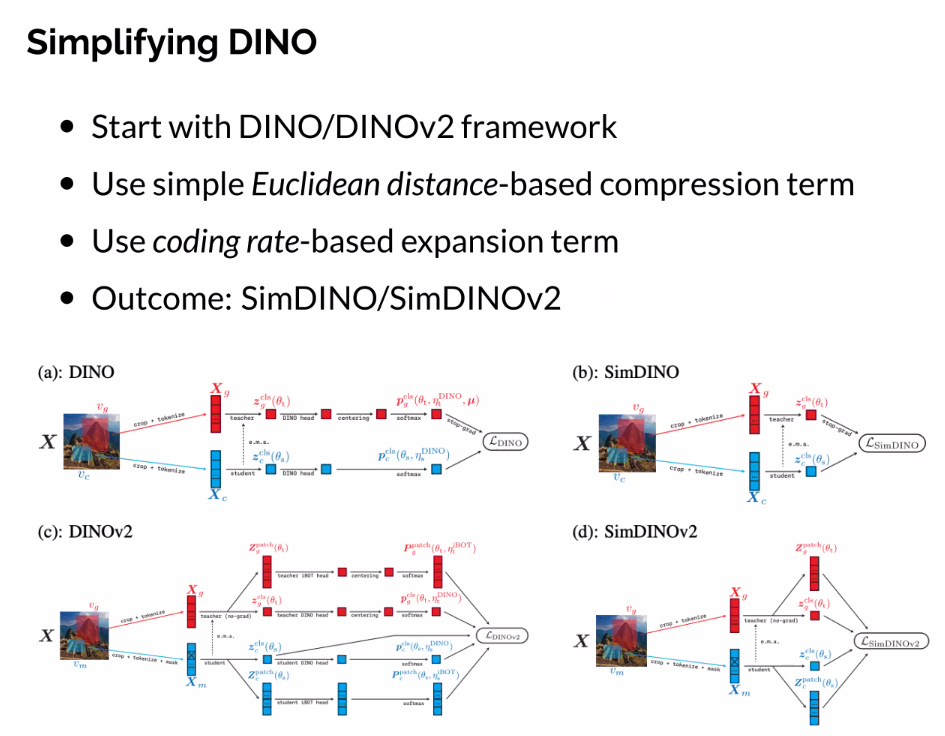
- Instead of relying on complicated optimization tricks to prevent collapse, switch to objective function of information gain
- Naturally prevents collapse
Concluding remarks
- Objective for deep representation learning can be operationalized to impact deep architectures/methods.
- Resulting architectures sometimes very similar to practice (e.g., CRATE). We can both understand practice and improve on it.
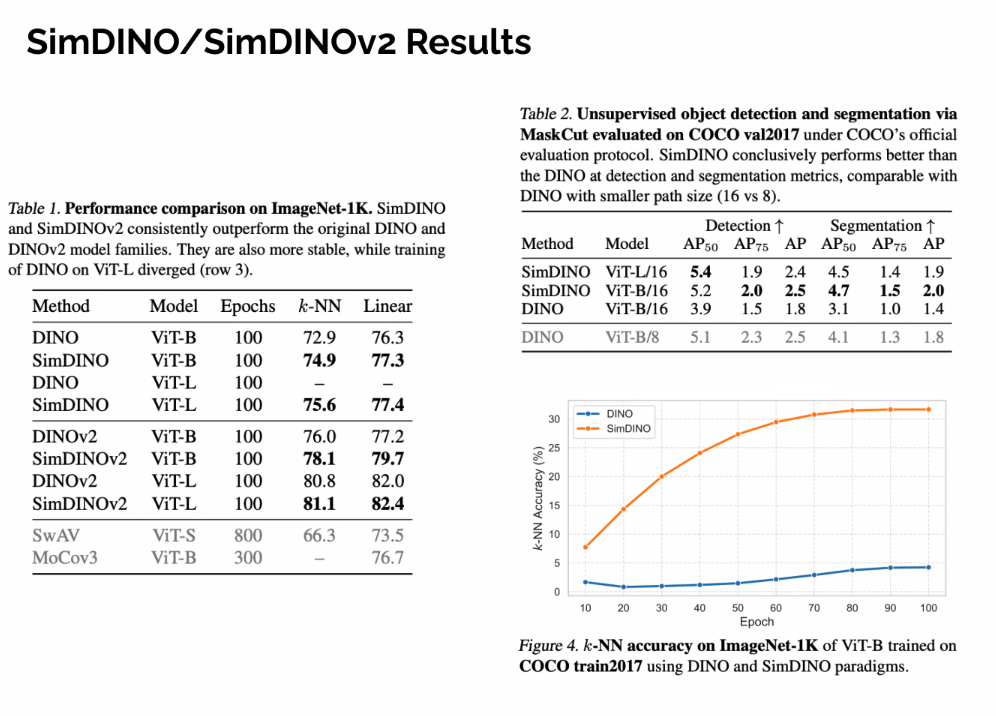
- Resulting methods can be significantly better and more stable than previous work (e.g. SimDINO).
The lecture is an overview of an upcoming monograph: Deep Representation Learning of Data Distributions
Filled out the form, hopefully get my hands on it!
🧪 -> Refresh the Info
Did you generally find the overall content understandable or compelling or relevant or not, and why, or which aspects of the reading were most novel or challenging for you and which aspects were most familiar or straightforward?)
Did a specific aspect of the reading raise questions for you or relate to other ideas and findings you’ve encountered, or are there other related issues you wish had been covered?)
🔗 -> Links
Resources
- Put useful links here
Connections
- Link all related words